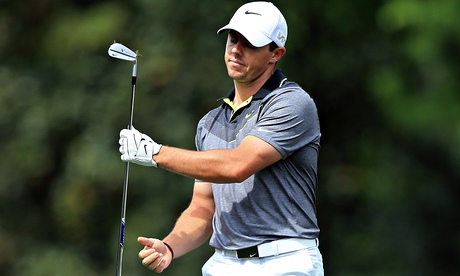
With meteoric rise comes great expectation. Nowhere more so than in the mind of the performer who has scaled such heights. The snap assertion in relation to what will ultimately, and unfortunately in so many ways for the sport, be a failed Rory McIlroy bid to complete a grand slam of major championships at the first attempt will relate to pressure. That is, the level of discussion around what victory at Augusta would have meant somehow skewed McIlroy’s focus before the 79th playing of the Masters.
The deduction would be an incorrect one. McIlroy himself has already been afforded plenty of scope to admit to the contrary.
“It hasn’t been a factor at all,” the world No1 says of external noise. “Any of the bad golf or bad shots I hit out there, I can’t put that down to what it would mean or what I was trying for. I am just out there trying to play the best golf I possibly can.
“It is such a fine line here. The margin for error is so small. I missed it in the wrong places sometimes. I missed a couple of short putts out there and that knocked my confidence a little bit. The good golf is in there, it is just a matter of getting rid of the bad stuff.”
That quest continued from 12.45pm here on Saturday, alongside Bubba Watson, another of whom great things were expected before a Masters ball was struck. As if McIlroy’s unrest at starting 12 shots off the leader would not be sharp enough, Watson is never the easiest of partners.
There is, though, a continuing and intriguing McIlroy subtext. He recorded nine-hole stretches of 40 or worse on no fewer than eight occasions in 2014. That represents an astonishing statistic for a player who, during the same year, firmly established himself as the finest in the sport, winning two major championships on the way.
That unwanted statistic returned on Friday at Augusta. McIlroy reached the turn in 40, at that stage looking in danger of a halfway Masters exit, which no serious onlooker had predicted. An inward half of just 31 might have been born partly out of anger but it showed precisely what McIlroy can do over what is hardly a straightforward set of golf holes. Just as McIlroy can draw upon that brilliance, the key to a Masters success – which will surely transpire at some point – is the erasing of what came before. He should not need to draw upon adversity.
Whereas McIlroy’s outlook is generally positive, his character amenable and body language one of a supreme athlete, that front half on Friday bore witness to more negative traits. This was not an isolated picture, although it has been a lesser-spotted in recent times. McIlroy was clearly troubled and frustrated; understandable in the context of an event that was running away from him, but not the bigger picture of a stunning career that is on an upward curve.
When things commonly go so right, it’s only logical that handling hurdles can be problematic. McIlroy can look as if he carries the weight of the world on his shoulders at times; just like the finest competitors in sport, individual or team, playing without the scent of victory is of little interest.
“I felt like anything I was trying to do out there wasn’t going my way,” McIlroy explained. “I hit one of the best iron shots I had hit all week into the 5th [on Friday], misjudged the wind and it went over the back, then I made bogey from that. It is hard enough round here without hitting good shots and not getting rewarded for them.
“It is tough. Whenever you start your second round 13 shots off the lead, it is difficult. In a way it isn’t a bad thing if it takes the pressure off you – you can just go out and play.”
But this isn’t the scenario McIlroy relishes. He has little appetite for a strong finish to secure top-10 placings, irrespective of venue, simply because this won’t define his career.
One of his challenges, aside from avoiding these ruinous runs of holes, is to remain outwardly and inwardly positive; Phil Mickelson, Seve Ballesteros, Tiger Woods and Nick Faldo would always be – or still are – the epitome of self-assurance, regardless of scenario.
Woods has offered the perfect example of that in recent days, when doubted by so many. In his prime, the 14-times major champion could negatively influence opponents simply by having the demeanour of an invincible force.
Mickelson’s Augusta attitude is pertinent. “The thing about Augusta is that, for me, I don’t feel like I have to be perfect, so it relaxes me,” says the three-times Masters champion. “Even though I may not have my best stuff on any given day, I still feel like I can shoot in the 60s, and I still feel like I can make pars and birdie some holes to shoot a decent number.”
Woods had earlier spoken in glowing terms about what lay ahead for McIlroy. “He’s going to have opportunity for decades to come,” said the 39-year-old. “I’m sure he’ll have many green jackets in his closet before it’s all said and done.”
This is representative of the broader faith in McIlroy, which is not without reason when youthful achievement is considered. Golfing greatness, which remains another step away, depends on the man himself avoiding the need to rebound.