Pravda
I must have been about seven or eight when I saw Pravda at the National Theatre with Anthony Hopkins [staged in 1985]. I’m not entirely sure why I was taken to see it, but I was. I don’t really think I picked up on the subtleties of the satire, but the lasting impression of it was of a single man keeping a huge audience rapt with everything that he did. That communion with somebody’s energy and with somebody’s charisma and magnetism left a huge impression on me. I still remember really, really clearly the first time he walked on stage. I’ve seen other performances since that have had that same kind of raw, animal instinct that keeps an audience on the edge of their seats, but that was the first time I realised it was possible.
The Clandestine Marriage
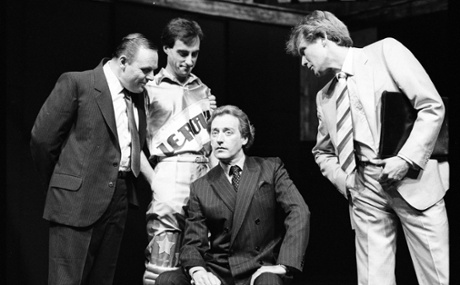
Around the same time there was a production of The Clandestine Marriage that my father [Roy Kinnear] was in with Anthony Quayle and Beryl Reid. It wasn’t so much what I saw on stage that I remember, it was that I went on tour for two weeks during my summer holiday with my dad. We roomed together and I became part of the company for that two weeks. That was where I was first introduced to not only the technicalities of putting on a play and the excitement of backstage life and the secrecy and whispering surrounding it all, but also that sense of company; that sense of a group of people who I’d never met before – and I’m not sure my dad had necessarily met before they started rehearsals – becoming friends and sharing their lives for a small period of time. You tend not to see them afterwards as well, but for that moment that you’re putting on a play and that you are a company there is this togetherness and connection and bond.
Cyrano de Bergerac
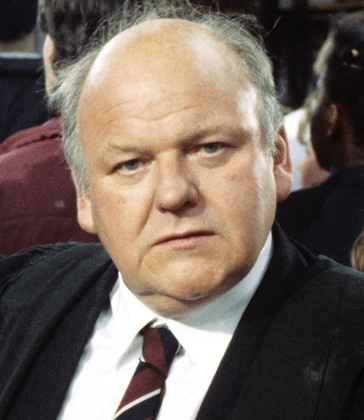
When I was 15 I was asked to do Cyrano de Bergerac at school and it fundamentally changed my life. It’s obviously an extraordinarily diverse and potentially electrifying part. It’s a big leading part and I hadn’t really played anything like that before; I was the one doing the comedy side bit. Being given that role and also the response that I had from friends and teachers and parents who had seen it really gave me the confidence to think that it might be something worth exploring. When you’re 15 you’re not really talking about the vicissitudes of fate and failed love and poetry and swordfighting – not a lot is necessarily touching on your own personal experience. But there was something about taking an audience through this central character’s story and moving them through the highs and lows of his life and his hidden sadness covered up with bombast and pride that may have chimed with me at the time. I do remember thinking that people were really generous to me about it afterwards and I guess that was the first chiming of the bells for me that this was something that I might be good at.
All My Sons
I went to see All My Sons at the National Theatre with Julie Walters, which Howard Davies directed. I was at drama school at the time, it was in my first term or so, and I was thrashing around in my head as to what this job would entail and what it could achieve and if its impact was meaningful enough to dedicate your life to. Those sorts of questions were going around in my head when I saw this production at the Cottesloe. I couldn’t move for about five minutes after the curtain call; I was just absolutely poleaxed with grief and sadness for this family and the sadness of life at times. It answered the queries that I’d been having about my job: if things are done well and the truth of the situation is mined and found and played naturalistically, and it draws an audience in, then your job can be endlessly rewarding because it makes you question the fundamentals of your life. That production made me question the fundamentals of my working life as well as my own feelings of grief or fate. It was one of those shows where I left thinking I would be so lucky to be able to work at a place like this putting on a play like that. And then about 10 years later I was lucky enough to do a play [The Last of the Haussmans] with Julie Walters directed by Howard Davies at the National Theatre. That was a real culmination of everything I’d hoped to do in my career when I sat there for those five minutes after the curtain call.
Hamlet
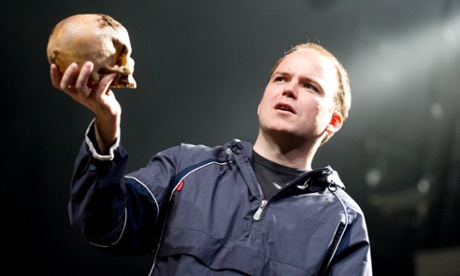
I’d not really ever expected to play anything like Hamlet. I hadn’t seen myself as a natural Hamlet, whatever a natural Hamlet is, and I quickly realised there is no such thing. I was doing a play at the National when Nick Hytner asked me about it and I was slightly bewildered by it all, but we had a few years to wait until we actually got round to doing it. There were lots of former Hamlets who gave you advice and lots of other people who thought you were crazy to take on something so daunting, and I guess I couldn’t really understand why people made such a big fuss about it. It was just another part and it was an exciting thing to do and I couldn’t wait to explore it for myself. Our son [with partner Pandora Colin] was born about three months into the run, so the next five months were centred around that excitement and exhaustion. I remember he was born at six in the morning and we did a show that night – and that was an incredibly special evening, knowing that I’d just become a father in a play so much about fathers. And afterwards you sort of realise what all those former Hamlets were talking about. It makes you explore your whole repertoire as well as make you explore the workings of the world in a deeper and more complex way than most roles do. I sort of understand why there is a brotherhood of Hamlets. It’s a nice part of acting; you do get to be part of gangs.