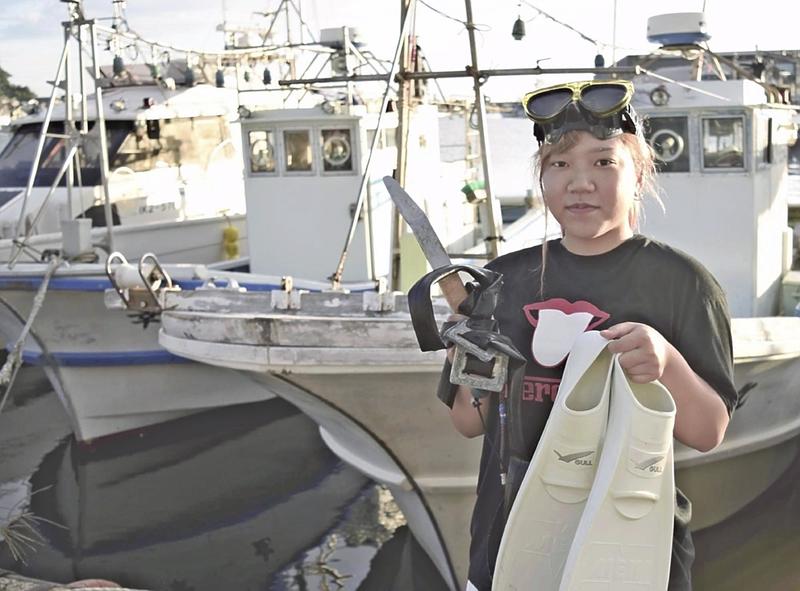
KANAZAWA -- Many fishing boats hoisting traditional "big catch" flags were anchored at Wajima Port on the northern Noto Peninsula in Ishikawa Prefecture. At around 6 a.m. in late August, when the sun began rising, several ama female divers carrying goggles and fins got on a small boat to head for fishing grounds about 50 kilometers off the coast.
"Since it's an early morning, we go offshore while sleeping on the boat," Sara Hayase, 20, said. She is the first rookie ama diver in a few years in Ishikawa Prefecture, which has the second largest number of ama divers in Japan.
Hayase is the eldest daughter of an ama diver family that has continued for generations. When she was a preschool child, her grandfather took her to a pool, where she was taught how to dive before learning how to swim.
Her mother Chiharu, 48, is a senior ama diver she admires. Growing up seeing her mother go offshore early in the morning, she made up her mind to become an ama diver some day.
However, after she entered high school, Hayase became preoccupied with visiting her friends' houses and going to Kanazawa for shopping. While she always helped with her mother's work in summer, the busy season for abalone and sazae turban shell fishing, she gradually became hesitant to follow in her mother's footsteps.
In the summer when she was a third-year high school student, she did not help her mother and changed her preferred post-graduation career plans from "ama diver" to "finding employment" in a school career survey.
"My life is not yours," Hayase said to her mother, who accepted her choice, saying, "You're right."
Homesickness hits
In the spring of 2017, Hayase began working at a nursing care facility in Komatsu in the prefecture, about 150 kilometers away from her parents' house.
It was the first time for her to leave home. While being busy at work, such as assisting residents at mealtimes, she occasionally remembered the sea in her hometown and her family. The more emails she exchanged with her 50-year-old father, Shuei, the stronger her desire to return to Wajima became.
"I feel lonely. I'll do what you told me to do, so I want to go back." Hayase finally said this to her mother at the end of 2017. Chiharu, who had expected that her daughter would eventually come back, was not surprised by her daughter's remarks and asked her, "Will you take over my job?"
When she was a high school student, she rebelled against her mother. But she had earlier admired her mother and dreamed of becoming an ama diver. She was now able to answer the question, saying, "Yes," without hesitation.
In July this year, Hayase finally made her debut as a rookie ama diver. As she had not seriously engaged in fishing by free diving, she was only able to dive to a depth of about five meters. Since her mother fishes at a depth of more than 10 meters at another fishing point, she cannot ask her mother to teach her the technique.
"I must improve my skills somehow," she thought. She began spending days repeatedly free diving while watching elderly experienced ama divers working at shallow fishing points.
Hunting for treasure
Hayase wakes up at 4:30 a.m. every day in summer, a busy fishing season for abalones and turban shells. She feels uncomfortable in a black wetsuit, having yet to get used to her work outfit. Sometimes she catches almost no shells for days, even while occasionally having sudden encounters with poisonous rays.
It is hard and dangerous work. But after a month passed, she developed sufficient skills to catch about 10 kilograms of turban shells a day. In early August, a momentous day finally came.
When she was swimming at a depth of about five meters, she found an abalone hiding in a narrow gap between rocks. "I finally found one!" she thought.
Hayase was excited as she finally saw her long-sought abalone for the first time. She tried to remove the abalone from the surface of the rock using a metal fishing tool that looks like a dagger, but the abalone's sticking power was fairly strong.
She came up for air many times and struggled to remove it. She removed it from the rock by force at last. Its shell was broken, which marred its shape, but it could be sold. The abalone boosted her confidence.
Ama divers in Wajima are said to traditionally call a day when they catch many abalones a "happy and good day." Hayase found herself attracted to the ama's work. "The work of ama divers is like treasure hunting. It's fun."
Hoping to dive for longer
On Aug. 22, the Wajima Taisai (grand festival) was held in the city. All ama divers in Wajima are off from work on the day of the annual festival.
Hayase usually works in the sea and has no time to talk with people other than her family members. However, on this day, she talked with her local friends for the first time in a while, watching as dynamic festival participants carried a mikoshi portable shrine around the city.
She is at the age of being fashion-forward, and her hair is blond with pink highlights. Even so, when asked about what she wants to do most now, she said, "I want to go to sleep early for tomorrow's fishing."
Ama divers gather shells and seaweed by free diving without oxygen tanks. The work is so hard that many young divers quit quickly. Despite such a trend, Hayase has become more motivated to improve her skills since she found the abalone on her own, and she now dives into the sea diligently.
"I want to be able to stay under water for longer and see the world of the sea that my mother sees. I want to catch many abalones," Hayase said.
Trying to catch up with her mother, who is an experienced ama diver, the rookie dives into the deep-blue ocean today as well.
Read more from The Japan News at https://japannews.yomiuri.co.jp/