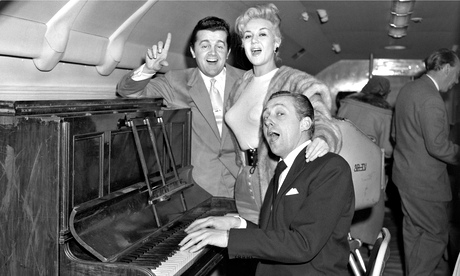
When he was six years old, Ronnie Ronalde, the variety performer, who has died aged 91, would whistle in the streets of Islington, north London, for pennies to give his mother to buy food. “Don’t cry, Mum,” he told her. “I’ll make lots of money.” And he did – that whistle took him around the world and earned him a fortune as one of Britain’s top variety stars in the 1950s. When he performed before Marilyn Monroe, she said his whistling sent shivers down her spine, and after his appearance at the 1953 Royal Variety show Prince Philip was observed in the royal box attempting to teach the Queen to whistle.
Ronalde was a rare case of a speciality act becoming a star. He had a pleasant if unremarkable singing voice and was an accomplished yodeller, but it was whistling that took him to the top of the bill. It was hard to believe that his piercing sounds emanated from such a small man; he always instructed theatre lighting crews to put the spotlight full on his face in case the audience thought he might have some whistling apparatus concealed in his mouth. Sometimes he sang a bit and then whistled or yodelled; sometimes he enchanted audiences with his hauntingly beautiful bird impressions.
His heyday was 1949-56, and his records – such as Delia Murphy’s Irish folk song If I Were a Blackbird (1950), Little Swiss Maid, Mockingbird Hill and Bells Across the Meadow – sold in their millions. His popularity as a live performer was astonishing. Frank Sinatra was a fan, and the composer Albert Ketèlbey sent him a letter congratulating him on his interpretation of In a Monastery Garden.
Ronalde was by no means the first siffleur in the British music halls, but he was the most famous. Before him came Arthur Astill (the Whistling Ploughboy), Gladys Church (the Whistling Songstress), Arthur Slater (the Whistling Man in White) and Albert Whelan, who always started his act by whistling Die Lustige Brüder as he slowly removed his top hat, coat, scarf and gloves.
He was born Ronald Waldron in London, to impecunious parents: Charles, his father, was often unemployed, and Ann, a dressmaker, supplemented the family’s income as a pianist and singer in local pubs. With few toys to distract him, he developed a remarkable ear when very young, copying the birds outside his bedroom window and the yodelling cries of the milkman and coalman. Like most other boys of those times, he whistled in the street, but it became apparent that there was something very special about his whistling when people stopped him on his way home from school and paid to hear him.
His mother, who played the piano, taught him to whistle Tales from the Vienna Woods and, realising his potential, took him for outings to the countryside to listen to songbirds. Soon there was no bird he could not imitate. At 14 he joined Steffani’s Silver Songsters, a 22-strong boys’ choir that toured the variety theatres. Each boy had a speciality – tap dancing, banjo playing and so on – but it was Waldron’s whistling that always stole the show, and by 1941 he was billed as Ronalde, the World’s Greatest Whistler.
In 1942 he was called up into the Royal Engineers. When he was discharged, Arturo Steffani disbanded the Songsters to concentrate on managing Ronalde as a solo act. In partnership with Steffani, Ronalde produced and presented touring shows and started to broadcast on Radio Luxembourg and the BBC Children’s Hour. Cheerfulness personified on stage, Ronalde had learned the value of money during his deprived childhood, and was a steely negotiator with theatre managements when it came to his salary, perks and billing.
The teeth are a siffleur’s greatest asset, and all his life Ronalde took the greatest care of his; he always refused anaesthetics for fillings or other dental work because, as he put it, “I had to stay in control of my teeth.”
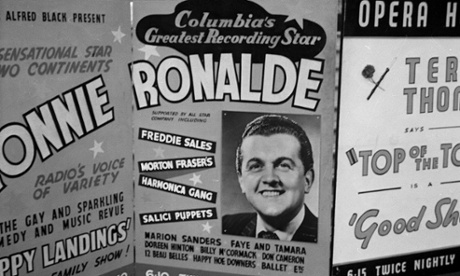
By the mid-1950s, billed as “the voice of variety”, he was a household name through his records, radio and television shows, pantomime performances and constant touring. He went to America, and filled Radio City Music Hall, New York, which had a capacity of 6,000, every night for 10 weeks.
After this, however, his career declined. He had been born about 30 years after his time: had he started earlier, he could have been a top draw for decades. By the late 1950s, the variety theatres were closing and, worse as far as he was concerned, rock’n’roll was dominating the record charts. Embarrassingly, Ronalde tried a couple of rock numbers, but was regarded as something of a showbusiness anachronism, even though he was still in his 30s.
Shrewd and realistic, in 1959 Ronalde invested some of his vast earnings in a large hotel in Guernsey. He married Rosemarie, an Austrian model, in 1961, and the couple successfully ran the hotel for many years, with Ronalde making occasional forays to the mainland for television or theatre work.
In the early 1990s, they moved to New Zealand, a country he loved and where he remained a favourite entertainer. He tried his hand at farming and made infrequent trips back to Britain. The family later moved to Gold Coast, in Queensland, Australia. In 2003 he celebrated his 80th birthday and 65th year in show business with a tour of UK provincial theatres. His ageing fans turned up to hear him whistling almost as skilfully as ever. CDs of his old records still sell.
In 1998, Ronalde explained that his appeal was based on something very simple: “You whistle when you are happy, but you don’t whistle when you are sad.”
Shortly after his 90th birthday in 2013, he suffered a stroke, and moved into Brinsworth House in Twickenham, west London, the retirement home for entertainers. He is survived by Rosemarie and their two daughters, Caroline and Christina, and son, Ronald.
• Ronnie Ronalde (Ronald Charles Waldron), variety whistler, singer and yodeller; born 29 June 1923, died 13 January 2015