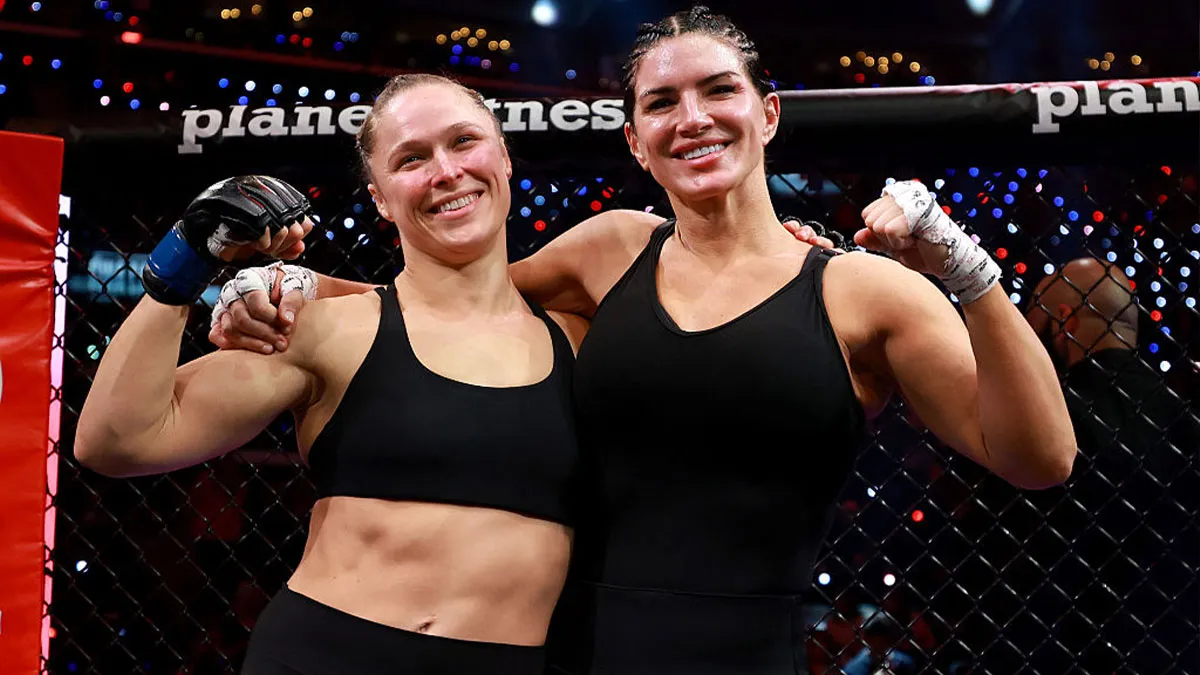
While some have called the May 16 MMA fight between Ronda Rousey and Gina Carano a great thing for women’s MMA, the simple reality is that nobody outside of MVP, the promotional company, truly benefited from two of the sport’s most prominent female fighters stepping out of retirement for a fight that some are calling a farce.
Recommended Videos
At one point, both Ronda Rousey and Gina Carano were trailblazers in women’s MMA. In the mid 2000s, Carano was involved in the first-ever sanctioned female MMA bout in Nevada, putting away Leiticia Pestova in 38 seconds. Carano was, for her time, the proto-Rousey.
Strong in a discipline that the crowd was eager to watch, she was a legitimate martial artist for the diehards to get behind. She also had the look to crack the mainstream, and offers for TV and movies provided lucrative alternatives to getting punched for a living. She had retired by 2009, after running headlong into Cris Cyborg, a brutal Brazilian fighter who was the truth that Carano had been advertised as.
The Rousey-era
Rousey, a talented judoka who started at age 11, made the Olympics at 17 and would eventually bring home a bronze medal from the 2008 Games in Beijing. She began her amateur MMA career in 2010, a year after Carano had retired. She hit the MMA promotion, Strikeforce, like a bomb, stacking up two quick armbar wins in 2011 against Sarah D’Alelio and Julia Budd, before taking on Miesha Tate in 2012 for the Bantamweight belt.
Tate deserves her own accolades as yet another early pillar of women’s MMA, a crafty wrestler known for being happy to endure tough fights. She nearly made it through a full round with Ronda before being submitted by a trademark armbar late in the first. Ronda had truly arrived and was perfectly placed to make Dana White eat his words after he claimed that women would never fight in the UFC.
After the UFC purchased Strikeforce, Rousey would fight Liz Carmouche at UFC 157 in 2013 for the first-ever UFC Women’s Bantamweight Championship. Ronda wasn’t the star she would go on to become just yet, but the pieces were all coming together. She would once again win by armbar late in the first, and MMA would have the beginning of its first-ever, truly breakout women’s star.
Rousey would go mainstream, appearing everywhere, on TV, talk shows, and in movies. Eventually, she’d run into the same problem Carano did, a brutal striker who could take advantage of the holes in her game. Holy Holmes and Amanda Nunes would take turns seeing who could big-sister Ronda the hardest, with Holmes doing it in just under a minute, finishing Rousey with a headkick so brutal that the former champion would talk about not being able to bite an apple for months afterward.
Nunes would take just 48 seconds to deal with Rousey a year later, a clinical dismantling that let Rousey know that nobody was scared of a fighter with a hole in their game so big you could drive a truck through. It was over for Ronda, and she retired in a cloud of unhappiness and acrimony with the MMA fans who had made her a star, only to delight in her downfall.
Coming back to the cage, but for what?
On May 16, 2026, 17 years after her last fight, Gina Carano was presented as a potential bogeywoman for Rousey, who was coming back to the sport nearly a decade after her own last bout. The marketing was obvious. Carano, a formerly skilled Muay Thai specialist, might just do it against a powerful grappler who had shown a weakness to deft practitioners of the striking arts.
Interestingly, for such a moment, and for two potentially contentious personalities, things were calm and cordial in the run-up to the fight. Both women just seemed happy to be there, Rousey, known for drama and thin skin, and Carano, recently a right-wing darling for going toe-to-toe with Disney, offered little in the way of headlines.
Most of the focus seemed to be that this fight was good for women’s MMA, but only one other women’s MMA fight appeared on the card as Aline Pereira fought Jade Masson-Wong, with Pereira taking a split decision in a bout that was buried on the undercard. It is traditional to promote the thing you are most interested in just before the main event. Rising stars, people on the cusp of title fights, or, in this case, it could have been more women. A daring tactic for an event designed to push women’s MMA, but one that the organizers opted not to take.
The main argument made seemed to be that it was good for women because this fight wasn’t happening in the UFC, but much of the main card was made up of former UFC fighters. Bare-knuckle king Mike Perry inflicted brutal damage on Nate Diaz until the Stockton natives’ corner stopped the fight. Philipe Lins was brought up from Light Heavyweight to be sacrificed to former UFC Heavyweight Champion Francis Ngannou. Even the main card opening bout featured another former UFC Champion, Junior dos Santos, who looked every one of his 42 years, and then some.
The event that set out to show you that you didn’t need the UFC to do great things sure did seem to need lots of former UFC fighters to give it some star power.
Rousey and Carano set a new MMA event record for audience size, with 17 million people tuning in on Netflix to watch it, but the 17-second fight consisted of Rousey instantly taking Carano down and tapping her out, with the internet accusing MVP, YouTuber Jake Paul’s promotion company, who organized the whole thing, and both fighters, of match-fixing.
The simple truth is that the closest Carano could have come to hurting Rousey would be to say something mean, and she opted to sit out that side of the potential promotional hustle. This fight was always over and done in quick fashion, with Rousey taking Carno’s arm whenever she felt like it.
The worst part of this whole thing is the involvement of Jake Paul, a man who has been happy to drag the corpse of boxing behind his promotional machine as a means to part gullible teenagers from their pocket money. The man has a beef with Dana White, which I respect, but is also a repugnant opportunist who has now turned his sights to women’s MMA as a new way to funnel “sports content” onto Netflix.
The sad thing is, it was two pillars of the sport’s history who happily handed it over to him.
(featured image: Sarah Stier/Getty Images for Netflix)
This is an opinion piece. The views expressed in this article are those of just the author.