A vial of what is purported to be blood from late president Ronald Reagan is on sale at an online auction house, sparking outrage from his estate and the medical community.
A seller at PFCAuctions.com – purveyor of "world class art, antiques and collectibles" – listed the vial of "dried blood residue from President Reagan" on Sunday.
By Tuesday afternoon, bidding had reached $12,000.
The vial is alleged to have come from the laboratory where the president's blood was sent for testing after John Hinckley shot Reagan on March 30, 1981.
"My mother worked for Bio Science Laboratories in Columbia, Maryland," the unnamed seller writes.
"Her laboratory was the laboratory contracted by the Walter Reed Army Medical Center as well as the George Washington University Hospital to handle blood testing as well as other types of testing."
The seller added that his mother, who has since passed away, asked if she could take the vial home with her after Reagan had been treated.
Now, 30 years later, the seller was told by the Ronald Reagan presidential library that they would consider taking the specimen as a donation. "I was a real fan of Reaganomics and felt that Pres Reagan himself would rather see me sell it rather than donating it," the seller writes.
"If indeed this story is true, it's a craven act and we will use every legal means to stop its sale or purchase," John Heubusch, executive director of the Ronald Reagan Presidential Foundation, said in a statement.
The medical community was similarly outraged.
"You don't go selling people's specimens or bodily fluids," Dr. Joseph Giordano, who was head of the trauma team that treated the president, told a local television station. "You have no permission to do that. It's unethical."
Reached by phone Tuesday afternoon, a spokesperson at PFCAuctions declined to comment on any of the ethical questions that have been raised.
"The Ronald Reagan library had said they would take it as a donation, so this person decided to auction it with us instead. Aside from that there is not much to comment on," he said.
A long history of selling human remains
Unethical or not, the selling or displaying of celebrity remains is perhaps as old as the notion of celebrity itself.
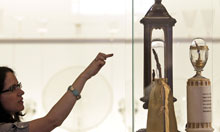
Galileo's finger was removed when the corpse was exhumed and now sits on display at the Museum of the History of Science in Florence, perched inside a glass chalice.
Most famously, and perhaps apocryphally, a tissue specimen that may have been Napolean Bonaparte's penis was sold as part of the "Vignali collection" of Napoleonic relics for $800 in 1924. In 1977 it was acquired by an American urologist, John Kingsley Lattimer, for the equivalent of $10,000 today.
Lattimer died in 2007, and his estate, which is still in possession of the emperor's member, is considering selling it.
Pop singer Michael Jackson was reported to have expressed interest in purchasing some or all of the remains of John Merrick, better known as the Elephant Man, who famously suffered from a congenital disease which created abnormal and excessive bone growth on his skull.
Jackson's offers, which were confirmed by London hospital's chief administrator David Edwards in 1987, were rebuffed.
Dorothy Jarlett worked as another singer's housekeeper for many years in the 1960s. She and John Lennon allegedly became close enough for Lennon to give her a tooth he had removed by his dentist, as one does.
Although the tooth is too fragile to conduct DNA tests on it to confirm original ownership, last year Michael Zuk, a dentist in Alberta, spent more than $31,000 to buy the incisor at an auction. He said his plan was to have it mounted in his office.
A lock of Che Guevara's hair – removed by a CIA operative after the revolutionary was killed in 1967 – was purchased for $100,000 in 2007. Bill Butler, a Texas bookseller, keeps it on display in his store.