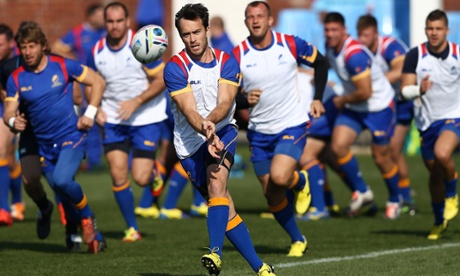
Among the 31 men in Romania’s squad is Michael Wiringi, a 30-year-old born and raised in Hawera, on the west coast of New Zealand’s north island. “A small-town boy that’s been given a huge opportunity”, as he says himself.
In 2011, Wiringi answered an advert in his local paper placed by the semi-pro club Baia Mare, based 400 miles north of Bucharest. They were calling for overseas recruits. He got an email back inviting him over on the next flight out. Wiringi, who has qualified for the Romania team through residency, wanted to learn a little bit about the country before he travelled, so he started looking online.
Wiringi would have found plenty of reading material. Romania, who have played in every World Cup but never made it to the quarter-finals, have a long, proud history in the game. Not least in their rivalry with France, whom they play in the first World Cup match at the Olympic Stadium on Wednesday night. The two countries have played each other 51 times. Newcomers such as Wiringi might be surprised to find that the Romanians used to hold their own. Between 1960 and 1980 they won six and drew two of the 22 Tests the teams played.
It was students, studying in Paris, who first brought the game to Bucharest at the start of the 20th century, and Romania’s first proper Test was against France in 1924. The French, blackballed from the International Rugby Board until 1978, cultivated a partnership with the Romanians instead. They sent coaches to work in the domestic league and arranged annual fixtures. The bond grew stronger because the IRB kept both countries at arm’s length for so long. Romania’s application for membership was rejected in 1953, and in 1966 the board stopped Australia from accepting an invitation to play in Bucharest.
The IRB ban was lifted in 1970, but even then there was a proviso that matches against Romania would not have full cap status. By then Romania were one of the strongest teams in Europe, the players well-supported by the communist government which gave many of them jobs with the army and police force. The French team that won the grand slam in 1977 lost to Romania in Bucharest at the start of that very season. These were the glory years. They beat France again in 1982, then Wales in 1983 and Scotland in 1984.
It was then, too, that things started to fall apart. The Romanian economy slumped, funding was cut. Then the revolution came in 1989. Five of the national team’s players died in the fighting, among them the captain Florica Murariu, who had led the team in a six-point win over Wales in Cardiff the previous year. Domestic clubs lacked the money to buy basic kit such as jerseys and balls, and participation numbers dropped from a peak of 8,000 to fewer than 3,000.
Romania last beat France in 1990. They have been struggling ever since. Since the game turned professional they have never been within 30 points of a repeat. For this match the French have felt able to make 13 changes to their team. The Romanians are fielding one of their most experienced teams, with 684 caps between the XV, and two players, Paulica Ion and Danut Dumbrava, appearing in a fourth World Cup. Despite that, their squad looks a little different. In 2011 every single player was born and bred in Romania. But now Wiringi is one of four overseas-born players brought into the team in this past year. “I guess they didn’t find a young guy,” he said, “and ended up taking me.”
For all the excitement about the growth of rugby in Japan and elsewhere, it always feels a little poignant that the sport was allowed to decline in another country where it was once so well established.