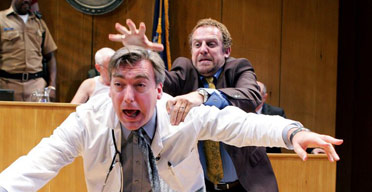
I was distinctly underwhelmed by David Mamet's madcap legal farce when I saw it in New York in the spring. But even if it remains minor Mamet, Lindsay Posner's vastly superior London production generates a fair quota of laughs and shows that the play has its own demented logic.
Set in a New York court, while the city is preoccupied with an Arab-Israeli peace conference, the play shows the pompous formalities of the law spiralling into chaos. The pill-popping judge turns into a power-mad hysteric. The defendant, a Jewish chiropractor, engages in vitriolic verbal battles with his Catholic attorney. And the upright prosecutor finds a domestic row with his gay lover erupting into the courtroom. Imagine Joe Orton crossed with Kafka and you get the general idea.
Clearly Mamet is out to make some serious points. "How," asks one character, "can you have peace in the world when you can't have peace in the home?" Mamet also suggests that America's supposed respect for law conceals a raging paranoia and prejudice: everyone demonises some imagined rival group whether it be Jews, Muslims, straights or gay people. In a society seething with irrational hatreds, implies Mamet, it is absurd to expect a diplomatic solution to global tensions.
The problem in New York was that the production over-stressed the play's zaniness from the start. But Posner shrewdly suggests that this wood-panelled courtroom exists at only a slight tangent to reality. This makes the shock all the greater when Colin Stinton's sober-suited defence attorney makes crude anti-semitic remarks to his client and Nigel Lindsay's defendant retaliates by crying: "I hired a goy lawyer! It's like going to a straight hairdresser." Posner's production also gains from the powerful presence of Frasier's John Mahoney as the judge. It is precisely because Mahoney exudes white-haired gravitas that his descent into hallucinogenic frenzy is funny. His eyebrows wildly semaphore like those of Groucho Marx and he gaily tosses his gavel over his shoulder.
But my favourite moment comes when he turns to Nicholas Woodeson's reluctantly outed prosecutor and says, in a darkly accusatory tone, "And then you watch black and white films, right?" I am still not convinced that farce is Mamet's natural forte; and, as a study of New York sliding into dementia during important global events, Romance pales beside John Guare's The House of Blue Leaves. But Posner's production at least anchors the mayhem in reality and the Manchester-born Mahoney confirms that he is Britain's greatest gift to America since Alistair Cooke.
· Until October 22. Box office: 0207-359 4404