The NFL Draft process is an inexact science. Armed with all the possible information in the world, from film to testing data to metrics and analytics through information even gained from private investigators, 32 NFL teams have a wealth of data at their fingertips when they make every selection.
They still make mistakes. They still miss on players.
That being said, there are some players that might be a bit riskier of a selection than others. Even players that you are guaranteed to see come off the board in the first round come with some potential downsides. Here are some of those players.
Laviska Shenault Jr, WR, Colorado

Laviska Shenault is one more the more tantalizing prospects in the entire 2020 NFL Draft. He seems like a player built for the modern NFL. The Colorado Buffaloes used him all over the field during his time in Boulder, aligning him at boundary receiver, slot receiver, running back, tight end, H-Back and even quarterback. To listen to his quarterback Steven Montez tell the story, the best route on a given play was the one Shenault was running.
Consider further that Shenault does this with a body composition and athletic testing numbers that are more in line with running backs like Jordan Howard and Larry Johnson. According to MockDraftable.com, these are some of the best comparisons for Shenault:
There is a reason that Pro Football Focus compared Shenault to Saquon Barkley in their draft guide. He is built like a running back, can run people over like a running back, but aligns all over the field. Sounds too good to be true, right?
Well, it just might be.
Consider first the injury history. The Colorado WR suffered two different injuries during his sophomore season. First, he missed three games with a turf toe injury, which required surgery at the end of the season. Additionally, Shenault suffered a torn labrum in his left shoulder near the end of the 2018 campaign after he returned to the lineup. He was able to play through the injury and finish the season, but underwent surgery in February of 2019 to repair the labrum.
Then prior to the NFL Combine, it was reported that Shenault was dealing with a lingering groin injury. He reported to Indianapolis and attempted to test, but then pulled out of the Combine and it was disclosed that he was undergoing surgery to repair a sports hernia.
That playing style comes with a price.
Then there are legitimate on-field concerns. Shenault is a matchup weapon right now more than a refined wide receiver. A large part of his production came due to scheme and favorable matchups rather than him running a route and beating man coverage. He needs to work at the finer points of playing the position to be a consistent threat at the next level.
A perfect roadmap for Shenault can be found with Cordarelle Patterson. When he was drafted by the Minnesota Vikings, that staff tried to utilize him as a true receiver. They expected him to have good footwork on his routes and clean releases against press. Minnesota asked him to do things like run a perfect comeback route against man coverage. Perhaps unsurprisingly, it did not completely work out.
Then when he arrived in New England to play for the Patriots, they asked him to…just be an offensive weapon. They used him on jet sweeps. They gave him a limited route tree to run. When injuries mounted they put him in the backfield and handed him the football.
So the scheme fit is going to be a big part of the story as well.
Provided he is healthy, and finds the right landing spot, Shenault can thrive at the next level. But those are two huge “ifs.” Given that the NFL on the whole has only started to think outside the box when it comes to the quarterback position – and how the league might be struggling when it comes to players like Isaiah Simmons – how confident are we that Shenault is going to find such a fit on draft night?
Kenneth Murray, LB, Oklahoma

As alluded to in the previous discussion, the notion of scheme fit on the defensive side of the football is real, and it provides us with our first risky selection from a defensive position.
Kenneth Murray has been a starter at linebacker since the moment he stepped on campus. He is a heat-seeking missile at times on the football field, and his 104 total tackles as a true sophomore in 2018 attest to what he can do production-wise. But sometimes in the scouting world you need to comb through what the player was asked to do, and perhaps more importantly, what he was not asked to do. Answering those questions unlock the true measure of what he can be at the next level.
Here is how and where Murray excels. He is a sideline-to-sideline defender who is one of the most explosive linebackers in this class. He can destroy plays in the screen game, like he did on this example against TCU:
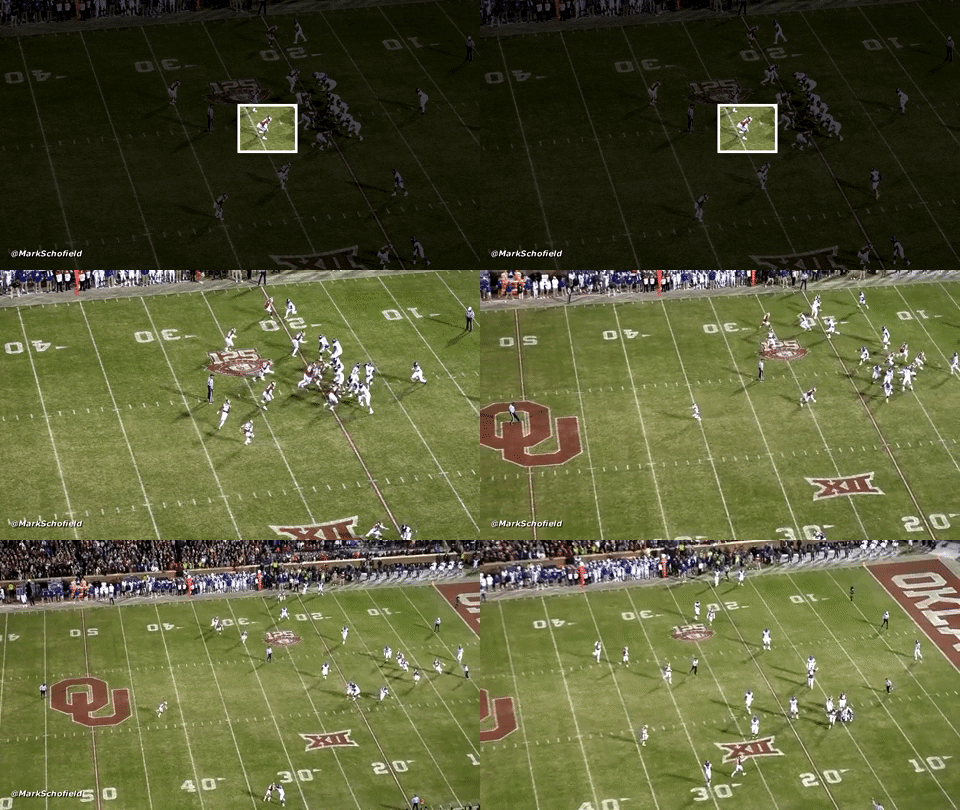
Murray wants to attack first and ask questions…never. Oklahoma played to that strength of his, using him primarily as a blitzer on throwing downs and an underneath weapon when he was not attacking the passer. He is also a force playing downhill against the run, who can beat the blockers to the hole and on those rare occasions that he does not, he will stand the blocker up in the hole, stack and shed them, and scrape off to make the tackle.
That is what he can do.
Where he struggles is the bigger issue. Reading concepts, running with tight ends vertically, matching players out of pattern match coverages. The things that modern NFL linebackers are tasked with doing on a down-to-down basis given what NFL offenses are running against them? That is where he tends to struggle. As such, Oklahoma limited his exposure to those moments. He was far more likely to be a spy underneath, or blitz off the edge, than he was to drop into coverage and process a concept.
Now, that type of player can still be a weapon for an NFL defense, and a valuable one at that. But it will require a creative defensive coordinator to know how to use him and where to align him from snap to snap. Some outside of the box thinking is require. Again, do we trust NFL teams to go down this road? Because if an NFL defensive coordinator just asks him to be your traditional linebacker, there will be a steep learning curve. Given that Murray is largely viewed as a first-round pick, the team that does make that selection better have the right plan in mind for him.
Tyler Johnson, WR, Minnesota

A few weeks ago, Minnesota wide receiver Tyler Johnson made it into Touchdown Wire’s Top 11 wide receivers for this year’s draft. As I wrote at the time:
Johnson is one of the better route runners in this class, with great footwork and fluid movement into and out of his breaks. Having worked out of the slot and on the outside, he has a versatile skillset that he will bring to his first NFL training camp. Given his experience playing along the boundary, Johnson is well versed at handling press coverage, and he has the movement skills and the upper body strength to play through contact at the line and work off defenders using tight man coverage after the snap.
All of this still remains true. Johnson’s route-running ability, coupled with what he can do against press coverage, makes him an appealing option in this deep wide receiver group. But there are a few red flags.
His pre-draft process is one. Unlike Denzel Mims, who has crushed the build-up to the draft, Johnson has not exactly covered himself in glory. He was invited to the East-West Shrine Game, but withdrew from that week citing a wish to focus on preparing for the Combine. Then Johnson decided to forgo testing out in Indianapolis, saving his workout for his Pro Day.
Which was canceled as COVID-19 started to make its way across the globe.
Now none of this has anything to do with whether Johnson can beat a cornerback’s press attempt at the line of scrimmage, extend the separation into his route stem, and maintain speed by sinking his hips into his break, maintaining that separation. None of these decisions have anything to do with how Johnson cradles the football into the chest with his hands as he breaks free, and picks up yardage after the catch. None of those things matter with what he does on the field.
But “preparing for the test” matters to old-school NFL decision-makers. What compounds the issues for Johnson are the rumblings about “character issues” that came up during the college football season:
I mean, that does not add up to a pristine scouting evaluation.
Again, I am in the camp that Johnson is worthy of an earlier selection than a sixth- or seventh-rounder. But I might be out on a limb on that one. With these pre-draft red flags – added to some of the areas where Johnson struggles – it makes for a pretty risky picture come draft time.
Quarterbacks Not Named Joe Burrow

Quarterbacks rise up draft boards every single draft cycle. Because of the importance of the position, teams find themselves reaching for a quarterback before addressing other positions, because if you don’t have a signal-caller, it is hard to have success in this league. That leads to players like Jake Locker, Paxton Lynch, E.J. Manuel and others coming off the board perhaps early than their true draft grade reflects.
This year’s crop of signal-callers is no different. Joe Burrow is a very clean evaluation, but the rest of the quarterbacks expected to go in the first round (Tua Tagovailoa, Justin Herbert and Jordan Love) all have serious question marks.
With Tagovailoa, the issues begin with his hip. The dislocated hip injury that Tagovailoa suffered near the end of the college football season ended his Alabama playing days, and has many concerned about both the short-term implications of the injury, and the potential longevity issues that could arise. Add to those concerns recent reporting from former NFL general manager Mike Lombardi, who relayed that two NFL teams actually failed Tagovailoa on a physical basis at the Combine, and that the quarterback had some earlier, undisclosed, broken wrists.
If you are an NFL team picking near the top of the draft and you need a quarterback, are you drafting a player with that medical history? Especially in the current environment where you might not get a second medical examination of him?
But what are your other options? Justin Herbert? The Oregon passer has a live arm and the athleticism that today’s offensive coordinators crave, but what else does he bring to the table? Herbert ran a system at Oregon that is not an exact one-to-one translation to the pro game, and his numbers were brutal under pressure. According to charting data from Pro Football Focus, Herbert was one of the worst quarterbacks in college football last season when pressured. Among 129 qualified passers, Herbert ranked 124th in negatively graded plays when he was under duress.
Pressure happens in the NFL.
If not Tua or Herbert, is Jordan Love the answer? The quarterback with 17 interceptions, or as he termed them, “teachable moments” in 2019? Perhaps you can calm yourself by studying his 2018 film, but even there you are going to find examples of him making throws that perhaps should have been interceptions, but were not.
If you are a team that needs to address quarterback in the first round, unless that player is Burrow, there are going to be some associated risks.
Javon Kinlaw, DT, South Carolina

Similar to the recent buzz around quarterback Tua Tagovailoa, reporting in the past 24 hours or so has turned around what looked to be Javon Kinlaw’s rise to the top of the defensive tackle board.
Kinlaw started generating draft buzz in the buildup to the Senior Bowl. Once draft analysts started diving deeper into his game tape in preparation for the week in Mobile, they loved what they saw: An explosive, long defensive tackle with the ability to disrupt the pocket when the opposing quarterback drops to pass, but the lower body strength and ability to anchor that enables him to be a force against the run. Then Kinlaw showed up in Mobile, and looked like the best football player at Ladd-Peebles Stadium.
For many, this moved him above Derrick Brown in their interior defensive tackle rankings. It did just that for this author. But then, the smoke started to form. Kinlaw’s Senior Bowl week was cut short due to a knee injury. Then, Kinlaw chose not to work out at the Combine, stating he would wait until his Pro Day.
Which, like Tyler Johnson’s, was canceled due to the COVID-19 crisis.
Then reports surfaced this week that Kinlaw’s injury history is a bit more complex. Bryan Broaddus, a former NFL scout who now works for 105.3 The Fan in Dallas, reported this week that the Dallas Cowboys are out on Kinlaw, given a hip injury from his past that required labrum surgery after the 2018 season.
This suddenly cloudy medical history darkens the prospects for Kinlaw. Now, of course this is “lying season,” when tall tales are told in the hopes that players perhaps fall in the draft, perhaps to the team circulating the rumors. One never knows what to believe when it comes to the pre-draft rumors. But this is not a rosy medical picture being painted, and it makes one wary when considering Kinlaw at the top of the first round.
Second-Tier Offensive Tackles

One of the truisms about this draft class is that there is a “Big Four” at the offensive tackle position. You could even go beyond that and say there is a “Fab Five.” Tristian Wirfs, Jedrick Wills Jr., Andrew Thomas and Mekhi Becton currently constitute the “Big Four,” and you can arrange them in almost any order and be confident in your analysis. Sliding in Josh Jones from Houston to make it a “Fab Five” probably is not a bad idea either, given what he put on film and how he performed at the Senior Bowl.
Beyond that, however, it gets a bit dicey.
Consider the second tier of offensive tackles. Names currently bandied about are Ezra Cleveland, Austin Jackson, Jack Driscoll, and Ben Bartch. Cleveland, the Boise State product, played himself into early Day Two contention with a strong performance at the Combine. His 4.93 40-yard dash placed him in the 97th percentile among tackles, and his 4.46 20-yard shuttle landed him in the 96th percentile. His 30 bench press reps also demonstrated that he could “prepare for the test” as it were. The problem becomes the level of competition. Boise State did not play the toughest slate over the past two years, and that makes for a difficult sell.
Jackson might be next on that list, and a bet on him is a bet perhaps on potential. Jackson is just 20 years old, so the upside is enticing. But he has lots of technical areas to address. His hand placement can be slow at times, he play strength needs to improve, and he is often vulnerable to power moves at the point of attack. What could work in his favor is how last season he was slowed as a result of a medical procedure he underwent to aid his sister, who is battling a rare blood disorder. Jackson donated bone marrow in the off-season prior to the 2019 campaign, which put him in a difficult position when the season started, because he was not yet back to full strength. Perhaps teams examine his 2019 film through that prism, and view it more favorably as a result.
Then there is perhaps Jack Driscoll, the Auburn offensive tackle. Pro Football Focus terms him the “sleeper” of this offensive tackle class, but there are still some question marks. He is undersized as far as NFL OTs go, and while he managed to get up to 306 pounds for the Combine he was under that 300 mark at the East-West Shrine Game. Driscoll’s lack of size shows up on the field, as he struggles against power moves. He has the agility you love to see from a tackle, it is a matter of keeping that while adding strength and weight.
Speaking of adding strength and weight, you could also look at Ben Bartch. The Division III prospect gained national attention when the weight gain concoction he used to add 70 pounds in college was discovered. Bartch also did what you want to see a small school prospect do on film: Dominate lower level competition. He looked the part at the Senior Bowl, where at times it seemed he was the best tackle there. But is a team going to be willing to turn over their left tackle spot to a D3 kid?
Netane Muti, IOL, Fresno State

Netane Muti might be the best interior offensive lineman in this group. At Touchdown Wire we ranked him our third interior prospect, behind Cesar Ruiz and Jonah Jackson, and at Pro Football Focus he claimed the top spot in their IOL group. He has almost legendary strength, is dominant as a run blocker and has allowed just 14 pressures on 697 career pass-blocking snaps, according to charting data from PFF.
The problem can perhaps be deciphered from that statistic. Muti has played just 318 total snaps over the past two seasons. In 2018 he suffered a ruptured Achilles, which ended his season after just 84 snaps. Last year it was a Lisfranc foot injury that ended his season, after playing in just three games. Doctors cleared him at the combine, and he was scheduled to participate at Fresno State’s Pro Day, but as a result of the COVID-19 crisis that was canceled.
When he is healthy, he is one of the strongest interior linemen in this class and a potentially dominant NFL guard. But that is a huge question mark. Two lower body injuries – in back-to-back seasons – are going to have an impact on how teams view him. Without a chance for him to test (aside from his impressive bench press numbers at the Combine) he might have to wait a little bit longer to hear his name called in the draft.