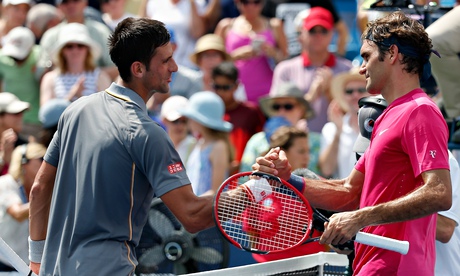
Roger Federer hit such a plane of brilliance over the weekend, comprehensively beating Andy Murray and Novak Djokovic to win his seventh Cincinnati Masters, that it is logical to wonder if he can do the same three weekends from now at the US Open, where he has won five times.
What needs to be said is the last of those arrived seven years ago, when he beat a 21-year-old Murray to close out a remarkable run of consecutive victories at Flushing Meadows – starting with Lleyton Hewitt back in 2004 – when he was supreme not just there but on every court in the game.
On that 2008 weekend he also beat Djokovic and Murray back to back, although the Serb and the Scot were still moving towards the heights of their game at that point. This past weekend he caught them cold in their prime, when each of them might have expected to prevail.
And it was not just the scorelines – 6-4, 7-6 against Murray and 7-6, 6-3 against Djokovic in Sunday’s final – but the manner of their delivery.
To the astonishment of few Federer has reinvented himself at 34 but to win in Mason he went even further than his previous experiments with racket and coach. The talk of the tournament was his seemingly suicidal willingness to crowd the net if he sensed his opponent’s second serve was going to be under-powered.
Up 4-1 in the tie-break, Federer even took one Djokovic second serve on the half-volley on the edge of the service box. “I thought this is the time to do it,” he said. “I thought he was going to go backhand and he went big forehand. So I had to lunge and had the perfect timing on it.”
The Swiss Charge, as it has become known, was a remarkable sight, although Murray said he was not greatly troubled by it, and Djokovic chose not to comment at length on that surreal tie-break magic, a sign perhaps that it spooked him.
Afterwards Federer played down his chances at Flushing Meadows and said his move back to No2, above Murray, was not hugely significant. “It’s not that important for me to be ranked No2 or 3,” he said. “For me, wouldn’t it be maybe better to play Novak in the semis? Possibly. Now it’s out of the question. I won’t see him before the finals. To be quite honest, I don’t think that far ahead because I haven’t been in a final since 2009.
“So I’ve got my work cut out. Usually everybody does play well in New York. It’s a fair surface, good court. Everybody knows it’s the last chance [of the year] to do well at a slam.” A lot of people reckoned Federer’s last chance passed a good while ago, but he continues to prove everyone wrong.
Serena Williams, meanwhile, has the added weight of expectation on her shoulders going to New York, not just as a two-time Cincinnati champion after a hard-fought win over Simona Halep on Sunday but because she is reaching for the calendar grand slam, a burden she tried vainly to ignore afterwards.
As ever, her biggest challenge lies not in the players around her but in her own heart, which sometimes seems troubled and elsewhere is beating proudly. “I compete a lot against my standards, probably even more,” Williams said. “I have such high standards for myself and I expect the best from me and nothing less.”
Yet, even with 21 majors to her name – four more than Federer, who is a month older than her – Williams struggles to mix the natural arrogance of a champion with the caution that plagues most professional athletes. It is an often angst-ridden combination, although she seems settled after another fine performance here. “The win here helps me,” she said. “It also makes me realise the feeling of winning. It’s ridiculous. I like that feeling and want to do the hard work and listen to Patrick [Mouratoglou, her coach and partner] and all the stuff that he tells me.”
Williams’ vulnerability and dependence on her team contrasts starkly with the easy confidence of Federer, but Williams uses that energy to her advantage.
She craves the pressure of living up to expectations. “I decided I prefer to have that pressure than the pressure of not winning,” she said. Not everyone can handle that pressure, but I’m okay with it. I would rather be to this position than another one.”
So who did she think could stop her rounding out a remarkable year by holding all four majors in the same season, as well as moving alongside Steffi Graf with 22 slam titles? “You never know,” she smiled. “Someone might come out and start treeing against me. If I am playing well then hopefully no one will. We’ll see.”
So the two most dominant players of their respective Tours in modern times head for New York with similar ambitions and different mindsets. It would be quite something if they both won, and not entirely the biggest shock of the year.