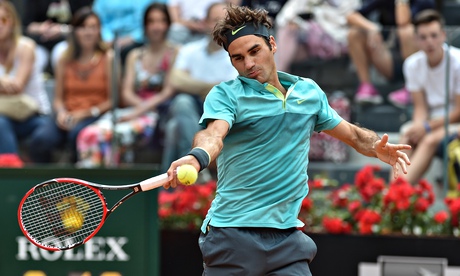
Roger Federer says that, whatever the form book or the doubters say, Rafael Nadal is his favourite to win the French Open, which starts on Sunday week.
If he was indulging in locker-room mind games – with a view, perhaps, to gingering up the world No1 Novak Djokovic, whom most odds-makers have installed as the favourite at Roland Garros – he disguised it like one of his better drop-shots.
Coming to terms with his own slightly diminished powers at 33, Federer appreciates that Nadal, who has won the French title nine times, has hit a few poor patches this summer, even on his favoured clay. But, as a member of the ancien régime, the world No2 is not about to abdicate just yet.
“Do I know what it’s like to be confident then not so confident? Absolutely,” he said on Friday, not long after batting Tomas Berdych out of the way in little over an hour, 6-3, 6-3, to ooze into the semi-finals of the Rome Masters, one of the two ATP 1000 events – along with Monte Carlo – that he has not won. “But, regardless of what anyone says to me, Rafa is always the favourite at the French Open.”
He had cause to reconsider that view once later when Nadal succumbed 7-6, 6-2 to Stan Wawrinka, who he will now face in the semi-final. Nadal’s dominance on clay appears to be slipping ahead, and he has now lost five of his 22 contests on the surface this year and was beaten in straight sets by Novak Djokovic and Andy Murray in the last fortnight before his latest defeat.
As the season’s second major nears, much of the pressure is mental for the leading contenders because they pretty much know where they are physically, and Federer has been in splendid form in front of the microphone in that respect this week. In answer to a question about his on-court demeanour under pressure, he opened a window to emotions that simmer but rarely hit boiling point.
Referring to the occasional flick of his locks after losing a point, the coolest Swiss in the business said: “It was something I had to figure out early in my career, because it was just quite crazy in my head; a lot of things were going through it. I was pretty much a perfectionist back then. I couldn’t understand how I could miss certain shots.
“That’s why I decided to do it this way. I tried to understand how I could get rid of the negativity, that constant drive for perfection: to ignore it or to analyse it for a couple of seconds and then move on.”
He added: “The time between points is crucial. You try to relax as much as possible so you can get up for the next point. If you think about the point [just gone] for too long, you’re going to maybe drag that over to the next point and into the next game, and so forth, so it’s piling up.
“I decided I was not going to play like that for 15 years – or I’d be mental eventually. So now, I think about it for two seconds – like, how could you miss that? – and then move on. I guess you go through a zone of relaxation. The last few seconds when you go and hit the serve, for instance, that’s when you start to think of where you’re going to serve, what you’re going to do, or what’s been happening. Then you go to the next stage.
“So there are three phases from the moment a point is over until the next point starts. It’s important to use that the right way. Obviously, at some stage you get into a routine, where it just comes natural. It’s quite easy, actually.”
Now you know. That split-second follicular tic is a safety valve, and one of the secrets to Federer’s success – of which there was more when Berdych struggled to compete. While Rome is Federer’s “losingest” tournament, with 15 ducks from 15 innings (and three futile finals), in dismissing the skittish Czech for the 14th time he confirmed he is in excellent fettle.
Even though Berdych, the world No5 fresh from outlasting the erratic Fabio Fognini in front of his own fans the day before, brought strong form to Court Centrale on a muggy afternoon Federer made it look easy. After a tight first set he broke in the seventh game of the second and again at the end, a quiet statement of intent for those left in the draw.
There are, apparently, 18 ways to say “stubborn” in Spanish, and David Ferrer surely is the most “obstinado” of his contemporaries. In a battle of David and David, the dogged, put-upon sufferer from Valencia David Goffin hope by losing focus midway through their quarter-final before digging in to win 6-2, 4-6, 6-3 in two hours and nine minutes .
So the eternally boyish Belgian (24) experienced what might have been in store for Andy Murray had the Scot not withdrawn from their third-round match on Thursday to give him a walkover.
Next up for the Ferrer treatment is Djokovic, who beat Kei Nishikori, 6-3, 3-6, 6-1 on Friday, emphatic revenge (with a mid-match blip) for losing to him in the semi-finals at Flushing Meadows last year – although he did subsequently bagel him in the third set at the ATP World Tour Finals.
As for Ferrer, the Serb has crushed him in their past eight encounters stretching back five years (14-5 overall), for the loss of two sets.
In the women’s event Simona Halep crushed her Romanian compatriot Alexandra Dulgheru 6-1, 6-0 in 56 minutes. The second seed has been unstoppable in Rome, losing only seven games in three matches, and she next meets Carla Suárez Navarro. The Spaniard beat the Madrid winner, Petra Kvitova, 6-3, 6-2 while 21-year-old Daria Gavrilova reached the last four of a WTA event for the first time to set up an all-Russian semi-final against Maria Sharapova, who beat Victoria Azarenka 6-3, 6-2.