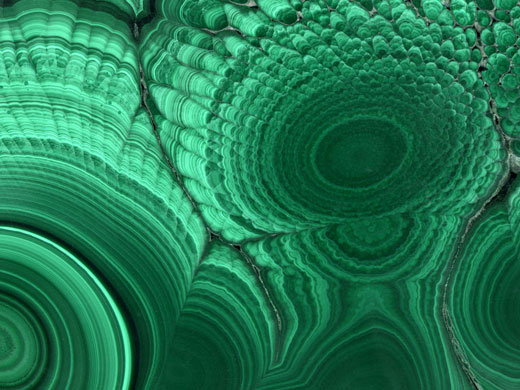
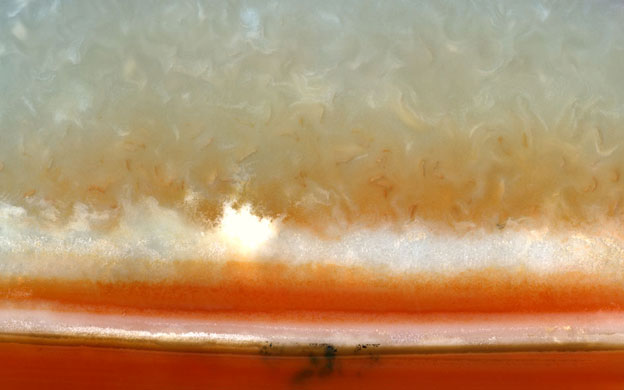
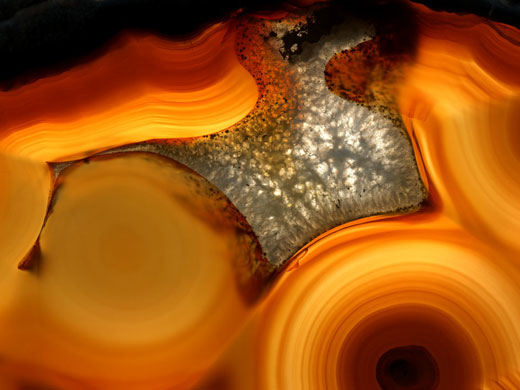
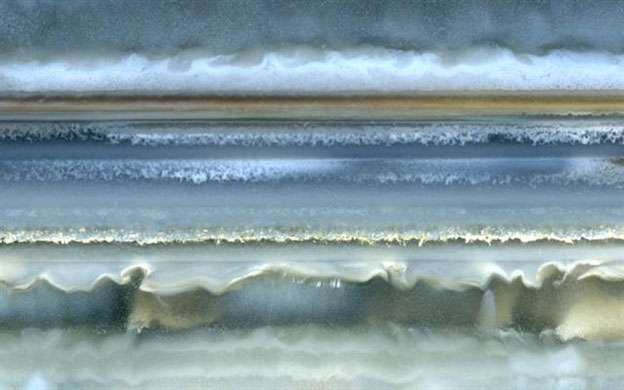
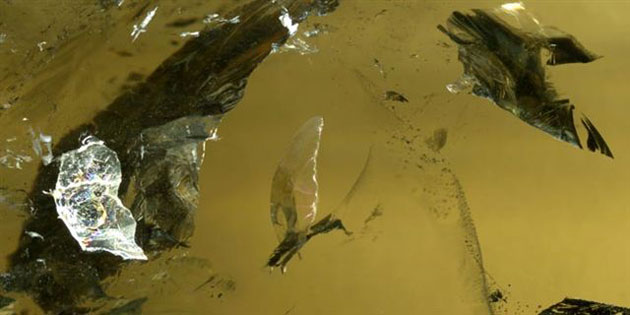
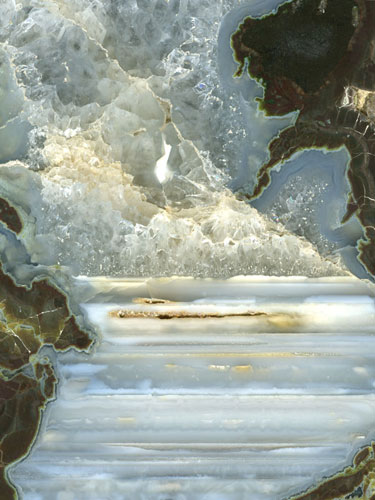
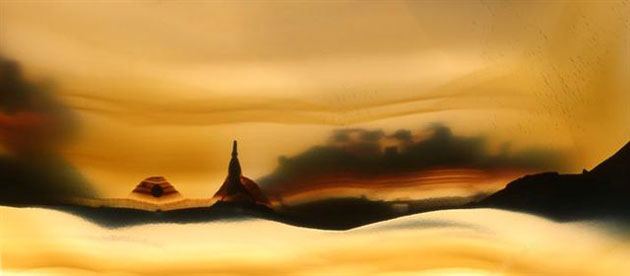
Earth Art: A selection of highly magnified images of rocks and minerals from the world's largest private collection by Prof Richard Weston, of Cardiff University's Welsh School of Architecture. This photograph shows an agate with an unusual combination of concentric and level banding, which makes for a compelling imagePhotograph: Earth Images LtdMalachite is a carbonate mineral that often results from weathering of copper ores found around limestones. Renowned for its vibrant green colour, it was used as an artist's pigment until about 1800 and has been mined for more than 3,000 years at King Solomon's Mines in IsraelPhotograph: Earth Images LtdQuartz is the most abundant material in the Earth's continental crust, made up of a lattice of silica tetrahedra. In ideal conditions it forms a perfectly clear six-sided prism and is commonly found in veins in rocks formed by hot water and in the coarse-grained igneous rock pegmatitePhotograph: Earth Images Ltd
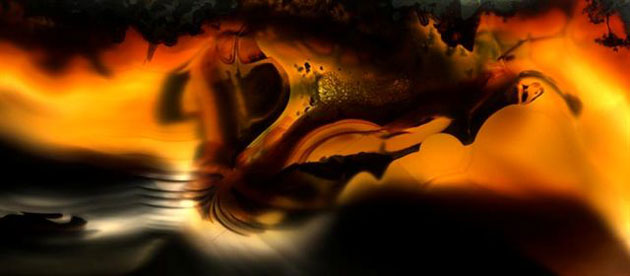
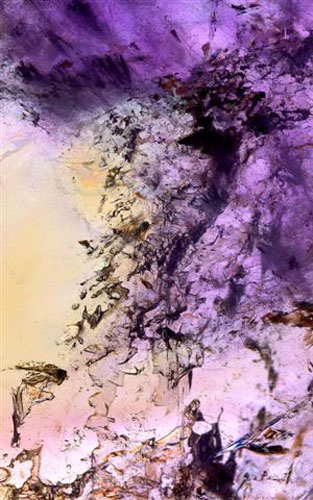
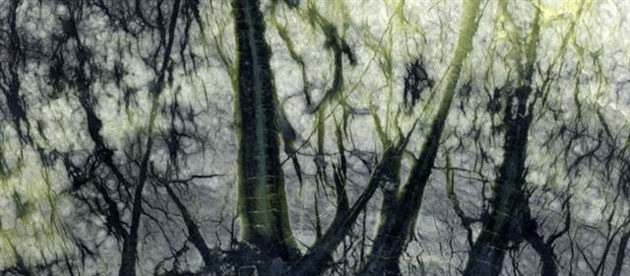
Discovered in Siberia in the 1970s and named from the Russian 'chary' which means charms or magic (some claim the name comes from the River Chara), charoite is purple and often has a distinctive swirling appearance interrupted by yellow-brown inclusions of tinaksite crystals. The black 'rocks' in this specimen are due to inclusions of aegirine. This image is taken from a long, narrow specimen that looks like a purple streamPhotograph: Earth Images LtdEven the basic processes of agate crystallisation are disputed by mineralogists, and an extraordinary formation such as this near the perimeter of a banded agate utterly defies explanationPhotograph: Earth Images LtdRhodochrosite is a manganese carbonate mineral found in rock veins into which it is carried by low-temperature water. This specimen is from a stalactitic formation of a kind found in an old Inca silver mine in Catamarca, Argentina. Cross-sections reveal highly attractive concentric bands of light and dark rose-coloured layersPhotograph: Earth Images LtdAmethyst is the violet-coloured variety of quartz. Until recently its colour was attributed to the presence of manganese, but it has now been shown that a complex interplay of iron and aluminium is responsible. The Greek roots of amethyst mean 'not intoxicated' and ancient Greeks and Romans used to wear amethyst amulets in the hope of avoiding intoxicationPhotograph: Earth Images LtdThe serpentine group includes some 20 common rock-forming minerals. This beautifully marked and veined specimen comes from China and may well be more accurately described as antigorite, a polymorph of serpentine with a different crystal structurePhotograph: Earth Images LtdIn this banded agate, most of the rock void was filled by an infusion of crystallised gel in horizontal bands. The blazing red and oranges in agates are most likely due – as in artists' pigments – to cobaltPhotograph: Earth Images LtdPaesina – 'landscape' – stone comes from Tuscany, Italy. A silty limestone formed during the Cretaceous period, it is marked by a 3D network of fine cracks through which groundwater diffuses bringing oxides of various minerals and creating the intricate, landscape-like colours and patternsPhotograph: Earth Images LtdImage taken close to the perimeter of a banded agate. Some of the formations appear to be typical 'hemi-agates', but how the dominant peach-coloured, egg-shaped feature arose is not clear. The dominant dark blue colour is probably the result of titanium, copper and manganesePhotograph: Earth Images LtdThis image scanned with transmitted light from the perimeter of a banded agate, shows an island of quartz framed by the concentric rings of agate 'eyes', which are generally the result of slicing through hemispherical formations that typically develop near the outer surfacePhotograph: Earth Images LtdParallel bands such as these form when a void is left at the centre of the developing agate following the formation of concentric banding. The later bands form horizontally under gravity from a secondary infusion of liquid silicaPhotograph: Earth Images LtdImage from a natural citrine, a variety of quartz that ranges from pale yellow to brown. It may be from an artificially produced one – cheaper varieties of quartz have been heated to enhance their 'rarity' since Roman timesPhotograph: Earth Images LtdThunder Eggs typically form in tennis-ball-sized pockets in volcanic rhyolites. The centre is generally filled with variants of chalcedony – agate, jasper or opal – and, as here, quartz and selenite are often also presentPhotograph: Earth Images LtdA small detail from a large agate slice. The basic structure of the concentric bands is clear, but quite what gave rise to the unique details is a matter for speculationPhotograph: Earth Images Ltd
Sign up to read this article
Read news from 100’s of titles, curated specifically for you.