Afternoon summary
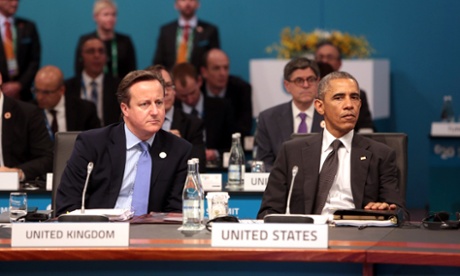
- Ed Miliband has accused David Cameron getting his “excuses in early” and blaming global factors for the failure of the government’s economic strategy. Speaking in the House of Commons, Miliband said that Cameron tried to say that Labour was to blame for all the economic problems before 2010, but was now saying global factors were to blame for the problems currently facing the problems. Cameron, who was in the Commons for a statement on the G20, rejected this. You can read the full exchanges at 5.07pm.
- Cameron has refused to comment on suggestions that the government deficit-reduction programme is falling further behind schedule. When Labour’s John Woodcock put this idea to Cameron, he just said that the government had cut the defici by a third and that the latest figures would be announced, as usual, in the autumn statement.
-
Cameron has urged MPs to quash some of the “wholly false arguments” being made about the impact of the EU/US free trade deal, the transatlantic trade and investment partnership (TTIP) on the NHS. Campaigners claim that it will lead to American firms having the right to take over legal services. Cameron said that Karel de Gucht, the EU’s trade commissioner, has explicitly denied this. (See 4.58pm.) He told MPs:
We need to work hard to quash some of the wholly false arguments that are being put about by opponents of TTIP. This does not in any way have to affect our national health service.
Cameron also claimed that there was nothing sinister about the inclusion of an investor state dispute settlement provision (ISDS) in the TTIP. These were a feature of every trade deal Britain has signed, he said, and he claimed Britain had never lost a case. He also claimed that some people who were lobbying MPs about this did not fully understand the issues.
I do think, and I hope as members of parliament we can all try to do this, when you get that barrage of emails - people sometimes have signed up without fully understanding every part of what they’ve been asked to sign - people want to spread some fear about this thing, and we have a role, I think, of trying to explain properly why these things are good for our country.
-
He said the European Central Bank should adopt a more activist stance to promote growth in Europe.
Britain and America have shown that an active monetary policy, delivered by an independent central bank, can make a real difference. And I think, with the signs of rather staggered growth in Europe, then there’s a need for the European Central Bank to take that action as well.
-
He signalled that he was planning to give the Charity Commission new powers to stop extremists abusing charity law. Charities could also be given legal advice to help them expel extremists, he hinted.
There is a problem with some charities that have had charity status that have used their existence to support extremism or the extremist narrative. There are two things we need to do here, which we have been looking at through the extremism taskforce. One is to help organisations who might need to take lawyers or legal advice to throw extremists out of their organisations. The second is to make sure the Charity Commission has the resources and the teeth it needs, including possibly new legal powers, so it can take action too.
- He signalled that he would approve of extremists fighting with Islamic State being charged with treason. (See 5.13pm.)
That’s all from me for today.
Thanks for the comments.
Peter Bone, a Conservative, asks if President Putin really left early because he was tired. Or was it because, like most bullies, he didn’t like someone standing up to him.
Cameron says he does not know why Putin left early. He says his view is that you should always stay to the end at summits like this, unless something gets agreed that you disagree with.
And that’s it. The statement is over.
I’ll post a summary shortly.
Philip Hollobone, a Conservative, says Britons who fight with Islamist State should be prosecuted for treason.
Cameron says he agrees. These people should face the full force of the law, he says.
Miliband versus Cameron on the economy
The most interesting aspect of the exchanges between Cameron and Miliband was what they both had to say about the global economy.
Miliband accused Cameron of getting his excuses in early.
Today you tell us there are red lights flashing in the global economy.
I think that is what is known as getting your excuses in early.
You used to tell us that the problems in the British economy were all to do with the British government and nothing to do with international factors.
Now, you want to tell us that on your watch they’re all to do with international factors and nothing to do with the British government.
Isn’t the truth that before you went to Brisbane we already knew your export targets were off track and the trade deficit is the highest it’s been for 25 years?
Before you went to Brisbane, we knew that Britain’s productivity had stagnated on your watch.
Before you went to Brisbane, we knew that average families were £1,600 a year worse off.
You have gone from saying everything is fixed thanks to you to everything is not fixed but is nothing to do with you.
All along you should have been listening to the British people who see deep problems in an economy not working for them.
Isn’t it time you stopped blaming everybody else for an economy that’s great for a few people at the top but isn’t delivering for most working people?
Cameron said he was happy to debate Miliband on this.
I’m very happy to defend and take some credit for what is happening in the British economy - growing at 3%, the biggest fall in unemployment on record, 400,000 new businesses.
Because of the difficult decisions that we took, the British economy is doing well.
The difference I would say is now while there are problems in the world economy, you can actually see that Britain is outperforming other countries in the world and the figures speak for themselves.
Cameron also ended with a jibe at Miliband.
Can I say what a pleasure it always is to get back to Britain and find some things haven’t changed - our language, the beauties of our climate and that crucially you are still in your place?
(I’ve taken the quote from the Press Association. Before someone starts complaining BTL, I think they’ve turned an “right honourable gentleman” into a “you”.)
Updated
Labour’s Andy Sawford asks which prime minister turned up to the discussion on climate change: the one who said he wanted to hug a husky, or the one who said he wanted to cut the crap.
Cameron says it was the one who set up the green investment bank, and the one who commissioned a new nuclear power station when Labour did nothing to restart the nuclear programme.
Here is the quote that David Cameron cited earlier, from Karel de Gucht, the EU trade commissioner, saying the NHS would not be covered by the free trade provisions in TTIP (which allegedly could open it up to services being taken over by a US firm). It’s in this BBC story. De Gucht said:
Public services are always exempted - there is no problem about exemption. The argument is abused in your country for political reasons but it has no grounds.
Labour’s Sheila Gilmore asks why the NHS cannot be formally exempted from TTIP.
Cameron says these ideas can be discussed. But there is not point raising unnecessary fears amongst the public.
Margaret Ritchie, the SDLP MP, asks if a devolve administration could be forced to pay money to a private company under an investor state dispute settlement (ISDS) under TTIP.
Cameron says these ISDS arrangements have been part of every trade deal Britain has signed. And Britain has never lost a case, he says.
John Baron, a Conservative, says the problem with talking loudly and carrying a small stick is that you get found out by the bullies.
Camerons says he does not accept that. Britain has one of the top five defence budgets in the word. Two new aircraft carriers are being built, and destroyers. Britain has a full set of capabilities. We should not talk it down.
Updated
Cameron says a former EU trade commissioner said there was “no problem” about public services being exempted form TTIP and that these arguments were being abused “for political reasons”.
Labour’s Gisela Stuart asks why Cameron is so sure that the NHS will not be covered by TTIP.
Cameron says what makes him confident is a statement from the European Commission about states having the right to keep their health service in the public sector.
Politicians should challenge the things being said about TTIP, he says.
Here’s Labour’s John Woodcock summarising an exchange he had earlier.
Asked PM if G20 signalled the UK's budget deficit would take even longer to clear. He just said figures "would be set out in the normal way"
— John Woodcock (@JWoodcockMP) November 17, 2014
Labour’s Alison McGovern asks if Cameron will campaign for an international right to health coverage.
Cameron says she’s right. This should be considered when the Millennium Development Goals are updated, he says.
Julian Lewis, a Conservative, asks Cameron for a commitment to keep defence spending above the Nato target (2% of national income) while he is in office.
Cameron says he has set out his plans for this parliament, and that he will set out his plans for the next one at the election.
Labour’s Derek Twigg asks how having so many people on low-paid jobs addresses the productivity problem.
Cameron says a large number of jobs are being created and that it is a myth to say they are all low-paid ones.
Hugh Robertson, a Conservative, asks if Cameron discussed cutting funds to Islamic State from Arab countries.
Cameron says he discussed this issue with Barack Obama and Tony Abbott, the Australian prime minister.
Labour’s Rushanara Ali asks about an initiative to cut remittance costs for people sending money back to developing countries.
Cameron says remittances are a critical source of income in these countries.
Sir Edward Leigh, a Conservative, suggests spending £650m from the aid budget on a climate change fund is not the best use of public money.
Cameron say breaking promises to the poorest in the world would not be the right thing to do.
The SNP’s Angus Roberston invites Cameron to congratulate Nicola Sturgeon on becoming leader of the SNP.
Cameron says he is happy to congratulate her. At the G20 almost all leaders came up to say how pleased they were the UK was staying together.
Liam Fox, the Conservative former defence secretary, says it is the eurozone itself that poses a threat to the EU’s recovery.
Cameron says the eurozone needs structural recovery. And Britain and America have shown an active monetary policy can make a difference. The European Central Bank should follow that course.
Labour’s Keith Vaz asks if Cameron discussed trade in his meeting with the Indian prime minister, Narendra Modi. And did he invite him to the UK?
Cameron says more can be done to promote trade with India. They discussed the need for the free trade talks with the EU to get going again.
Cameron says changes in the US Congress make an agreement on TTIP (the transatlantic trade and investment partnership) more likely. But supporters of TTIP must attack the myths about its impact on the NHS, he says.
Labour’s Dennis Skinner accuses Cameron of “hypocrisy” because he is imposing sanctions on Russia, while helping Russians donate to the Conservative party.
Cameron says he does not know where to start. Skinner used to support the Communists, he says, but they don’t run Russia any more.
Sir Malcolm Rifkind, the Conservative former foreign secretary, says further sanctions on Putin and his “cronies” will not have any effect.
Cameron says he disagrees. The value of the rouble has fallen, he says. Economic sanctions are having an effect.
Labour’s Pat McFadden asks if Cameron regrets watering down Labour’s anti-terror laws.
Cameron says the government took advice and took the right decisions.
Jack Straw, the Labour foreign secretary, asks about Luxembourg’s “scandalous” record on tax avoidance when Jean-Claude Juncker was prime minister.
Cameron says Luxembourg has now signed up to action on tax avoidance.
Sir Peter Tapsell, a Conservative, asks if Russia would take more notice if Britain were re-arming.
Cameron says Britain is investing in arms. But what Putin really notices is a united opposition.
Cameron is responding to Miliband.
He says all EU leaders who met Putin gave him a clear message.
Further destabilisation would trigger more sanctions, he says.
On taxation, Cameron says what is crucial is that tax jurisdictions have agreed to share information.
On climate change, Cameron says Britain has already made money available.
The biggest breakthrough is that China and America came to an agreement on targets at the Asian summit.
On growth, Cameron says he is happy to defend and take some credit for what is happening in the UK: growth at 3pc, the biggest fall in unemployment on record.
The difference is that, while there are problems in the world economy, now Britain is outperforming other countries.
Coming back to the UK, it is a pleasure to see some things have not changed: our language, the pleasures of our climate - and Miliband still in his place.
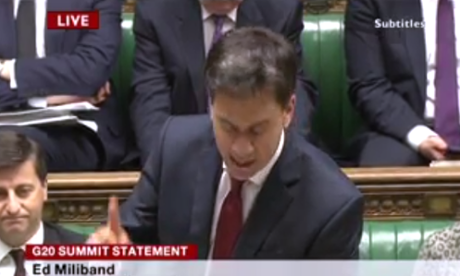
Ed Miliband is responding to Cameron.
He endorses Cameron’s comments about the murder of Peter Kassig.
On Russia, does Cameron think enough is being done to get Russia out of Ukraine? And what has to happen for further sanctions to be applied?
On corporate taxation, will developing countries be given a role in forming the new rules? This was promised, but has not happened. Why not?
When will the UK announce our contribution to the climate fund?
On Ebola, Miliband welcomes the UK’s role as the second largest donor. But the G20 conclusions were short on commitments from other countries. What can be done to get them to contribute more?
On growth, Cameron says there are red lights flashing in the global economy.
I think that is what is known as getting your excuses in early.
Cameron used to say problems with the economy were all to do with UK decisions, not global ones. Now he is saying it’s all to do with global factors.
Updated
Cameron says the G20 plan is plan for jobs and growth. It is intended to boost the global economy by $2 trillion.
The warning signs in the global economy show it is more important than ever to stick to the government’s long-term economic plan, he says.
He says his focus at the summit was helping to deliver global growth by tackling the threats to it.
On free trade, he pushed for the EU/US trade deal to be completed next year. And he pushed for the EU to do other trade deals, including with Australia.
On global taxation, he says there was progress on ensuring big companies pay the taxes they owe. This is a moral issue, as well as an economic one. Cameron says he put this on the G20 agenda at the summit in Northern Ireland. It is not embedded in the G20 agenda.
On the threat posed by conflict and disease, Cameron says he called on Russia to respect the Minsk agreements. And he said Britain was prepared to tighten sanctions. President Putin said he did not want a frozen conflict, and he said he saw Ukraine as a single political space. But he must be judged by his deeds, not his words.
On Ebola, Cameron said he wrote to the Australian prime minister before the summit asking for this to be included. He pushed for global measures to tackle a similar outbreak in future, such as having a standing pool of medics, and more action on fighting bacteria.
This was a good G20 for Britain, he says.
Updated
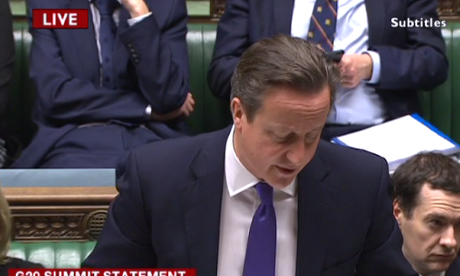
David Cameron's statement
David Cameron starts by condemning the murder of the US aid worker, Peter Kassig.
He says tackling the threat posed by terror formed part of his conversations with the Australian prime minister. He has announced powers to stop extremists returning to the UK. A full statement about the counter-terrorism bill will be made soon.
Apparently David Cameron only got back from the G20 summit at lunchtime. And his body clock will be telling him it’s the middle of the night. He might not be in a very good mood ...
Lord Ashcroft’s weekly poll is out. Here are the figures.
Ashcroft National Poll, 14-16 November: CON 29%, LAB 30%, LDEM 9%, UKIP 16%, GRN 7%. Full details on @ConHome, 4pm.
— Lord Ashcroft (@LordAshcroft) November 17, 2014
Voting intention with changes in this week's ANP: pic.twitter.com/3Ceh9aCbmy
— Lord Ashcroft (@LordAshcroft) November 17, 2014
Updated
Labour’s Michael McCann isn’t impressed by Cameron’s latest argument about the state of the global economy.
Extraordinary that the 2008 global crash was Labour's fault while this isn't the Tories responsibility. http://t.co/FErFSLjWVf
— Michael McCann MP (@MichaelMcCannMP) November 17, 2014
My statement on #G20 and why warning signs in the global economy mean we must stick to the long term economic plan at 4pm in the Commons.
— David Cameron (@David_Cameron) November 17, 2014
David Cameron will be making his Commons statement on the G20 summit in about half an hour. It would normally start at 3.30pm, but there is an urgent question about the army reserves first.
For some background, here’s a piece from Guardian Australia’s Van Badham on 10 things we learnt from the G20.
Here’s a short afternoon reading list.
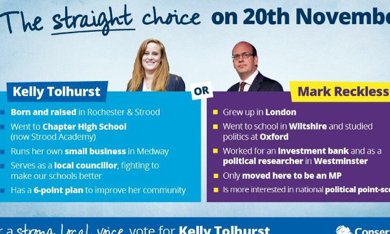
The idea that voting Conservative is a blow against career politicians without local connections is openly risible. To put it on your leaflets is an act of desperate prattishness.
Updated
Lunchtime summary
-
A “web of lies, deceit and indiscipline” by police officers led to former government chief whip Andrew Mitchell and his family being subjected to an extended and vitriolic press campaign, the High Court has heard. As the Press Association reports, James Price QC was opening Mitchell’s libel action against News Group Newspapers (NGN) over a September 2012 story in The Sun which the MP says meant that he was guilty of launching a grossly offensive and arrogant attack at Downing Street police officers two days earlier, branding them “fucking plebs” and “morons”. Mitchell sat in front of his counsel as he told Mr Justice Mitting, who is hearing the case in London without a jury, that what the MP was alleged to have said was a “gross caricature of an attitude of mind which has been out of date for decades”. Price said that the detail of the encounter which was leaked to the newspaper by a number of officers was “wholly false”.
This web of lies, deceit and indiscipline, and by police officers, led to Mr Mitchell and his family being subjected to an extremely unpleasant, indeed vitriolic, press campaign and a good deal of hostility from the public who believed what they had read in the press. It also placed him in a position where he required considerable determination and, above all, confidence in the rightness of his position, to stand by his account of events.
NGN argues that the article was substantially true and, at the heart of its case, is the account given by Pc Toby Rowland. He claims that Mitchell, having demanded but been denied the right to leave on his bicycle by the main Downing Street gates, lost his temper and said: “Best you learn your fucking place - you don’t run this fucking government - you’re fucking plebs.”
In his witness statement to the court, Mitchell said:
I admit to sometimes using bad language in conversation. I also admit that I can sometimes be impatient and short-tempered when I consider I am being prevented from going about my legitimate business. I even admit that I can be - or at least that I can appear to be - rude on these occasions. To the best of my recollection, I have never called anybody a ‘pleb’, however, let alone a policeman. Since the incident I have thought long and hard about this and cannot recall a single instance when I have called anybody a ‘pleb’. It just isn’t a word I use.
For detailed reporting from the trial, @DannyShawBBC, @JoshuaRozenberg and @TimesCrime are all worth following.
-
Downing Street has said David Cameron will convene a meeting of the government’s Cobra contingency committee to consult with security chiefs and other senior officials following the Islamic State beheading of US hostage Peter Kassig.
Updated
The Institute for Fiscal Studies has published a short note today saying that the amount the government is saving from changes to benefits and tax credits is much lower than expected. Amongst other reasons, this is partly because of higher spending on pensioners, and partly because anticipated savings from cuts to tax credits, housing benefit and disability living allowance have not materialised.
George Osborne, the chancellor, has used an interview with BBC News to back David Cameron’s comments, in a Guardian article, about the “red warning lights” flashing on the dashboard of the global economy. Osborne said:
You have to make a realistic assesment of the global economy today. We’ve discovered that Japan has gone into recession, Europe remains vey weak, and although the British economy is perfoming well we’re not immune to these things happening in the world. It’s all the more reason why we’ve got to go on working through our long term economic plan and why it would be a complete disaster to divert from that plan, to borrow and spend more. That would put Britain in a place where many other countries find themselves today.
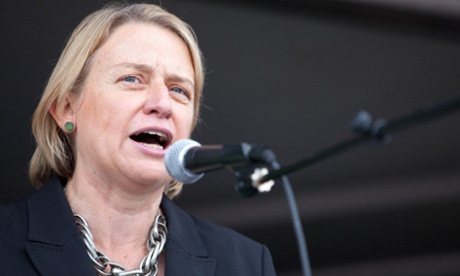
But Natalie Bennett, the Green party leader, has put out a statement saying the coalition is to blame for problems with the economy.
It is helpful that Mr Cameron has finally noticed the extreme fragility of the global economy, if only belatedly, but what’s clear from his remarks is that he’s trying to lay the blame for the failures of his own government in any place but the right one.
Voters will no doubt recall that this government came into office promising to ‘rebalance’ our economy, away from the financial sector and back towards manufacturing - a move that would have required substantial investment in the real economy, rather than cash flowing into financial and property speculation.
That has not happened; the UK’s rate of investment is comparable to El Salvador’s, and the financial sector has debts totalling 1,300% of GDP.
Furthermore, the government has utterly failed to rein in the excesses, the fraud, management and risk-taking of the bankers, as the massive fines for market rigging this week demonstrated
The Green party says this has to end. We need to slash the size of the financial sector and see that it serves the needs of a boosted real economy that manufactures the goods and grows the food that we need, providing jobs that workers can live on, and homes they can afford. That would also reduce our exposure to the international economic, political and military turbulence.
Here’s the Press Association on the security scare at Westminster this morning. (See 10.28am.)
A security alert which closed a key Parliamentary building was sparked by suspicions over a tablet computer belonging to a minister’s aide.
Portcullis House - which contains MPs’ offices and committee rooms - was evacuated and sealed off while police examined the device.
Tory MP Nick Boles took to Twitter to reveal that the false alarm erupted around his newly-recruited apprentice.
“An exciting start to my apprentice’s first day at Parliament: the whole of Portcullis House evacuated cos of security scare over his iPad!” the Skills Minster posted.
His office said he was not providing any more details of the incident - which saw a number of high-profile figures locked out of meetings.
Scotland Yard confirmed that an item found in the airport security-style entrance area of the building opposite the Palace of Westminster was investigated and found not to be suspicious.
And here’s the tweet from Nick Boles, the minister for skills.
An exciting start to my apprentice's first day at Parliament: the whole of Portcullis House evacuated cos of security scare over his iPad!
— Nick Boles (@NickBolesMP) November 17, 2014
A Rochester byelection round-up
Here is a Rochester byelection round-up.
It started in Clacton. That by-election was significant not only because it launched Ukip into Westminster, but also because it taught the party how to campaign. Clacton was the first electoral battle in which Ukip waged a modern, professional and intensive effort. It was the first time that Ukip experimented with a “voter identification system” – a database of information on each voter – and therefore the first time that the party approached different areas with different messages.
Thus Labour voters heard about opposition to the “bedroom tax” and the need to punish bankers; Tory voters heard about the need for more GPs. It was also the first time that younger Ukippers became seriously involved, learning the importance of more targeted, subtle and nuanced messages before their own campaigns next May along the East Coast.
Ironically, this change was not the product of diehard Ukippers but of two new recruits: the defector Douglas Carswell, who has long written about how to revitalise parties; and the experienced organiser Chris Bruni-Lowe, who used to run local referendums for MPs.
Their priority was to own the “local space” before other parties arrived. In Clacton, the frontline was not Europe or immigration. It was fixing street lights, finding more GPs, saving a maternity unit and curbing knife crime.
Precisely the same is now happening in Mark Reckless’s seat of Rochester and Strood. The Tories have started too late and remain focused on a story about the national economic recovery, which even a quick look at the surveys would show is not being felt by most Ukip voters.
I do believe that I am a normal person. The only candidate who is a true person of Rochester and Strood is me ... I’ve not wanted to be an MP since I was nine. I’m not a career politician, I never set out to do this. But I really want to represent this area because I come from here, I know the people and I think I can do a good job.
-
Roger Helmer, the Ukip MEP, says the party will benefit in the byelection from the government’s decision to pledge hundreds of millions of pounds to a new Green Climate Fund in Berlin on the same day as the poll.
Cameron to announce £600 million foreign aid "to fight climate change". How many votes will that be worth in Rochester?
— Roger Helmer (@RogerHelmerMEP) November 17, 2014
-
Mike Smithson says people who have made a forecast of the byelection result on his Political Betting website expect Ukip to win by an average margin of 8.88 percentage points.
Final consensus in the PB Rochester by-election prediction competition is that UKIP will win with margin of 8.88% pic.twitter.com/tshw0uCzEE
— Mike Smithson (@MSmithsonPB) November 16, 2014
David Cameron is going to host a Cobra meeting on the latest Islamic State beheading, Downing Street announced at the Number 10 lobby briefing.
Prime Minister to chair Cobra meeting on the latest Isis beheading video when he returns from the G20 http://t.co/61BgDR2ZGR
— ITV News (@itvnews) November 17, 2014
There is also going to be a statement in the Commons from Cameron on the G20 summit at 3.30pm this afternoon.
The plebgate libel trial has got underway.
I won’t be providing minute-by-minute coverage here, but the BBC’s Danny Shaw seems to be providing good rolling coverage here on Twitter. Here are his opening posts.
Main issue for libel case is whether Andrew Mitchell did swear at police & describe them as "plebs". Mr Justice Mitting presiding. #plebgate
— Danny Shaw (@DannyShawBBC) November 17, 2014
#plebgate James Price QC tells court Andrew Mitchell is "innocent man" as he outlines his case at start of libel action
— Danny Shaw (@DannyShawBBC) November 17, 2014
#plebgate Price says police responsible for a "web of lies, deceit & indiscipline" which led to "vitriolic" press campaign against Mitchell
— Danny Shaw (@DannyShawBBC) November 17, 2014
#plebgate Price: Andrew Mitchell is "not a snob, he is a good man". The word "pleb" is "not in his vocabulary..it's the very opposite of ...
— Danny Shaw (@DannyShawBBC) November 17, 2014
#plebgate Desmond Browne QC for Toby Rowland says Mitchell was a "Jekyll & Hyde" character - a "mix of charm & menace"
— Danny Shaw (@DannyShawBBC) November 17, 2014
#plebgate Browne says Mitchell has "foul temper" & uses "foul language"
— Danny Shaw (@DannyShawBBC) November 17, 2014
#plebgate Browne says Mitchell told security officer in another encounter he was "a little s***"
— Danny Shaw (@DannyShawBBC) November 17, 2014
#plebgate Browne says Mitchell put another officer down saying "that's a bit above your pay grade Mr Plod"
— Danny Shaw (@DannyShawBBC) November 17, 2014
Rochester byelection hustings - Summary and verdict
Who’s winning in Rochester and Strood? Having listening to this morning’s hustings, I’m tempted to conclude that the answer is - Sir John Major. I spent a day in the constituency three and half weeks ago - you can read about it here - and I was told explicitly by Ukip that they were putting immigration at the heart of their campaign. They showed me this, which they described as their main campaign leaflet.
Ukip election leaflet in Rochester pic.twitter.com/EeHeXUqwLW
— AndrewSparrow (@AndrewSparrow) November 17, 2014
Yet today a different story emerged. This is the key news line from this morning’s hustings.
- Mark Reckless, the Ukip candidate, has downplayed the importance of immigration as a key campaign issue. Asked at the start of the BBC Radio Kent hustings to summarise in 60 seconds why he should be MP, he did not mention immigration and instead said he was focusing on health.
First and foremost, because I’m putting backing Medway’s NHS at the centre of my campaign. My father’s a doctor, my mother was a nurse and I’m extremely concerned that under both of the parties we’ve seen problems at Medway hospital being allowed to fester for at least a decade now. Kelly Tolhurst, the Conservative candidate and Reckless’s main rival, also highlighted the state of the local hospital as her main issue.
Why could this mark a result for Major? Because, within the last week, he has twice spoken out on this subject in ways that seem designed to shame Ukip over its anti-immigration stance. Last week he spoke about his “huge admiration” for immigrants, and yesterday he described Ukip as a party of “negativity and sheer nastiness”.
There could be an alternative theory. In an interview with BBC Radio Kent after the hustings, Tim Bale, an academic, said Ukip could be focusing on health because they “own” immigration as an issue anyway. Perhaps. But if you “own” an issue and you think it’s winning you votes, it is customary to keep banging on about it.
As for the rest of the hustings, here’s my verdict on how the candidates performed.
Mark Reckless: He easily comes over as the most professional candidate (as you would expect from someone who’s been the local MP for more than four years) and he comfortably trumped Tolhurst at several points on local detail. But he was given an easy ride. His Lodge Hill flip-flop was only addressed fleetingly at the end (see 10am), and sadly he was not challenged on why a man now fighting a byelection on his commitment to the NHS defected to a party run by a man who two years ago wanted to dismantle it.
Kelly Tolhurst: Rather poor. Having impeccable local credentials is a strength, but she is weak on policy, having little to say when pressed on what she wanted David Cameron to do about immigration (see 9.33am) and, given what the presenter was revealing about the state of Medway schools, she is probably lucky that this has not been a bigger issue in the campaign in the light of her role as cabinet member on the council in charge of education.
Naushabah Khan: She was good. I probably wouldn’t go as far as Rod Liddle, who described her as “best, by a million miles” after another hustings, but she was articulate, and had a good grasp of the issues.
Geoff Juby: For understandable reasons, he sounded as if his heart wasn’t really in it. (The latest Ashcroft poll puts the Lib Dems on 2% in this fight.)
Clive Gregory: He sounded refreshingly different. Listening to him made me think that Natalie Bennett could do well if she gets included in a UK televised leaders’ debate, not so much because the country would endorse every Green policy, but because there is an appetite for an alternative to what the main parties are offering, and the Greens could fill it.
That didn’t last long.
Security Alert is over at Portcullis House. Roads and building reopened.
— Darren McCaffrey (@DMcCaffreySKY) November 17, 2014
There is a security alert at Parliament. Portcullis House, the building opposite the main Houses of Parliament where many MPs have offices, has been partly evacuated because of a suspect package.
Westminster cleared of people and traffic after major security scare around Parliament pic.twitter.com/Ym5pNIHiSW
— Jordan Newell (@jordannewell) November 17, 2014
suspect package at portcullis house - Waterloo bridge shut - though policeman tells me it should be sorted soon pic.twitter.com/sxbxFesBFd
— Beth Rigby (@BethRigby) November 17, 2014
Q: Why is there not central fund to help countries accept migrants?
Gregory says that would be a good idea.
Q: Why are disability issues not featuring in the campaign?
Juby says he has only been approached by one disability group?
Q: Ukip have no credibility. They flip-flop. When you were a Conservative MP, you defended the plan for the Lodge Hill development. Now you are against it?
Reckless says that, since he made those comments, it has been designated a site of special scientific interest. If it were allowed to go ahead, the whole system of environmental protection would fall apart. One of his reasons for holding the byelection was to campaign against this, he says.
Khan says she is in favour of Lodge Hill. Extra homes are needed. Both Reckless and Tolhurst have changed their mind on this, she says.
Tolhurst says that’s not true. She has never voted against it, she says.
And that’s it.
I’ll post a summary soon.
Tolhurst says Reckless claims he secured the funding for Stood academy. But that happened before he became MP.
And she says Reckless talked about two primaries closing. That was Labour policy, she says.
Reckless disputes that. He says it was a decision taken by the council.
Juby says Labour created the academies.
Khan says people do not understand that there is a difference between Labour and coalition academies. Under Labour, academy status was used to improve failing schools. Under the coalition, the best schools have been encouraged to become academies.
Gregory say the whole system is a problem. There is too much focus on league tables. Teachers should be allowed to teach.
Q: That’s Michael Gove’s fault, isn’t it?
Reckless says Gove was right to place an emphasis on standards.
Reckless says there has not been enough urgency at the council.
He has a one-year-old child, and two-and-a-half-year-old. There is a good local primary near him. But he is just outside the catchment areas.
He says Tolhurst is responsible for local schools being poor.
Tolhurst says she has been working hard to improve schools. She has set up a system where schools have to come in an explain their Ofsted performance.
We are seeing improvements, she says.
But these things do not change overnight.
Q: [To Khan] What would you do about local schools?
Khan says she went to local schools, and she is a school governor.
Q: You’re governor of a secondary school. Do you have a problem with the quality of children coming through?
No, says Khan. But it’s a selective school.
Tolhurst says that Khan is contradicting herself, saying standards generally are poor, but not at the intake for her school.
Khan does not accept that. (Julia George, the presenter, says it’s a selective school.)
Q: [To Tolhurst] You have been the cabinet member for schools on Medway council.
For 18 months, says Tolhurst.
Q: School performance has been catastrophically bad. It is near the bottom of the table nationally on various educational measures. You say you will give parents a choice of outstanding schools. But there aren’t any here.
Tolhurst says she has been addressing these problems.
Key stage two results have improved, she says. For the first time in many years schools in Rochester and Strood are going to achieve 100% at key stage two.
Q: Most of these schools are going to be given to other schools to look after because Medway council has done so badly.
Tolhurst says, since she has had this portfolio, there have been improvements.
Partnership working is important, she says. The council has encouraged that.
Juby says there is one school in the Medway were pupils speak more than 100 languages. Immigration puts pressure on services. But he concedes he does not have all the answers.
Reckless says Tolhurst wants to limit the number of immigrants coming from the EU. But you cannot do this if you are in the EU. So, Kelly, will you join me in campaigning to leave the EU.
Tolhurst says Cameron wants to limit the numbers coming in.
Khan says, when Cameron made his Bloomberg speech on the EU last year, he did not even mention immigration.
Tolhurst says Cameron has a record of delivering, on issues like the EU budget. She will keep pushing him on immigration until he delivers.
It’s “words not action,” says Reckless.
Juby says immigration is good for this country. And limits would be dangerous. There are around 200,000 Spanish people in the UK, but more than one million Britons in Spain.
Q: [To Gregory] You would let anyone in?
No, says Gregory. But what goes around comes around. There are Britons working abroad as a result of the EU.
Khan says immigrants are contributing a great deal to the economy.
And the EU is bringing inward investment to the area.
Q: What is your real position? You speak about its benefits. But you seem to have been nobbled by Labour, and talk about the problems too.
Khan says she does not accept that. The last Labour government made mistakes.
Q: [To Tolhurst] Has someone told you not to mention it?
Tolhurst says immigration has benefits. But it is having a big impact locally. We need to take measures to reduce it.
Q: What are you urging Cameron to do?
Tolhurst says she wants him to fight, and have a renegotiation with Europe.
People coming to this country should work and contribute. It should not be open to immigrants who are not working, she says.
Q: But that’s happening?
There is more we could do, Tolhurst says.
Q: But what about people coming here to work? What do you want him to do?
Tolhurst says she would like Cameron to control the numbers.
Q: How?
By having some agreement?
Q: Permanently? Or temporarily, as John Major suggested.
For a short period of time, says Tolhurst.
Q: In other debates immigration has come up a lot. Has anyone told you not to mention it?
Reckless says people know Ukip has a fair policy on immigration, with an Australian-style points system.
Q: Do you think this is not a vote winner?
Reckless says it is a huge issue. It gets raised a lot on the doorstep.
Q: You did not mention it in your opening remarks.
Reckless says he thought it would come up.
Q: What would you do to improve health?
Tolhurst says Medway hospital being in special measures in unacceptable. She has a personal interest; the hospital save her life last year.
She has talked about this with Jeremy Hunt, the health secretary, who was down here last week. She would like to pair the Medway hospital up with an outstanding hospital, possibly a London one, to drive it out of special measures.
Reckless says the hospital has already paired up with the Homerton hospital to improve A&E.
Tolhurst says a general pairing would be good.
Updated
Julia Smith says there used to be two mental health wards in the local hospital. Now there is just two thirds of one.
Q: Does that concern you?
Juby says this concerns him very much. This is a national problem. The Mental Health Trust is not getting the money it needs.
Q: Is this because mental health does not get parity with physical health?
Juby says the problem is we say we want to treat people in the community, but do not give them proper back-up.
Q: What about people who need a hospital bed?
Juby says he agrees; there need to be more beds.
Q: Would you fight for more mental health beds?
Juby says in Medway the Lib Dems have been fighting for more beds. And this is a Lib Dem priority nationally too.
Q: What would the Green party do on mental health?
Gregory says Reckless is right to say there is no proper management. You need a full-time CEO in charge.
The NHS will get worse if TTIP comes in, he says. We must stop that, or we will lose the NHS completely. The NHS has to be taken out of TTIP. And the Health Act must be repealed.
Q: But what would you do in the constituency?
Gregory says the management is the main issue.
Julia George says it is interesting how much emphasis they are putting on health. At the start of the campaign immigration was more of an issue.
Q: What could you do to improve the hospital?
Khan says she would vote for the bill that stops the privatisation of the health service.
Q: It’s not just the hospital, is it? Labour say they would allow people to see a GP within 48 hours. But Labour raised GP salaries, while allowing GPs to opt out of night calls.
Khan says when Labour was in power you could see a GP within 48 hours. You cannot now. Labour would hire another 8,000 GPs. It would fund that through a Time to Care fund, raising money from a levy on tobacco firms and a mansion tax.
Q: [To Reckless] Did you take your eye off the ball on Medway Maritime hospital?
Reckless says there is an alphabet soup of regulators. Ukip would have a single elected health board looking after Medway. That would unify management and oversight.
Q: What have you failed to do?
Reckless said that, when the Medway hospital went into special measures, he complained that no one was in overall charge.
The existing management team was left in place, with no support.
Q: What did you do when a chairman was brought in on a part-time basis on a huge salary?
Reckless says he said that was unacceptable.
Q: Do you ever ask your family about this?
Reckless says he talks to his family a lot about this. His brother is a doctor and medical director.
George is asking each candidate to give a one minute reason why they should be the MP.
Labour’s Naushabah Khan says, as someone born in the constituency, she knows they can get things right. But there are issues to address, like the local hospital.
Clive Gregory, the Green candidate, says he has live on the Hoo peninsula for more than 20 years. He is absolutely opposed to the Lodge Hill development. And the Greens have the right stance on other issues too.
Ukip’s Mark Reckless says he is putting the Medway hospital at the heart of his campaign. His father was a doctor, his mother was a nurse. He wants a unitary health authority for the area.
The Lib Dems’ Geoff Juby says he has lived in Medway for 30 years. He would fight for better health services and better transport.
Kelly Tolhurst, the Conservative, says she is the true local candidate. She was born here, went to school here and runs a business here. She wants to bring the hospital out of special measures. It’s a two-horse race. If you don’t want a Ukip MP, vote for me, she says.
Julia George is presenting the show. It will last for an hour.
She will be asking questions, but also taking questions.
You can email her at julia@bbc.co.uk.
Rochester byelection hustings on BBC Radio Kent
There are 13 candidates in the Rochester and Strood byelection. The full list is here.
The five main ones are taking part in the hustings. They are:
Clive Gregory - Green party
Geoff Juby - Lib Dems
Naushabah Khan - Labour
Mark Reckless - Ukip
Kelly Tolhurst - Conservative
There are three more days of campaigning befoe the Rochester and Strood byelection and this morning the five main candidates are taking part in a hustings being broadcast on BBC Radio Kent. Mark Reckless, the Ukip candidate who triggered the byelection by leaving the Conservatives and resigning as the constitutency’s MP, has been criticised for missing some of the other hustings, but he is taking part today.
Just off to Chatham studio to go on @BBCRADIOKENT for my third debate with other candidates from 9-10am
— Mark Reckless (@MarkReckless) November 17, 2014
I’ll cover the whole event live.
Here’s the agenda for the day.
9am: BBC Radio Kent Rochester byelection hustings.
10.30am: The libel cases involving Andrew Mitchell, the former Conservative chief whip, and PC Toby Rowland starts at the Royal Courts of Justice. The cases revolve around whether Mitchell did or did not call the police plebs.
11am: Number 10 lobby briefing.
2.30pm: Theresa May, the home secretary, takes questions in the Commons.
3pm: Sir David Higgins, HS2 chairman, gives evidence to the Commons transport committee.
As usual, I will be also covering all the breaking political news from Westminster, as well as bringing you the most interesting political comment and analysis from the web and from Twitter. I will post a summary at lunchtime, but I will be wrapping up after that because I’ve got a meeting this afternoon.
If you want to follow me on Twitter, I’m on @AndrewSparrow.