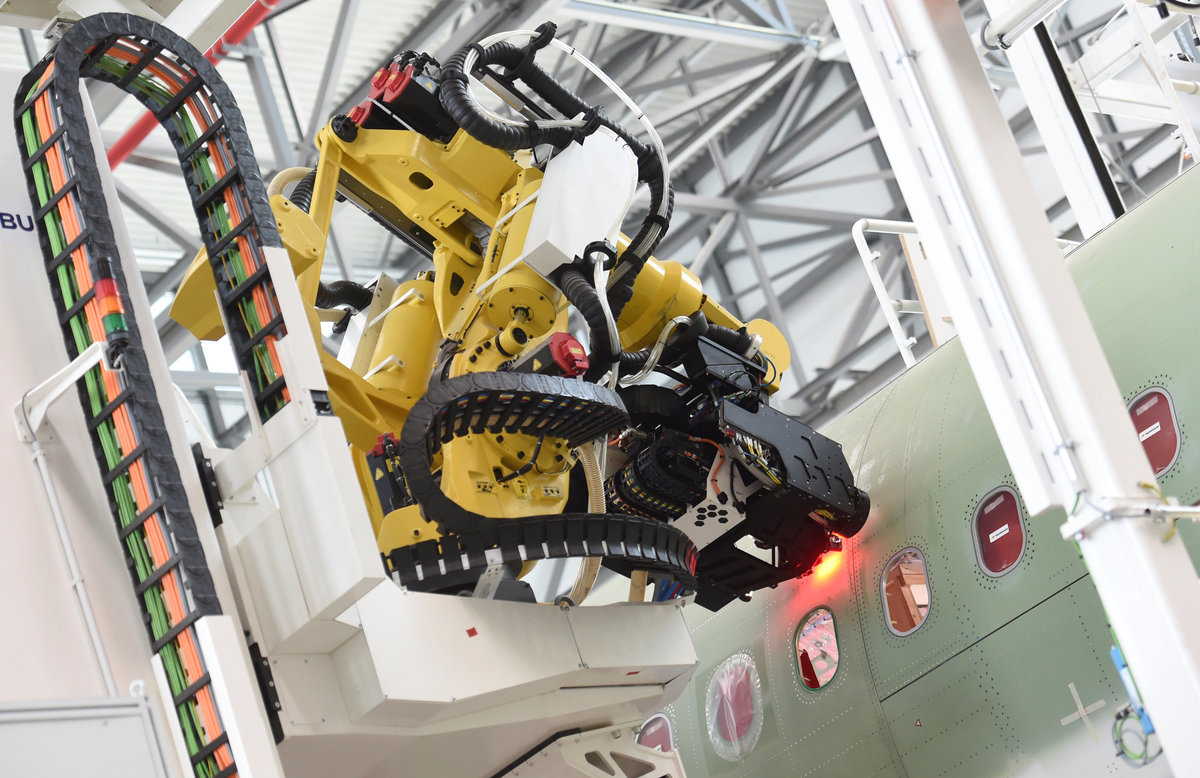
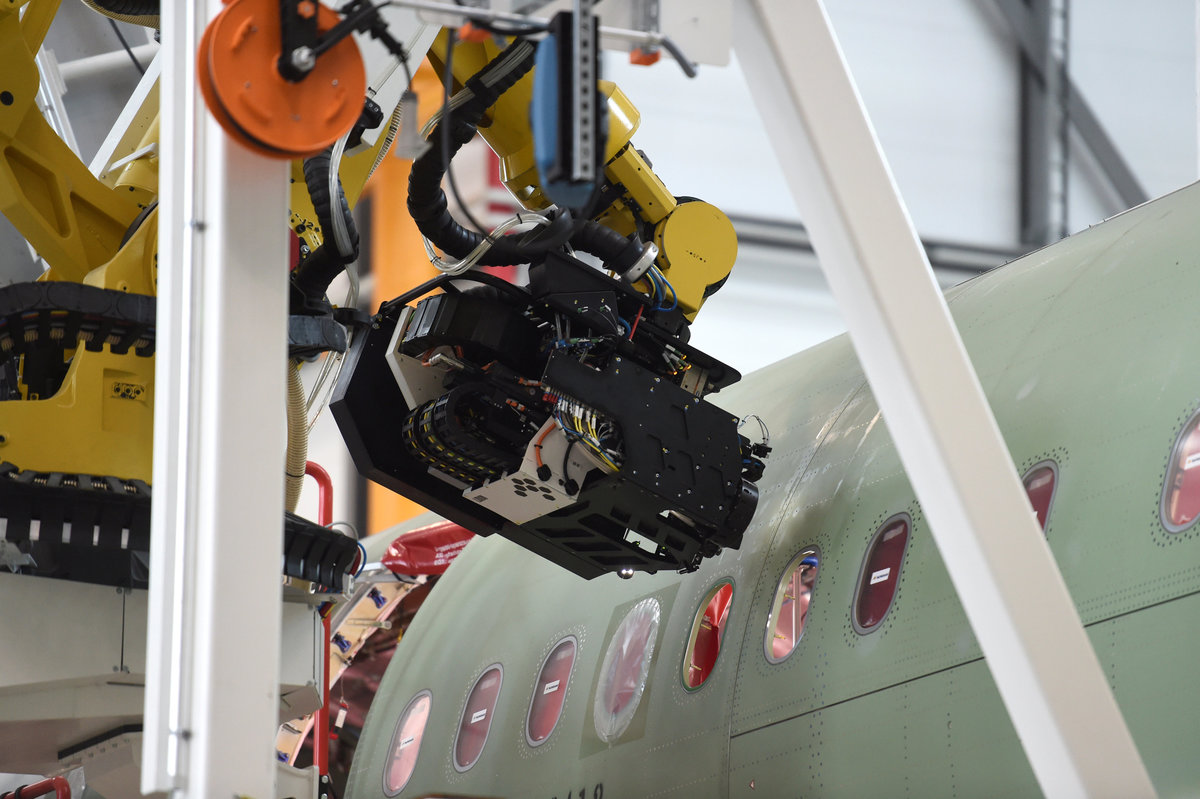
HAMBURG (Reuters) - European planemaker Airbus inaugurated a new production line for its best-selling A320 jet with robots Luise and Renate joining human workers as it turns to new automation to help it deal with an eight-year order backlog.
Airbus hopes digital technology will enable higher production and trigger a significant shift in research and development spending toward high-tech manufacturing.
The planemaker is ramping up production of the single-aisle A320 jet, which competes with Boeing's 737, from 50 to 60 planes per month. Airbus has sold 8,000 of the jets with another 6,000 on order.
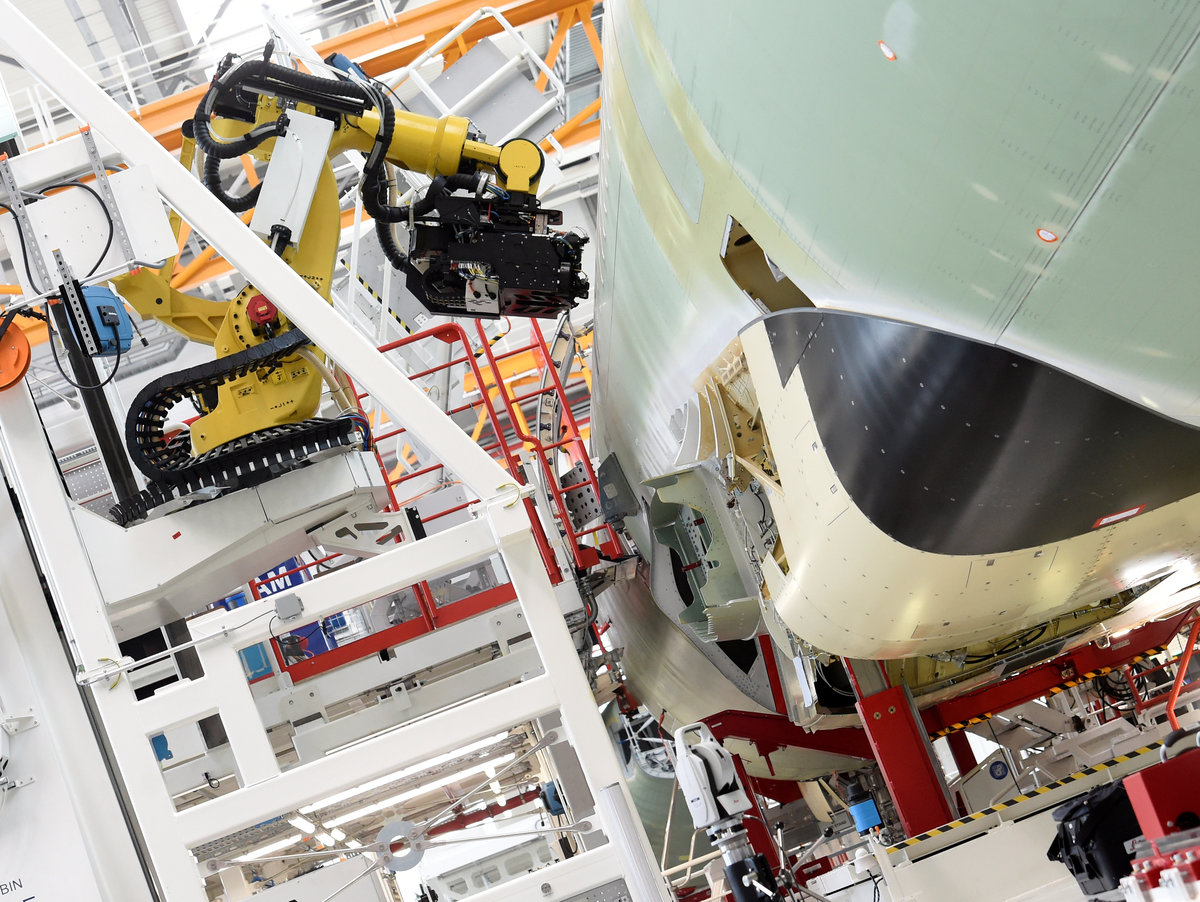
The new final assembly line in Hamburg, like other lines, has a top rate of 10 aircraft per month, which it will reach by mid-2019.
The two robots, whose names were chosen by employees, will in particular help to drill over 2,000 holes to join the two halves of the fuselage together, work normally done by humans.
They form part of a new final assembly line where the fuselage and wings are transported by automated moving tooling platforms, rather than being lowered by cranes onto fixed jigs, and where dynamic laser tracking is used to perfectly align aircraft parts.
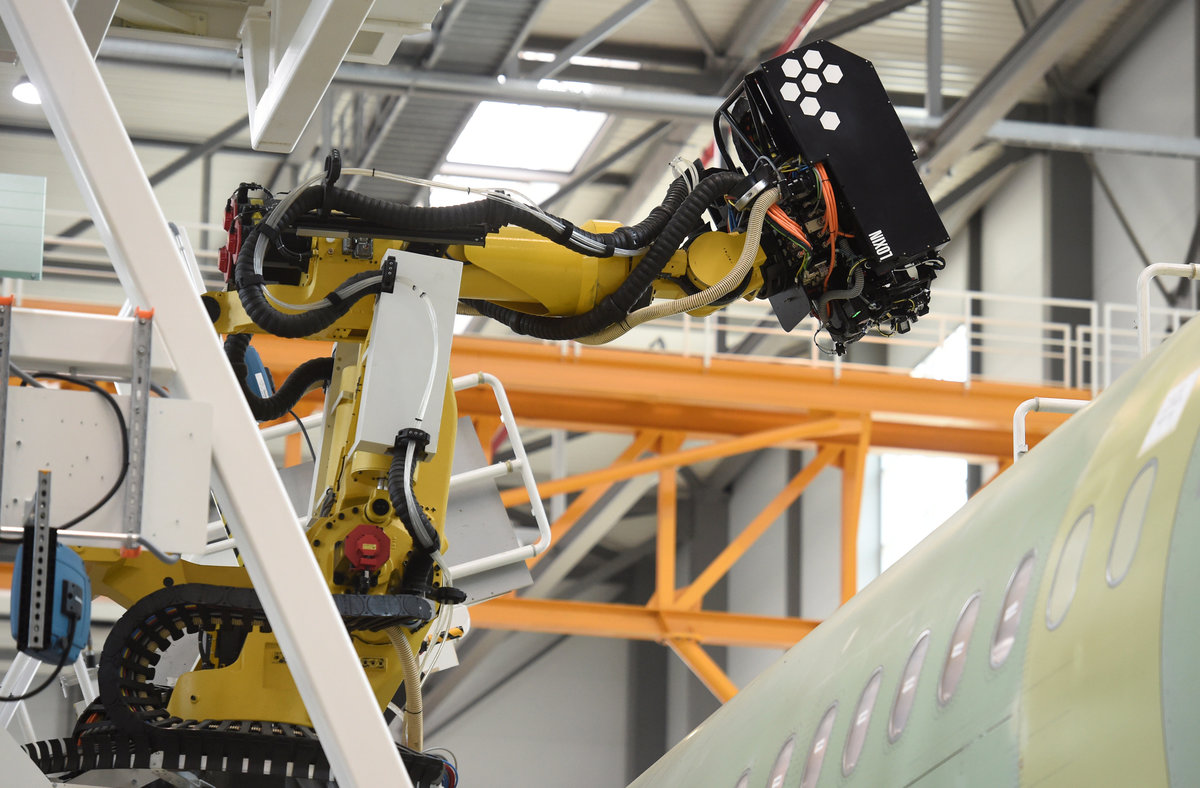
The savings from the new technologies are not about time, but about precision and ergonomics, Airbus staff said.
"It's more efficient when you are not drilling all holes by hand," Klaus Roewe, head of the A320 family program, told reporters in Hamburg, saying that the other new technologies for maneuvering parts would help to reduce the likelihood of damage or errors.
Roewe said around one-third of the new technologies on the new final assembly line could potentially be transferred to other lines, whether in existing ones in Hamburg, France, China, or the United States.
"The priority is to ramp up and then we will start thinking about what we can transfer," he said.
Airbus has also extended and modernized its delivery center for the A320 family in Hamburg as part of plans to help it deal with the production ramp-up.
(Reporting by Victoria Bryan; editing by David Evans)