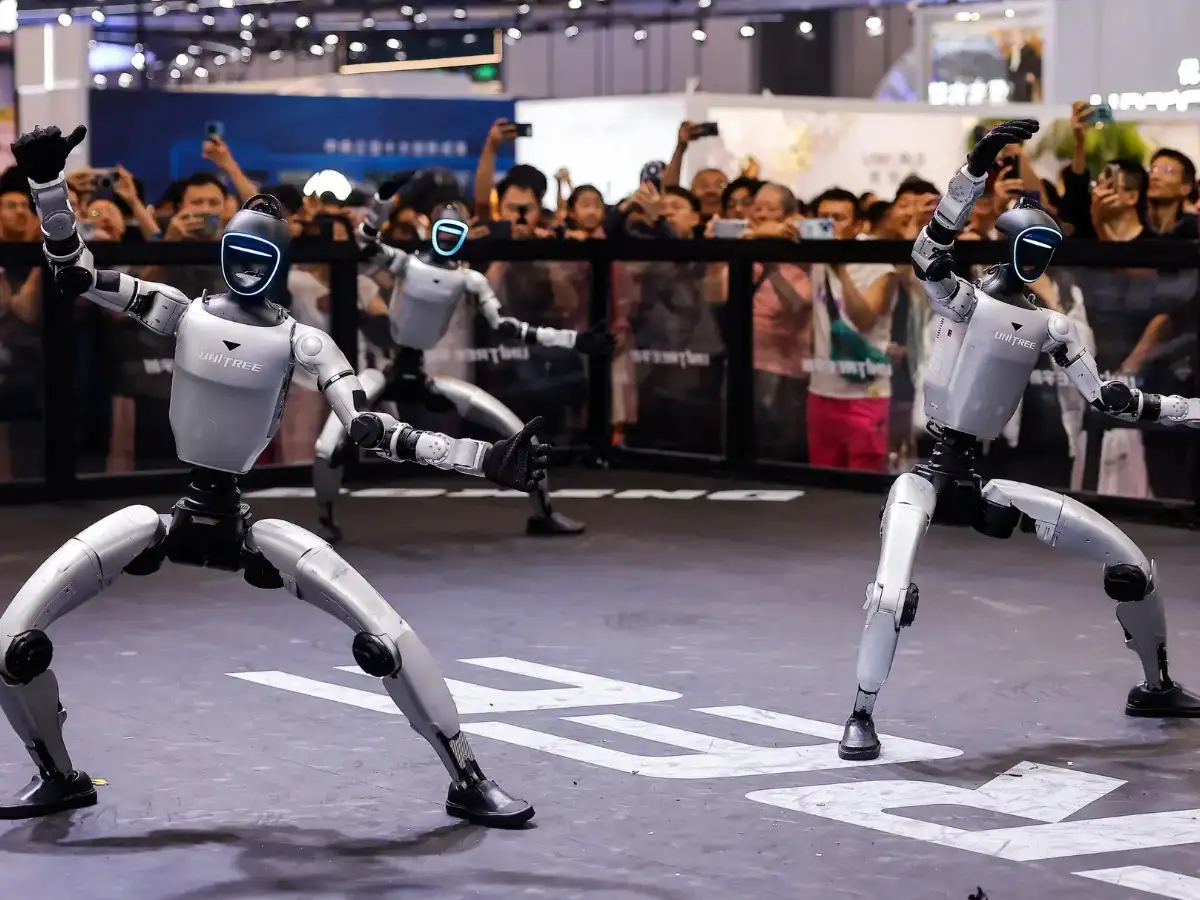
China's robotics industry has had a remarkable few days. China may not match what goes on inside Tesla, which makes Optimus humanoid, or Boston Dynamics, which is known for its humanoid Atlas, but on the ground it may be winning the robot race, for now.
Recent reports describe how in Hangzhou a 1.88-metre wheeled "Robocop" is policing traffic, with 15 machines reportedly issuing more than 170,000 warnings since May. In Shanghai, Unitree's shares surged as much as 629% on their debut after an IPO that was more than 8,000 times oversubscribed. Two days earlier, Unitree had unveiled "Superman", a biped that can jump two metres from a standing start and reach 12.66 metres per second, faster than global record holder athlete Usain Bolt. In Beijing, more than 300 companies are showing thousands of robots at the World Robot Conference, underlining a shift from robots that perform spectacular tricks to machines being tested for actual work.
ALSO READ | China replaces traffic police with robocops: Wheeled robot warns helmetless riders and monitors traffic
China's robot story unfolds on the ground
The most revealing machine in this week's news may not be Unitree's Superman. It is the T2 traffic robot operating on Hangzhou's streets. Developed by SUPCON Information, the 98-kg machine uses cameras, radar and onboard computing to detect helmetless e-bike riders, passengers on e-bikes, vehicles crossing stop lines and pedestrians ignoring traffic signals. SUPCON says its 15 deployed robots have issued more than 170,000 warnings since May and helped cut monthly cases of helmetless riding and stop-line violations by more than 40%. The company plans to expand the fleet to 200 machines across eight cities in three provinces by the end of the year.
ALSO READ | China robot makers flock to Beijing show, seek path to mass adoption
The exact performance figures are company claims and deserve independent verification but the larger significance is clear. China is testing robots in repetitive jobs where lies the answer to the crucial economic question -- can a machine perform a task continuously and cheaply enough to replace or supplement human labour? That is more important than another viral robot demonstration.
The same transition is visible at the World Robot Conference. More than 300 exhibitors from across China, with Unitree, UBTECH, AgiBot, Leju Robotics, Galbot, LIMX Dynamics, RobotEra and SIASUN are among the companies displaying machines for factories, logistics, services and other applications. The conference is evidence of a broad robotics industrial ecosystem coming up.
China already has the manufacturing advantage
The US-China robotics contest looks very different when humanoids are put aside. China is already the world's largest industrial robotics market. The International Federation of Robotics says Chinese factories installed about 295,000 industrial robots in 2024, 54% of global installations. China's operational stock exceeded 2 million machines.
The US installed roughly 34,000 industrial robots that year. China therefore accounted for roughly 8.6 times as many new installations.
The US has an important advantage in robot density, with about 307 industrial robots per 10,000 manufacturing workers compared with 166 in China. That reflects America's highly automated factories and smaller manufacturing workforce. But China has the much larger installed base and, more importantly, the world's biggest market in which robot makers can learn, compete and scale.
Chinese manufacturers are also taking a growing share of their home market. They accounted for 57% of domestic industrial robot installations in 2024, up from roughly 28% a decade earlier. This industrial base counts because humanoids require a formidable collection of components such as motors, actuators, reducers, batteries, sensors, power electronics, controllers and computing hardware. China already has enormous manufacturing capacity in many of these areas.
That gives Chinese robotics companies a dense local supply chain, something that cannot be built overnight.
Unitree shows what cheap robotics can do
Unitree is the clearest example of this model. The company sold more than 5,500 humanoid robots last year, according to figures cited by the Financial Times, alongside a much larger business in quadrupeds. Its inexpensive robots have become popular with researchers because they provide relatively cheap physical platforms on which developers can experiment with locomotion, manipulation and AI.
That affordability is strategically important. A university or startup can buy a Chinese robot, put its own software on it and start gathering real-world data. If hardware costs $10,000 rather than $100,000, far more researchers can experiment and far more machines can be deployed.
Unitree's new Superman robot illustrates the other side of China's advantage, a rapid hardware iteration. The company says it developed the machine in a little over three months. Its claimed top speed of 12.66 metres per second would exceed Usain Bolt's peak speed of about 12.4 metres per second during his 2009 world-record 100-metre run. It can also jump two metres vertically from a standing position.
The Bolt comparison is mostly marketing. Speed is not intelligence and it is not necessarily useful labour. But the development time is revealing. Chinese companies are becoming increasingly adept at turning robotics research into physical products quickly.
Then came the extraordinary IPO. Unitree's shares opened at 150.8 yuan and rose as much as 629%, eventually closing 460% above the offer price. The company's valuation briefly reached tens of billions of dollars. Retail demand was more than 8,000 times the shares available.
That valuation should not be mistaken for proof of current robotics economics. The Financial Times notes that Unitree's business is still heavily dependent on relatively inexpensive robots, while humanoids remain expensive and largely focused on research and development. The market value reflects expectations about future robotics rather than today's profits.
But the IPO reveals how strongly Chinese investors have embraced robotics as a strategic technology.
Unitree is not the whole story
The most important development may be that Unitree is no longer an isolated success. AgiBot has reportedly overtaken Unitree in humanoid shipments. Industry estimates put AgiBot's first-half 2026 shipments at roughly 8,400 units, giving it about 44% of the global market. Overall global humanoid shipments reached roughly 19,100 units in the first half, with Chinese companies accounting for about 97%.
Those numbers need some caution because the definition of a "shipment" does not necessarily tell us whether a robot is producing useful economic output. But the scale is still striking.
China's robotics ecosystem includes UBTECH, which is pursuing factory and service applications; Galbot, which focuses on warehouse work; Leju Robotics, whose KUAVO is aimed at industrial applications; LIMX Dynamics; Fourier Intelligence; RobotEra and others. A broad field of companies is targeting everything from parcel sorting and factory automation to eldercare and logistics.
The Financial Times reports that more than 90 robot training centres have emerged across China by mid-2026. These centres are often backed by local governments and robot makers. They buy robots, use teleoperation to generate training data then sell that data back to manufacturers.
This model has obvious risks. Much of the current demand is policy-supported rather than purely commercial. Training centres buying robots does not prove that factories will eventually buy them because they generate attractive returns. But it does give Chinese companies a large domestic environment in which hardware and software can be tested repeatedly.
America still has the best brain
None of this means Chinese robots are simply better than American robots. The US remains extraordinarily strong in artificial intelligence, robotics research and software. Boston Dynamics has demonstrated advanced robotic movement for years. Tesla is developing Optimus around its experience in AI, computer vision, batteries and manufacturing. Figure and other American companies are pursuing humanoids designed to work with increasingly capable AI systems.
The ultimate challenge in humanoid robotics is not walking. It is understanding. A useful general-purpose robot has to recognise unfamiliar objects, interpret instructions, navigate changing environments, manipulate things it has never seen and recover when something goes wrong. That increasingly becomes an AI problem.
The US has an enormous advantage in foundation models, AI research, computing infrastructure and semiconductor design. If embodied AI makes a major leap, that advantage could become decisive.
Tesla's Optimus is therefore a particularly important counterweight to China's manufacturing lead. Tesla is not merely trying to build a good humanoid but also betting that a combination of AI and mass manufacturing can eventually produce a capable robot at enormous scale.
Boston Dynamics represents a different American strength. Its Atlas platform demonstrates how far frontier mechanical engineering can go. But the strategic question is no longer simply who can build the most impressive machine. It is who can manufacture enough capable machines cheaply enough to make them economically useful.
China's advantage could matter more than robot IQ
Imagine an American humanoid that performs 90% of a broad range of tasks but costs five times as much as a Chinese robot that performs 70%. The cheaper robot could still win.
A robot that completes a task adequately for $10,000 may create more economic value than a machine that performs the task brilliantly for $100,000. Robotics is ultimately an industrial technology, so cost, reliability and utilisation matter as much as raw capability.
China's experience in electric vehicles offers a useful analogy. Chinese companies did not need to invent every element of the EV. They built a manufacturing ecosystem around batteries, motors, electronics and supply chains, competed fiercely in a huge domestic market and drove costs down. And robotics could follow a similar path.
The Chinese strategy does not require Unitree to build the world's smartest humanoid. It requires Chinese companies to build robots that are good enough, cheap enough and plentiful enough to be deployed everywhere. That creates a feedback loop. Lower prices lead to more robots. More robots generate more physical-world data. More data can improve software and hardware. Better robots increase demand and production volumes.
The US has enormous advantages in the intelligence layer but China has an unusually strong position in the physical layer.
The recent US ban creates a dilemma
Washington's recent restrictions on foreign-made advanced robots underline the strategic stakes. In July, the Federal Communications Commission added foreign-produced advanced humanoid and quadruped robots to its Covered List, preventing new affected models from obtaining the authorisation generally required for US sales unless they qualify for an exemption or other approval. National security concerns include possible surveillance, cyber risks and remote control.
The measure is formally country-neutral but its biggest practical target is China because Chinese manufacturers dominate the humanoid market.
But an uncomfortable side effect has emerged. American robotics startups and researchers have often used inexpensive Chinese hardware because it allows them to experiment without designing every motor, actuator and electronic component themselves. Restricting access to that hardware may protect domestic manufacturers but it can also force startups to spend scarce capital on robot hardware instead of AI, applications and autonomy.
China is trying to make physical AI cheaper by putting more robots into the real world. The US is trying to prevent Chinese hardware from becoming embedded in its own robotics ecosystem.
The Robocop could become a global product
This is why the Hangzhou traffic machine matters beyond traffic policing. The future "Chinese Robocop" does not have to be a humanoid police officer. It can be a specialised machine that performs any physical job in any public or industrial environment. Traffic enforcement is one example. Security patrols, infrastructure inspection, warehouse work, logistics, delivery and emergency response are others.
China could eventually produce entire families of inexpensive robots designed for narrow tasks. A city might not need a $100,000 humanoid capable of doing everything. It might want a $15,000 machine that patrols a parking area, detects violations and alerts a human. A factory might not need a general-purpose robot either. It may need a cheap machine that performs one repetitive operation for 18 hours a day.
This is where Chinese manufacturing scale could become globally significant. The US may develop the better general-purpose robot but China would manufacture millions of robots that are slightly less capable but dramatically cheaper. If that happens, Chinese machines could become the physical platform on which companies around the world build their own AI and applications.
China still has to prove that robots can make money
The biggest caveat to Chinese strides in robotics is economics. Today's humanoid robots are still expensive, have limited battery endurance and often perform better in demonstrations than in ordinary work. The Financial Times has warned that Unitree's spectacular valuation bears little relationship to its current earnings and that many humanoids remain primarily research platforms.
Reuters too reports that current humanoids are still less efficient than human labour in many applications. The next stage of the industry will therefore be less about spectacular demonstrations and more about proving that robots can work reliably for long periods and generate a return on investment. That test will determine whether China's current lead is durable.
If Chinese companies can solve autonomy while maintaining their manufacturing advantage, the US could face a formidable competitor. If Tesla, Figure or another American company achieves a major breakthrough in embodied AI and combines it with large-scale production, the balance could shift rapidly.
The future may split the robotics race in two
The simplest way to understand the emerging US-China robotics equation is America may have the stronger brain while China has the stronger muscle. That does not mean the US will lose to China in robotics. It means that the traditional measure of technological leadership may become inadequate.
A brilliant robot that costs too much will remain a laboratory machine. A cheap robot that cannot work autonomously will remain a specialised tool. The decisive combination is intelligence plus manufacturing scale.
That is why the most important question is not whether Unitree's Superman can outrun Usain Bolt or whether Optimus can perform a more impressive demonstration. It is whether either country can produce millions of robots that work reliably enough to replace meaningful amounts of human labour.
Unitree's CEO Wang Xingxing says robotics could be approaching a "ChatGPT moment" in which robots can understand ordinary instructions and perform unfamiliar tasks. He also says that breakthrough could still be two to ten years away. Galbot's founder has suggested 2028 as a possible turning point. These are predictions, not facts, but the industrial race is already underway.
China has more than 2 million industrial robots in operation, accounts for roughly 54% of annual industrial robot installations and now supplies the overwhelming majority of humanoid shipments. Its companies are putting machines into factories, warehouses and public spaces while investors pour capital into the sector.
The US still has exceptional advantages in AI and frontier robotics. The risk for America is therefore not necessarily that a Chinese humanoid becomes smarter than Optimus. It is that China produces a robot that is good enough, cheap enough and abundant enough to be everywhere.
That is the real meaning of the Chinese Robocops taking over the world. America may build the best brain but China is building the muscle to put robots into the physical world.