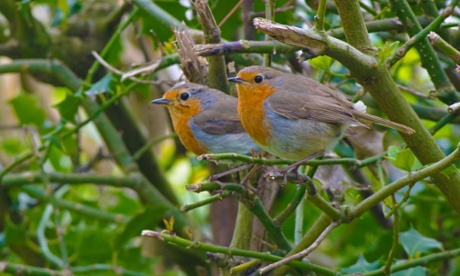
It’s territorial, chippy and punches above its weight – and that’s why Britons have voted for the robin to be the country’s national bird, according to the organiser of a nationwide poll.
More than 224,000 people cast their ballot in the National Bird Vote, organised by “urban birder” David Lindo, which finished on the day of the general election.
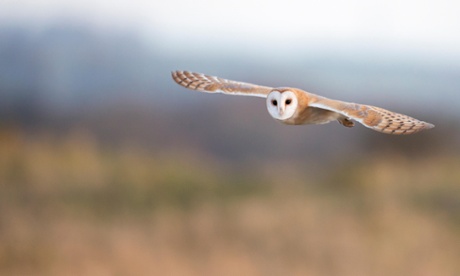
The robin won by a significant margin, taking 34% of the vote from a shortlist of 10 of Britain’s most familiar and beloved birds. The next most popular birds were the barn owl and blackbird at 12% and 11% respectively.
Lindo, who was openly critical of the robin in the final days of voting, said he had secretly hoped the blackbird would win.
“If the truth be known it would be great if something else had won, like a blackbird, but I’m very happy still that a robin has been confirmed as Britain’s national bird. I think it’s good and I think it’s a bird that we can be proud of and hoist up on our shoulders now.”
The robin is known for being openly aggressive towards birds it competes with for territory and food, and can kill them on occasion. Lindo attributed the bird’s popularity to a small island mentality.
“Despite being a seemingly friendly bird, the robin is hugely territorial and very defensive of its territory and I presume that reflects us as an island nation that we will stand our ground,” he said.
Lindo said he hoped the government would now act to bestow official honours on the robin. Britain does not currently have a national bird, in contrast to Sweden’s blackbird, the US bald eagle, France’s rooster, Japan’s green pheasant and India’s peacock.
Grahame Madge, RSPB spokesman, said it was the robin’s ubiquity that nudged it ahead. “Our birdlife is rich and varied, but perhaps it is no surprise that it is the robin which has stolen our hearts. It is the bird which summer and winter wherever you are in Britain is only a flutter away from our footsteps: a worthy winner.”
The recently-appointed environment minister, Rory Stewart, said: “The robin is synonymous with the British countryside and I’m delighted that so many people voted in the poll to name it their favourite bird.”
Lindo said the hen harrier, which came ninth out of the shortlist, was a notable inclusion. The bird has almost disappeared from England - just four pairs managed to nest successfully last year. It has been targeted by grouse moor gamekeepers as a predator of grouse and a competitor of shooters.
Lindo said the hen harrier was only vaguely known among the wider public despite a “massive movement” to try and protect it among conservationists. “Many people would have gotten to know about its plight” through the vote, he said.
Mark Avery, a conservationist and former RSPB director, said: “Three cheers for the robin – a lively bird and always the strong favourite to win this popular vote. But let’s hear it for Britain’s most-persecuted bird, the hen harrier. When will Defra act to end the illegal persecution of the nation’s ninth favourite bird?”
Lindo said the level of participation had been “incredible” and had twice crashed the site he had set up to receive votes.
In a separate poll at Knowsley Safari Park, a wildlife park just outside Liverpool, 500 children under 15 were asked to identify Lindo’s 10 most popular birds by their photographs. Less than half had seen the all of top 10 birds. But more surprisingly, only a third of the children believed that all were actually British.
Rachel Scott of the park said the results, which showed that robins and swans were easily identified but non-urban birds were unfamiliar, showed children were in need of reconnection with the natural world.
“The British bird population is a mixture of waterfowl, predators, scavengers and songbirds. Finding a space where children can pay attention to what’s soaring and swooping over their heads is the best way to encourage their interest in native birds,” she said.
“It does signify a disconnect,” Lindo agreed. “But it’s not about what you know in terms of what you can name. Its about your openness to it, for me. You don’t have to be an expert to be involved in nature. It’s about being out there and being immersed in it and I think that knowledge will come by osmosis.”