
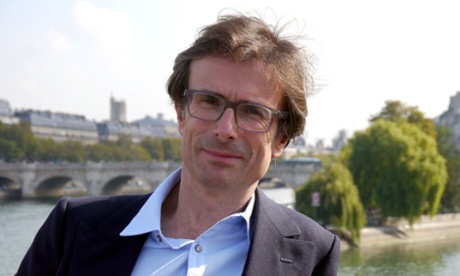
The BBC’s excellent economics editor, Robert Peston, has revealed that, early in his TV career, he was sent on several broadcasting courses in an attempt to correct “eccentricities” of speech that had irritated columnists and commenters. This reprogramming failed, he reported, but all thoughts of further therapy were abandoned when he became a screen star through his coverage of the global financial crisis.
The moral of this story seems to be that the BBC wanted him to sound like other news reporters but that the audience accepted his alleged imperfections once he had interesting enough things to say. As Peston sagely points out in the Radio Times interview, his distinctive delivery became his signature: “My eccentricities became quite a useful thing, because people knew who I was.” There’s clearly something in this: the BBC TV news reporting roster contains numerous men who smoothly speak in standard TV journalistic rhythms but who are never likely to be interviewed by magazines or impersonated by Jon Culshaw.
Peston’s repeated use of the word “eccentricities” to denote aspects that his employers considered problematic will worry some observers because it suggests that news editors have imposed a vocal norm against which presenters are measured. This would raise particular concern because there is a long history in television – from the historian AJP Taylor to the baking specialist Mary Berry – of people who have become star broadcasters through ignoring almost every rule of on-camera success.
It’s important, though, to separate different kinds of unusual screen manners. Some televisual eccentricities are deliberately adopted: John McCririck’s hat, whiskers and tic-tac signals; Sir Robin Day’s bow-tie; Jon Snow’s vivid neckties; Paul Merton’s refusal to smile, and Anne Robinson’s hacksaw voice. These are examples of personality branding – an attempt to stand out from the crowd.
Peston’s elocution is clearly not in that category. He has never spoken in a particular way for theatrical effect; his delivery on screen was essentially the same as it was when I knew him as a print journalist almost 30 years ago. The slight snaggings and elongations of words are a natural idiosyncracy or impediment of speech, perhaps slightly exaggerated early on by the inevitable tension and projection of live broadcasting. If they didn’t want him to sound like that, they shouldn’t have hired him.
For example, it seems likely that Ed Balls, as a former journalist whose career in politics has just ended, will soon be fronting radio and TV programmes. And, if so, let’s hope producers and consumers are mature enough to accommodate Balls’s controlled but occasionally audible stammer. Oddly, although you might intuitively assume that broadcasting will have become more tolerant of speech impediments over time, the panel show Call My Bluff, throughout the 1970s, accommodated the stammering Patrick Campbell as a team captain.
And even adopted eccentricities of speech are not necessarily a bar to comprehension. Some of the greatest stage actors – including Laurence Olivier, Paul Scofield and James Earl Jones – became memorable speakers partly due to their use of unexpected emphases and interrupted rhythms, which encourage greater attention than a voice of metronomic regularity would.
Beyond verbal nonconformities, there is a group of broadcasters who are considered completely as “eccentrics.” In the early decades of the medium, Professor AJP Taylor, the journalist Malcolm Muggeridge and the scientist Dr Magnus Pyke became unlikely stars, although ignoring all of the developing conventions about how a successful TV performer should look, sound and dress.
And the ability to be unchanged by the camera’s gaze seems to be crucial to becoming a successful TV eccentric. Just as Taylor, Pyke and Muggeridge carried on in the studio much as they might have done in an Oxbridge common room or private members club, the strange cook Fanny Cradock and the bizarre dog-trainer Barbara Woodhouse gave the impression that you were getting them as you would have found them in a kitchen or kennels.
An ignorance of TV – or even contempt for it – also seems to help. Muggeridge was famously dismissive of the medium, except when appearing on it, and Tom Paulin, a man so otherworldly that he would have struggled to turn on a TV set, persuaded many to tune in to late-night arts shows because he spoke instinctively rather than in a manner learned from watching other people doing it. Mary Berry, you suspect, wouldn’t do very well in a quiz on EastEnders – but has proved to be a TV natural simply by being her wise, kind self. There are two types of rule-breakers – those who know the lines they’re crossing and those who don’t – and the best telly eccentrics tend to be in the latter category.

In the context of Robert Peston’s comments, it’s also worth observing that Taylor, Woodhouse, Paulin and Berry would surely all have been much less effective performers if they had ever been sent on a training course.
But, if the BBC is becoming more hesitant about eccentrics, it would be easy to understand why. Three presenters who traded heavily on their on-screen wackiness – Stuart Hall, Rolf Harris and Jimmy Savile – are currently serving lengthy times in either jail or the most infernal regions of any afterlife for paedophile offences. In retrospect, Savile, Harris and Hall seem to have been playing a sort of double bluff: suggesting that, if they were so peculiar on the surface, they were unlikely to be hiding anything underneath.
As a result, extreme and cultivated eccentricity may perhaps be treated with suspicion by producers and viewers. Those men, though, had all created a persona for televisual effect and perhaps distraction from their true personalities. The other cases are quite different. Being yourself on the screen – even if it involves not speaking as other TV talking heads do – should not encourage attempts at re-education.
The Robert Peston Interview Show (with Eddie Mair) starts on Radio 4 on Monday 8 June.




.png?w=600)








