Hi Rob. So why are you doing a show on the brain?
Firstly, there’s lots of really exciting progress in brain science now. But at the same time, the ways in which it’s being interpreted in the pop science books is trying to force humans into a small mechanical box, and it’s quite ominous. Ever since Charlie Chaplin fell into the cogs in the assembly line in Modern Times, there has been comedy about humans refusing to be put in a mechanical box. So the show celebrates the science but deplores the interpretations.
What’s The Brain Show about?
It’s about how, after being a volunteer subject in a brain-imaging experiment, I emerged with more questions than answers, such as: “Are we our brains?” If there are more connections in our brains than atoms in the universe, then why are we spending €1bn mapping the brain in the European brain-mapping project? It’s unmappable, right? My quest to find answers to these questions takes me and the audience from Alan Turing emerging white as a sheet from a Blackpool fortune-teller’s tent, to Isaac Newton having a complete meltdown at Sturbridge county fair.

What is the brain sensor that you wear during the show?
An electroencephalograph. It’s supposed to give accurate readouts of my mental states during the show, by way of flashing lights of different colour, frequency and intensity. Only it is a bit temperamental …
So, as with your show The New Theory of Evolution, you’re taking on popular theories?
Well in pop science there are a lot of people who see what they want to see – that inequality is natural, women are better suited to servile jobs, people are fundamentally nasty. Some of it is troublingly racist, too.
Are you a naturally sceptical person?
My hero Bertrand Russell said that if you are certain about anything, you’re certainly wrong. And what I loved about science was that it was tentative, it was always suggesting. That’s science at its best. Now it’s become cut and dried and decisive, so the more certain they get the more sceptical I become. That helps as a comedian, too, as they’re getting funnier – certainty is always funny.
What’s your scientific background?
I like to think that my O-level paper is still being read in some academies. I was in the acknowledgements in a paper published in Nature this year, about defining the anthropocene. My interest really is in the philosophy of biology and interpretations of science, mainly because there aren’t as many equations.
When do you research?
My golden hours are between 5.30am and 7.30am before my daughter wakes up. I had two or three years when I was the primary carer of my daughter, and that’s when I was reading demanding things. I’d spend all day at the swings, so I wanted to use my brain for an hour. It helps not having a telly in the house because if I get a boxset my wife and I are just like junkies, we want to watch the whole thing in 24 hours.
What’s your definition of success now?
That’s a scary question, so easy to say something you’d regret horrifically afterwards. I think I’m aware of the vast ocean of my own ignorance, so I’m just trying to make that less awesome. There’s always the elation of doing a gig that goes really well. There’s still no joy like a new bit of material that you didn’t think would work, then goes over really well live.
If The Brain Show suddenly went huge and you got the chance to do it at Wembley Arena, would you do it?
No one ever has a good experience in a stadium. I’ve never enjoyed it; you lose the whites of the eyes. When the Clash were the biggest band in the world they headlined seven nights at the Lyceum theatre, which is about 2,000 people. I’d probably do something like that.
Who are your favourite comedians today?
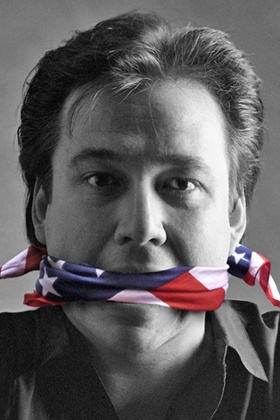
I love Dave Chappelle, how often he has to wait for you, he sort of slowly drops the joke out of his pocket on to the floor. I like Bridget [Christie] and Josie [Long], they make me feel less lonely doing my thing. Bill Hicks was a favourite and I regret not letting him support me when he wanted to.
When was that?
In the 90s, the last tour that me and David [Baddiel] did. Bill Hicks wanted to support us. For me it was like what Elvis Costello said when the Specials offered to support him – there wouldn’t be any stage left for me to play on. We missed meeting him several times, it would have been nice to meet your favourite comic.
Your shows are very ideologically driven, and you’ve been described as a political activist – are you?
No, not at all, but I have been really influenced by Reclaim the Streets and their whole philosophy. I can’t put into words how important that whole movement was for me. I didn’t do much in the way of marching, but it was totally inspiring and introduced me to a lot of influential stuff.
• Robert Newman’s The Brain Show is on a UK tour. His Radio 4 show, Robert Newman’s Entirely Accurate Encyclopaedia of Evolution, continues on 22 October.