1) On being a pundit
To Robbie Savage’s credit there are plenty of times within his new book, I’ll Tell You What … that he exhibits the everyman touch that some believe is the secret to his career. He can sum up the mood of a nation with a simple phrase. “I sometimes wonder how I ended up being a pundit,” he writes at one point.
Savage says it his role to inform, entertain and to get people to disagree with him. “It’s no use stating the obvious,” he writes, “you have to try to tell people something they didn’t already know.” To that end, he has built an office at his house so that he can do research. “But because I love the game, it’s not a problem,” he writes.
“It takes a certain kind of person to be a pundit and it won’t surprise you to know that I am that person,” he writes later on. While Savage is definitely a certain kind of person, he did rely on others when he started as a pundit, and admits to cribbing Lee Dixon’s stats before going on television. And Alan Shearer’s. And Michael Owen’s. “There’s nothing worse than a pundit who won’t share their research,” he reveals. But when he gets down to the brass tacks of his punditry style, it is this: “Where would we all be without a bit of banter?”

2) On dividing opinion
Savage revels in being football’s “Mr Marmite” and uses the phrase a lot. “I divide opinion like Moses divided the Red Sea,” he writes in the opening lines of the book. “That’s me all over. If I have colours, they’re nailed to the mast – big time!”
Being called Mr Marmite, he says, is the biggest compliment he could be paid. “It means you’re stirring things and creating debate,” he reasons. “What’s the point of sitting on the fence?” But it does come at a cost. “There are several people who no longer speak to me because of something I’ve said,” he writes. “That’s the price you pay for being honest but it’s the only way I can be.”
But Mr Marmite sometimes finds it hard when he is criticised. “If you want the truth about this I get really badly affected by some of the stuff that gets written about me,” he says, though he does accept it is part and parcel of what he does. One critical newspaper article made it into the hands of his son who was upset, and Savage had to explain that abuse is something he must take on the chin. Still, he was irritated by the piece. “The journalist involved seemed to be incapable of presenting a reasonable, intelligent argument and instead went for the lowest common denominator,” complains Savage, who five pages later writes: “I used to have this annoying habit where, if I didn’t agree with what somebody was saying, I would just stick my fingers in my ears, close my eyes and say, ‘Not listening, not listening, not listening’.”
3) On Messi v Ronaldo
Savage is not entirely sure whether Cristiano Ronaldo or Lionel Messi is the better player, and takes a chapter to weigh things up. “I used to think Ronaldo was the better player,” he writes, “but now it’s Messi.” But then he adds: “By the time I finish writing this chapter, I might be saying something different.” He decides: “If I was a manager. I’d actually pick Ronaldo.”
Still, there is hope for Messi. “Who knows? Perhaps Messi might get the chance to prove me wrong one day,” he concludes, offering the four-time Ballon d’Or winner plenty of motivation. Savage does suggest he would be happy to share the pitch with either Ronaldo or Messi, even if they were being paid more than him. “I honestly would not mind, providing they were putting in a full shift. In fact it would be a pleasure. But if I thought that they were just warming the bench week-in, week-out, and I was playing out of my skin for a thirtieth of what they were earning, I would be absolutely furious.”
4) On players’ wages
Savage is not afraid to defend Premier League players’ wages, which is perhaps not a surprise given there is later chapter called Me And My Cars in which he mentions the Bentleys, Porsches, Ferraris, Range Rovers, Lamborghinis, Mercedes, Hummers and Rolls Royces he has driven and the 50-foot yacht he once owned. In fact, he thinks footballers’ wages are on the low side and says Wayne Rooney’s reported £300,000-a-week salary is small fry compared to the wages of Formula One drivers, basketball players or NFL stars. “Wayne seems almost poor in comparison,” he notes.

5) On The Best League In The World
Savage believes the Premier League is still just about the best in the world, but is worried the big stars are shunning it. He has a theory as to why. “The problems the Premier League faces today have nothing to do with cash. If anything, they are more to do with the weather … [It’s] been shocking these past few years and I must admit it gets me down from time to time.”
Savage also has a theory on why English clubs can no longer compete in Europe, saying teams lack the ability to up the intensity currently. “Perhaps the English teams are now so full of foreign players that they don’t possess the required skill?” he argues. But largely he says the reason for the failure of English clubs in Europe recently has simply been bad luck, adding: “That might sound daft.”
6) On cheating
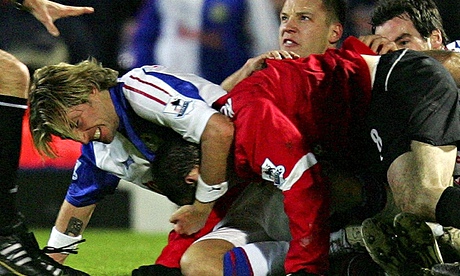
Cheating on the football pitch is fine, according to Savage. In fact, it’s not cheating, it’s gamesmanship. “As a professional footballer, you should do whatever it takes to win a game,” he explains. His reasons are not personal but altruistic. Teams that are relegated, he clarifies, can have a significant “knock-on effect for the town or city … more miserable faces would mean less productivity. The consequences are never ending.” There is a limit to his civic-mindedness, though. He says he now regrets throwing himself to the ground in the 1999 Worthington Cup final after Justin Edinburgh touched his hair – though does, jokingly add, “which in my book should be against the law.”
7) On England
Roy Hodgson seems like a nice man but should not be the manager of England. Savage’s main reason for this is because Hodgson did not go for the obvious choices of Ronaldo or Messi in his shortlist for the 2014 Ballon d’Or, but selected Javier Mascherano, Philipp Lahm and Manuel Neur instead. “What does that say about Roy Hodgson’s mentality,” questions Savage. He would make Glenn Hoddle England’s director of football instead, with Gary Neville, Phil Neville, Nicky Butt and “Scholesy if he was up for it” as a management team beneath him. “Get them on board!” he cheers.
He has considered management himself but doesn’t hold with the notion of having to take his coaching badges. “Coaching is not what being a manager is about,” he believes. Still, if a club did come calling he would give it a go because, as he says, “I miss the banter that you get in a dressing room.”
8) On his looks
“I attract attention. Is it done intentionally? Absolutely not,” he writes in a chapter entitled Vanity and in a book called I’ll Tell You What. Over several pages, he goes on to recount the story of him cutting off his long hair. “Having shorter hair certainly took some getting used to,” he writes. “I got in the shower, reached for the shampoo, and before I knew it, I was done!” Elsewhere he points out “I don’t really follow fashion, I create it.”

9) On chatting up a mop
When Savage writes about his playing days, he is on firmer ground. There’s the time he talked himself out of a transfer to Roy Keane’s Sunderland by leaving him an answerphone message saying simply: “Hi, it’s Robbie - whazzzuuupppp!. “I probably should have been a little bit more sensible,” he accepts.
As a Manchester United apprentice, Savage and his team-mates were often subject to punishments from the senior squad. “There was naked golf, which could be interesting,” he recalls. Players might be put in the kit room’s tumble driers for a spin, or placed face down on a massage table while other players took pot shots with a ball. One day, Savage was dared to chat up a mop. As one of the senior players repeatedly flicked the lights on and off to resemble a nightclub, a 16-year-old Savage was required to chat up a mop in front of the entire senior team. “To cut a long story short,” remembers Savage, “I was required to make love to a mop on a treatment table surrounded by several million pounds worth of international footballer. I wasn’t exactly what you would call skilled when it came to that sort of thing …”

10) On modesty
“Although I wasn’t handed the man of the match award, I had been the best player on the pitch,” begins one anecdote. Another includes the line “I turned myself into one of the most written about players the Premier League has ever had”. A story about Gary Lineker ends on this line, tongue in cheek: “People can’t resist talking about me – it’s a gift I suppose”. In one passage, Savage says: “Like it or not, I was box office. I created headlines, divided opinion and, most importantly of all, won football matches. I’ve said it before and I’ll say it again, to play in the Premier League for 11 years and captain every team you’ve played for, you have to be a great player. End of story.”
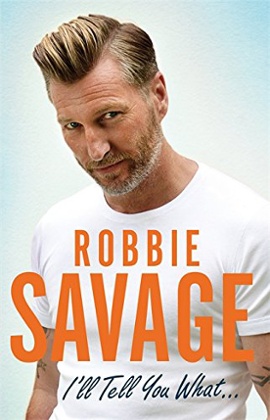
Extract from I’ll Tell You What… by Robbie Savage, published by Constable, out now