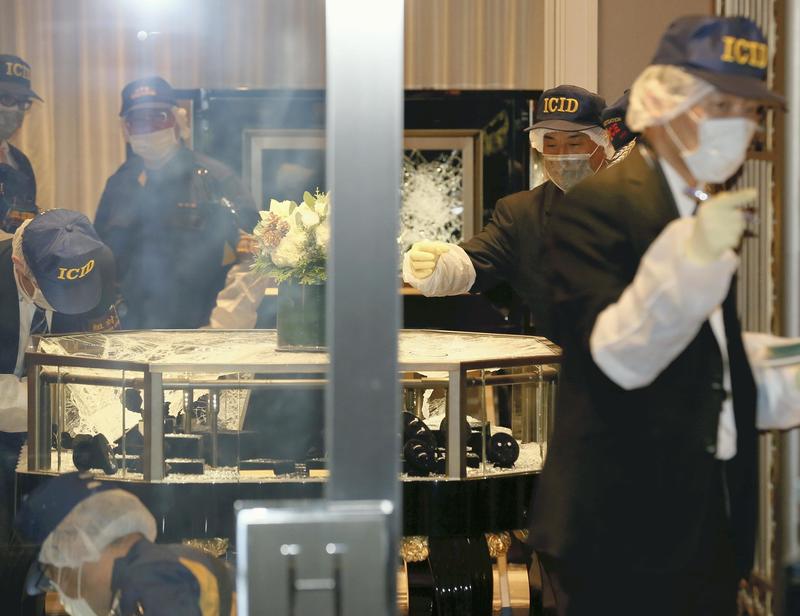
The extradition of three British nationals wanted for allegedly robbing a jewelry store in Shibuya Ward, Tokyo, in November 2015 is being discussed by Japanese and British police authorities, The Yomiuri Shimbun has learned.
The three men were put on an international wanted list for their alleged involvement in the heist, in which about 100 million yen worth of jewelry among other items was taken.
According to sources, both countries are now compiling the agreement necessary for extradition procedures.
If it is realized, it will be the first time a country that does not have an extradition treaty with Japan has turned over its citizens to Japanese authorities.
The robbery in question took place on Nov. 20, 2015, at a Harry Winston jewelry store in the Omotesando Hills, a commercial complex in Shibuya's Jingumae district.
The three men allegedly entered the store and punched a security guard, before breaking a showcase with a hammer-like object and taking 46 items worth a total of 106 million yen.
The Metropolitan Police Department examined security camera footage and immigration records, identifying the suspects as three British citizens aged 41, 33 and 23.
In October 2017, the MPD obtained an arrest warrant for them on charges of robbery resulting in injury and trespass, and put them on an international wanted list via the International Criminal Police Organization.
The United States and South Korea are the only two nations with which Japan has bilateral extradition treaties. If citizens of other countries commit crimes in Japan and return to their home countries before being arrested, securing their extradition is difficult.
According to investigative sources, the MPD initially tried to ask the British authorities to punish the suspects in Britain as the three men returned to Britain two days after the robbery,
While Britain has provisions to punish British citizens who commit crimes outside the country, as Japan does, robbery is not included in the scope of the British provisions.
For that reason, a senior MPD investigator went to Britain in the autumn of 2017 to ask the British authorities to hand over the suspects to Japan if they could not punish them in Britain.
The British side showed an understanding of the Japanese position and was positive about the handover request, according to the sources.
In Britain, it is said that there are precedents in which its nationals have been handed over to countries with which it does not have extradition treaties on condition that the charges are clear and that the countries seeking extradition have reliable justice systems, among other conditions.
With this in mind, the MPD sent investigation reports translated into English and evidence materials to the British authorities, and presented a draft agreement necessary for the handover of the suspects. In the autumn of 2019, the British side presented the MPD with an amended draft of the agreement.
According to sources, at least one of the three suspects was temporarily detained in Britain, but their current whereabouts are unknown. If the two countries reach an agreement, the British police are expected to search for their whereabouts, detain the suspects and complete extradition procedures so they can be turned over to the Japanese police.
Read more from The Japan News at https://japannews.yomiuri.co.jp/