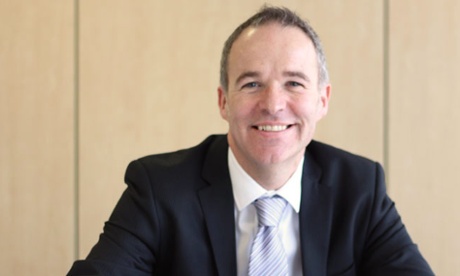
The NHS may or may not be the best health service in the world. But it takes the gold medal every time at the navel-gazing championships, according to the head of the NHS Confederation, the service’s leading representative body.
“What we are brilliant at is obsessing about our structures,” says Rob Webster, chief executive of the confederation, which this week holds its annual conference, bringing together more than 2,000 commissioners and providers of healthcare. “I’ve been in the NHS for 25 years and it’s what we’ve always done. We should really be obsessing about how to deliver better care or how to join up services, but if there is an opportunity to have a conversation about structures, we’ll have it.”
Webster is determined that this year’s conference in Liverpool should break that pattern. He intends to focus minds on the “massive change” that he says needs to happen if the whole health and social care system is to be made sustainable. But he emphatically does not mean structural change.
“We have the structures, the architecture, and we are making them work,” he says. “Let them mature. If they need to evolve and change, let those decisions be taken locally and for the right reasons. What we don’t want to see is some enforced re-engineering of CCGs [clinical commissioning groups] or health and wellbeing boards.
“We have stability of structures, we have stability and clarity of funding and we have stability of purpose with the Five Year Forward View and the public health priorities. That gives us the chance of making the change to care delivery that we need to make.”
That change, says Webster, amounts to nothing less than transformation of a health service that remains geared to “fixing you up and sending you home” to one that recognises that the typical NHS customer now needs continuing care and support for long-term conditions. “We’re dealing with a population that can’t be cured of being old, that won’t really ever be discharged from our care. The idea of discharge is redundant.”
The Five Year Forward View, which has won widespread support since it was unveiled late last year by the NHS England chief executive, Simon Stevens, and which even featured in last week’s Queen’s speech, embraces the imperative of such a shift. But Webster cautions that while it will be possible to “get somewhere” in five years, realising it in full is “going to take 10”.
Change must be woven into every policy and practice development, he argues. The government’s push for a seven-day NHS has to recognise that the goal cannot be replicating existing Monday-to-Friday services over the weekend, but reshaping those services. Similarly, any bailout of debt-laden hospital trusts such as King’s College, south London, which ended the last financial year £47m in the red, has to be strictly conditional on them adopting different ways of working.
“If King’s requires resources to be stabilised and change, which is what it is deep in the middle of, that’s great,” says Webster. “That’s part of the five-year game. But if we are just going to dole out money every year for crisis management, that’s failure.”
Hospital trusts have to accept that they can no longer behave as islands within the overall health and care system. And the change they face may not be easy. “But the NHS isn’t the National Trust,” says Webster. “If we treat it like the National Trust, if we preserve it in aspic, it will die.”
This time last year, the NHS Confederation called on the then coalition government for three key commitments: a 10-year funding settlement for the NHS, a £2bn transition fund to underwrite service change and parity of esteem between physical and mental healthcare. Arguably it has achieved the last – if only in terms of it being an official aspiration – and has got partway towards a funding settlement and a transition fund with David Cameron’s pledge of a minimum £8bn real-terms annual funding increase within five years in return for Stevens delivering £22bn worth of efficiency savings.
This year, Webster still has cash on his shopping list – for social care as well as the NHS – but he places it last of four items. “We usually start with the money and it’s the wrong place to start,” he says. “It’s incredibly important that we make money the servant of quality, not quality the servant of money.”
Third on the list he places a re-casting of the national/local relationship within the health and care system, enabling greater decentralisation. In second place he identifies a culture change so that people and communities are seen as assets, not problems. At the very top he puts the nurturing of health and care professionals, warning that NHS leaders have lost sight of the importance of a valued and motivated workforce.
“If you look back to 1999-2000, there was a real sense that we needed to say to people working in the NHS: ‘It’s a great place to work – you get a good career, good support and we’re interested in improving your working lives.’ I think we’ve lost some of that narrative. We need to get back to saying: ‘This is a place where you are the most important thing in the system.’ Why? Because the NHS is made of people.”
To give emphasis to this key theme, the conference is being preceded by a gathering in Liverpool of human resource directors of healthcare providers. They will be encouraged to stay on to contribute to the main event. “Let them have the conversation,” says Webster, “but then let’s make it mainstream at the conference.
“We need to remember that what we do is put together somebody who needs help and somebody who can give it to them. In the past, that would be a doctor. In recent years, it would increasingly be a nurse or therapist. In the future, it might be a peer. Everything else we do is just adding to that and trying to make it easier, better and more cost-effective. At the heart of it all, it’s really very simple.”