Do you see yourself as a bit of a risk-taker? Are you living on the edge, using your wits and wisdom to survive in this harum-scarum world? Or are you cautious and prudent, playing the long game, buying low and selling high? It’s a continuum obviously, and we’re all somewhere on it. You probably think you know where you sit and you’d be so, so wrong – because you almost certainly haven’t got a clue. How could you? You’re human. You’re hard-wired to detect snakes and spiders – all primates have some fear of both and detect them rapidly – but everything else is a mess, especially when it comes to driving a car.
Our understanding of the way people perceive threats, risks and hazards is grounded in the work of Robert W Kates, a steelworker from Brooklyn who became a high-school teacher in Indiana, then a professor of geography at Clark University in Massachusetts. Kates wanted to understand how accurately we assessed the hazards posed by the natural world. He coined the phrase “the prison of experience” to explain why we were so utterly terrible at estimating threats – preferring to take an insanely optimistic view of our chances in spite of, or perhaps because of, our previous experiences.
For instance, surveying residents on the east coast of the US, Kates found 90% of them had experienced dangerous storms in the past but only 66% expected them to recur in the future. Similar work by Prof Thomas Saarinen found that farmers suppressed their experiences of past droughts and adopted unrealistically optimistic attitudes towards the likelihood of future droughts. Farmers, he found, were like gamblers – droughts were “there to be beaten, and the good farmer would be the one who managed to survive through it”.


Different dangers: snakes on the plains and (top) pedestrians on the road
We love to deny the existence of hazards, doubt they will recur, argue that “lightning never strikes twice in the same place”. We put faith in higher powers, imagining patterns in irregular events or even convincing ourselves that certain hazards are becoming less frequent over time – even when the evidence proves the exact opposite.
“We seek out hazards using our experience of the environment to guide our eye movements and to guide our predictions – and in humans it’s almost all about vision,” says Prof David Crundall at Nottingham Trent University’s department of psychology. He explains that 100,000 years ago, our ancestors walking across the savannah would be looking for predators in places very different to the hazards we’re watching out for today, for instance, while driving.
“We segment what we see into areas that are important and areas that are less important,” Crundall explains. “It’s called applying scene priors. The problem is there’s good psychological evidence you can look at a vehicle but not process what you’re seeing, even if you are hugely experienced. Our attention tends to be drawn to things with low spatial frequencies – big and fat such as cars and lorries – before things with high spatial frequencies – slim, small things such as motorcycles. We look right and left at a junction for something like 200 milliseconds. Motorcycles only make up 1% of traffic [in the UK], so we’re not expecting to see them 99% of the time. In fact, the more we drive, the more we’re reinforcing our inability to see motorcycles.”
It was partly to overcome this problem that, in 2002, the UK government introduced a hazard perception test into the car and motorcycle theory test. This uses a timed stop button to measure learner drivers’ responses to developing hazards in a number of video clips.
Research by the Department of Transport in 2008 found 11% of all respondents reported they needed a lot of improvement in this area. The test, however, is a little clunky, for example, failing to account for expert drivers who spot hazards sooner but leave braking until later. Police drivers, for instance, seem to react at the same speed as normal drivers. When their physical arousal is measured, however, it’s clear their bodies respond far quicker than standard drivers – they are aware but delay their reaction until it is necessary.
Car makers have addressed the problem by developing technologies to aid hazard perception. In the case of the new Volkswagen Touareg, these aids include Night Vision – an infrared camera that spots pedestrians, cyclists and larger wild animals at a range of 10 to 130 metres and alerts the driver – and a collision avoidance Front Assist system, that uses radar sensors to measure the distance and speed of vehicles or objects in front of you and can put the brakes on if you seem on course for collision.
For aircraft pilots, the ability to spot hazards and risks is clearly a life-or-death issue. Rhona Flin, professor of industrial psychology at Robert Gordon University in Aberdeen, has been helping airline pilots with risk assessment and other safety related non-technical skills for the past 15 years.
“The problem is we haven’t really evolved much since the savannah,” she says. “When it comes to the way we gather and process information, our limits are fundamentally determined by the limitations of the human memory system, speed of information processing, your brain’s working bandwidth and how sensitive you are to interference. Our brains like having their attention caught by the bits and pieces that interest us – although while in moving machinery we need to survey the environment.”
Successful safety procedures for pilots are based around reducing interference and keeping the bandwidth free, she explains. Aggression or rudeness can severely affect our cognition skills – even just observing aggression can make us less capable of dealing with surprising information. So a family row isn’t just upsetting – it’s positively dangerous on a motorway.


The Hudson River (top) became an unlikely landing strip for Chesley Sullenberger (above)
“Chesley Sullenberger, who landed on the Hudson River in 2009, has an MSc in psychology and he says the key to his safe landing was how conscious he was to not overload himself or exceed his bandwidth with unnecessary information – so he stayed clear on his priorities,” Flin says. “Pilot training these days includes a lot more about resilience, adaptability and coping with surprising situations. For some people on some occasions you get a brain wipe and there are only a limited number of ways we can retrain our brain capacity.”
Keeping calm and avoiding overload should be easier for computers – which aren’t distracted by emotion and can repeat tasks ad infinitum without degrading their response. Hazard perception in self-driving cars involves three technologies: cameras installed around the car for 360-degree vision; high-tech sensors for Light Detection and Ranging (Lidar) that use lasers to send out invisible light pulses, then measure the time and location of reflected light to determine the position and size of nearby objects; and, finally, radars, which track moving objects. But is the technology safe enough?
“Certain things are very important – head direction, eye gaze contact … if someone is looking at you, the odds are they’re making a decision as to whether to step out,” Crundall explains. “It’s an ambiguous situation – will they step out? Unless you or they make an overt gesture, it’s a judgement call. You could imagine a car understanding that a pedestrian had their face turned to face it – but could a car understand that if they’re looking at you but just above your eye level the chances are they think you’re too close and are already looking at the car beyond?”
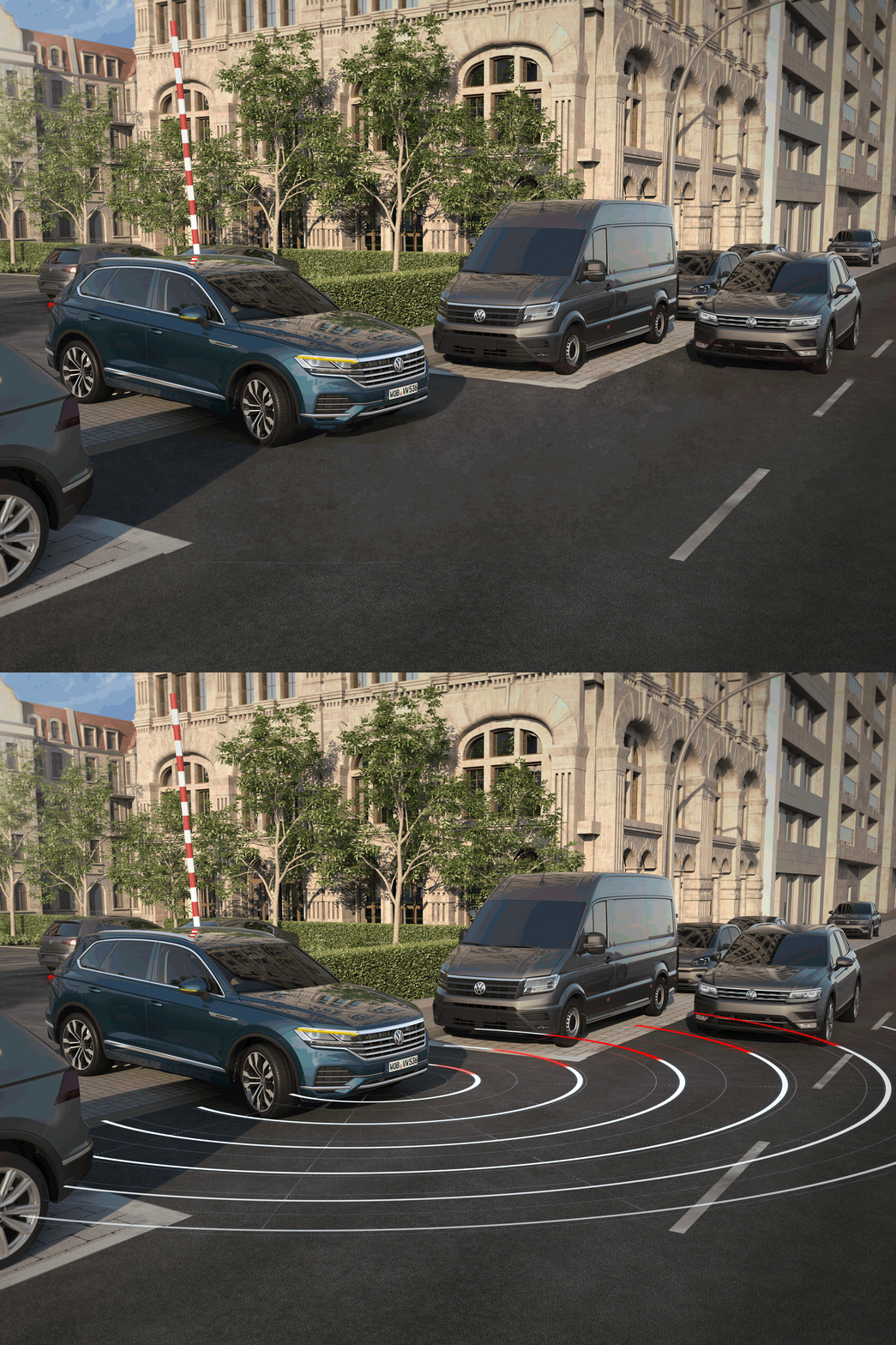
The VW Touareg senses and adapts to potential collisions
The purely autonomous solutions to date haven’t been promising. Uber has suspended testing of self-driving cars after crashes, while Transport for London’s GATEway project, which had autonomous pods operating a shuttle service around Greenwich in London, overcame the problem by deploying a top speed of 5.5mph, with pods stopping to think every time any pedestrians or cyclists got too close. Cute but no commute.
The short-term answer looks like technology aiding human perception rather than replacing it – two in every three new cars sold in the UK have high-tech driver assistance systems including collision warning, autonomous braking and blind-spot alerts, according to the Society of Motor Manufacturers and Traders.
What no car can do is stop your passengers shouting at you if they weren’t expecting the sharp braking – or shouting at you if they think you need to brake, or arguing about directions, or playing their own music and criticising your new shirt. Fortunately, you have cognitive psychology on your side. Don’t overload my bandwidth, you can tell them. I’m managing risks here. If you’re rude to me, you might actually die. Or be late for school, which is clearly worse.
Photography: Jonny Storey, Suki Dhanda, Getty Images