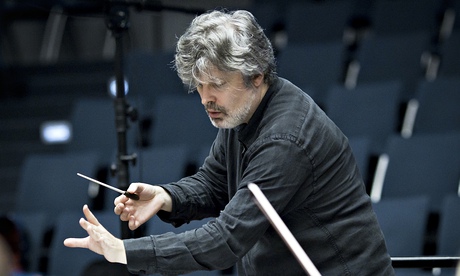
Not unlike Rossini with his Petite Messe Solennelle, James MacMillan seems to have named his new Little Mass in a spirit of irony, as the 30-minute setting of the Kyrie, Sanctus and Agnus Dei turns out to be a vast tapestry of orchestral colour. The only little thing about it is the voices - the smallest imaginable in fact, as the Liverpool Philharmonic Youth Choir was augmented by its feeder organisations, whose youngest members are only seven years old.
It’s an uncompromising piece, which MacMillian has not attempted to make child-friendly. Yet the superb junior singers took the dissonant intervals and difficult entrances in their stride. As this was not a requiem mass, there was no fire-and-brimstone Dies Irae to contend with. Yet MacMillan’s setting of the Sanctus was quite terrifying enough, full of sepulchral trombones, explosive crescendos and heavy-duty usage of a thunder-sheet.
In the Kyrie and Agnus Dei, the vocals were primarily used to create a hazy penumbra of sound around an eddying orchestral texture. Many of MacMillan’s effects were strikingly original, including a passage of un-pitched, non-metrical whispering; and a stratospheric ascent on Hosanna in Excelsis that felt like the highest praise of all.
The mass, written for the Royal Liverpool Philharmonic’s youth choir on the orchestra’s 175 birthday, was bookended by diametrically opposed pieces of Easter tone painting: Wagner’s Prelude and Good Friday Music from Parsifal and Rimsky-Korsakov’s skittishly impious Russian Easter Festival Overture. Only Rimsky could have the verve – not to mention the nerve – to conceive Orthodox chant as dance material. Wagner’s gravid prelude was perhaps a peculiar choice for a family-oriented concert, and met with some restlessness from the younger members of the audience. Yet the rich sonority achieved by the brass for Parsifal’s theme truly was the holy grail.