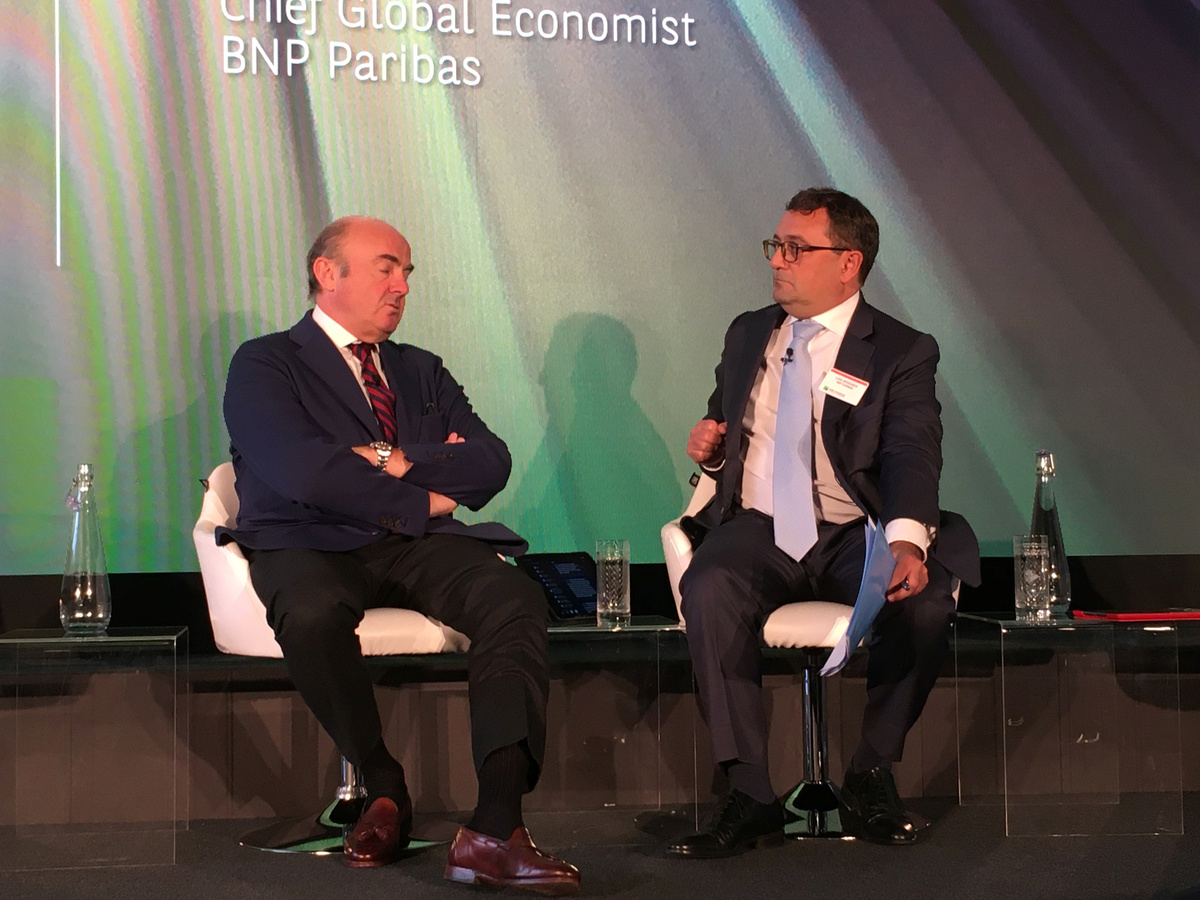
LONDON (Reuters) - ECB Vice President Luis De Guindos said on Thursday that Europe faced only a "very low" risk of recession, but he called on all euro zone governments - not just those with fiscal surpluses - to help revive the bloc's economy.
De Guindos spoke said after data showed the region's largest economy, Germany, narrowly avoided edging into recession in the third quarter.
Europe's growth remained "below potential", he said, adding that the ECB needed "to pay close attention" to the situation.
He said authorities needed to confront the risk of "Japanification" - a prolonged period of low growth and low inflation - if measures were not taken to stimulate the economy.
But he also said the term was an over-simplification due to the differences between Japan and Europe, including Europe not having a credit bubble and having more fiscal room to manoeuvre than Japan had in the past.
In September, the ECB pushed euro zone interest rates further into negative territory and said it was restarting its mass bond-buying programme having only wound it down at the end of last year.
De Guindos echoed recent calls for governments to step up their support efforts, but also suggested that an "aggregate" fiscal stance was required.
"Now our party line is more or less that countries that have space should do more and countries that do not have fiscal space should continue reducing the public deficit," he said.
"I think that position, the logical one, in consideration of the set of rules that we have now, is not enough," suggesting the need for a more comprehensive, bloc-wide plan.
De Guindos said that in his opinion the ECB and other central banks around the world will need to expand their "toolkit" in the sense of doing more than conventional monetary policy usually entails.
The ECB is currently working on a review of its policy framework.
PROFITABILITY PROBLEMS
De Guindos also said that low bank profitability was currently the main financial stability risk in the euro zone.
He acknowledged that it was a negative side-effect of the ECB's sub-zero interest rates but stressed that "structural" problems like overcapacity in the banking system were more to blame than ECB policy.
He welcomed the German finance minister's recent support for a Europe-wide banking union.
He also rejected the idea that monetary policy alone could be used to tackle lacklustre growth. "Central bankers, we are not almighty. We do not have the philosopher's stone. We cannot address all the problems of the world economy."
(Reporting by Marc Jones; editing by Elizabeth Howcroft and Hugh Lawson)