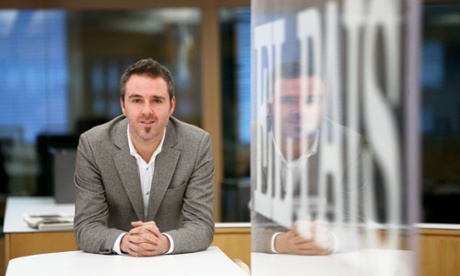
What are you most excited about in the digital marketing space at the moment?
I love how quickly technology has developed to allow marketers to reach consumers in a variety of different ways, while also analysing the relationships they have with the brand. Direct communication between a brand and its consumers provides an excellent platform for interaction and allows us to gather enhanced information about customer habits to improve customer service.
What’s your favourite example of innovative digital marketing?
I like the tools that some brands are using to improve measurement of ROI from advertising and marketing. It saddens me when I hear people in the digital marketing industry still only talking about impressions, clicks and conversions rather than engagement metrics or the actual impact that a piece of content has on the consumer.
At PRISA we launched an ecosystem measurement project just over a year ago in collaboration with the Bill & Melinda Gates Foundation, called Future Planet. Measuring the impact that content has on the user is a challenge and this will help us to do that and further innovate our content strategy.
What defines good content?
I think the definition of ‘good content’ is changing. Content should be assessed on its individual merits and whether it is in demand or engaged with by consumers. It should also be analysed from an engagement point of view, as well as its influence and the types of user it attracts. I believe strongly in the power of heterogeneity of users and their various needs.
To this extent why should a shorter piece of content be any worse than a more extensive piece, and why should a basic, easy-to-read piece of content be inferior to a deeper intellectual article based on analysis and opinion?
What is the biggest myth about content marketing?
I believe there are two. One – that anybody can create quality content, and two – that you don’t need to worry about how content will be distributed to readers.
Not everyone has the ability to create great content – I really admire the ability of journalists for example to create great content. Content creators have to understand the digital landscape and find the most effective channels in the distribution chain. Deep knowledge of the consumer, context and digital environment can only benefit the creation process, which is why it is so important to use analytics in digital marketing.
How are you amplifying and maximising your content?
Digital analytics allow us to retain our current audiences, as well as seeking out new opportunities. We are constantly looking at new ways of gaining audiences such as SEO, RRSS and crosslinking. We also try to improve user engagement with a site once users have visited the page by using recommendation engines and segmentation tools.
Intelligence from data consumption has also helped us to develop new services, such as Verne.es, which helps us to reach out to new users.
Where do you go for great content?
My main sources for general information are elpais.com, huffingtonpost.es and cadenaser.com. I go to Marca and AS.com for sports news.
I also enjoy content on feedly and Twitter, where I tend to read more than participate. I have little time for large scale consumption on a day-to-day basis so these help me keep up-to-date with quality content that relates to my interests.
How do you work with Outbrain and what has been your experience thus far?
At PRISA we are very satisfied with platforms like Outbrain that help us to better distribute our content more widely. With channels like this we have been able to weave a network of automated content recommendations alongside similar topical pieces.
Outbrain’s network allows us to leverage our distribution capacity to over 20 web sites from PRISA across eight different countries, and improve the user engagement of our own content distribution because it always links to content that is most interesting for its readers.
This advertisement feature is brought to you by Outbrain, sponsors of the Guardian Media Network’s digital content hub