Chie Nozawa, a professor of the Faculty of Science and Engineering at Toyo University, spoke about the problems of a "society with excessive residential supply" with The Yomiuri Shimbun. The following is an edited transcript of the interview.
Rampant overbuilding
The Yomiuri Shimbun: What problems have there been with Japan's housing policies?
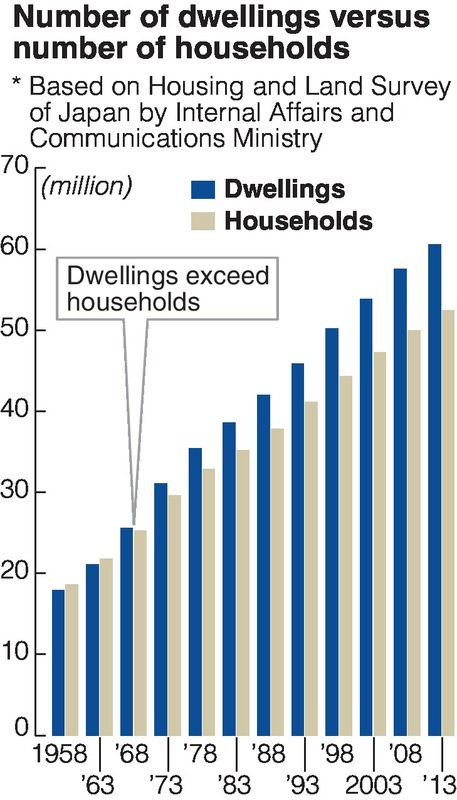
Chie Nozawa: Japan already has more homes [buildings] than households [people to live in them], yet more and more new housing continues to be built, leading to a "society with excessive residential supply." At this rate, future generations will be saddled with the burden of worthless inheritances. We need to find solutions soon.
Why is the housing supply still increasing? One problem lies in policies by local governments. Cities, towns and villages that want to increase their populations are keeping regulations on development to a minimum so they don't lose out to neighboring municipalities. The loose restrictions lead to attempts to have people live [in new buildings] on farmland designated as urbanization control areas, which is not prepared for residential use.
These moves are partly due to the fact that with more decentralization, urban planning authorities have shifted to cities, towns and villages. They also reflect the voices of regions that want to avoid depopulation and landowners who are hoping to use their land for other purposes, such as managing apartment buildings.
Also, in large cities, due to soaring land prices in the bubble economy, housing couldn't be built in urban centers, which caused a hollowing out there. So large cities had an earnest desire to promote housing in the central parts of the cities. Boosted by deregulatory measures, high-rise condominium buildings are being built one after another.
Another major cause is that the real estate industry focuses its efforts on construction of new housing. They purchase land, construct housing and sell it, then use that profit to purchase more land so they can build and sell again. This business model forces them to continue building, leading to a glut of new construction.
The public also has a strong desire to own their own homes, which may be another factor.
Since the end of World War II, Japan has deployed its policies to encourage people to own their own homes. Before the war, 30 percent or less of families in major cities owned their own homes, but that number is around 60 percent now.
A: Using these home ownership policies to resolve a housing crisis wasn't bad in itself. I think the problem was that they prioritized new construction without giving any thought to the question of what to do when all the old houses reached the end of their lifespans and needed to be repurposed or demolished.
Fewer households, more vacant houses
Q: The number of vacant houses is increasing nationwide. What problems does this cause for society?
A: Various deficiencies of housing policies, including the sudden increase in vacant houses, are starting to be exposed.
As many children already have homes of their own when they inherit a home from their parents, most don't end up living in their parents' home. In both urban and rural areas, there's a visible problem of an increasing number of vacant houses. They are abandoned as the owners want to sell but can't find a buyer, or there are issues with organizing the old owner's belongings, or for other reasons. I call these "vacant houses with yet-to-be-addressed problems."
It costs several million yen to demolish an empty house, and then property taxes go up on the vacant lot. If the home is inherited by someone living far away, they may not be interested in maintaining it. In the worst case, you don't even know who owns the home anymore, making it difficult for officials to respond to the issue.
In 2025, the baby boomers will all be 75 or older, rapidly increasing the elderly population in that age bracket. At the same time, there will be a huge number of inheritances, and their children will face these problems. There are fears that the issue of vacant houses will only get worse.
In 2013, vacant houses made up 13.5 percent of all housing. This is predicted to increase to more than 30 percent by 2033 as the number of households decreases and the number of homes increases.
A: Meanwhile, the development of new residential land is popping up right next to areas dotted with vacant houses that don't have a use. If new housing continues to be built in areas where transportation, elementary schools, parks and other infrastructure are not improved, funds will be needed for this infrastructure. There will be more areas that need antidisaster measures, trash collection and other public services, requiring a lot of tax money.
Avoiding 'burden houses'
Q: What steps can we take to solve the vacant houses problem?
A: A desirable policy would be to have builders construct new housing on vacant lots or land with vacant houses, instead of unruly expansion of residential areas. With the decreasing population and financial difficulties, local governments will eventually have to narrow the areas in which they provide infrastructure support.
For example, Maebashi city has a system in which you can receive a subsidy for rebuilding or renovating a vacant house near your parents' home. This is a good policy that hopefully will not only get rid of vacant houses, but also keep people in the city in two-generation houses that are located closer together.
The myth that land will always increase in value has been dispelled. In fact, a home may become a burden when you can't find a buyer and just keep having to pay taxes and maintenance.
We need to make it profitable for businesses to use existing housing. In addition to the circulation of more secondhand homes, we should expand the business of renovating homes to increase their value and functionality and then resell them. There's also the idea of using these buildings for something other than housing.
Regarding policies, housing policy should go in hand with urban planning and the tax system. Fixed property taxes are reduced or waived on new construction, but perhaps we could create a difference between areas that promote residency and areas that don't.
Q: Will our attitudes toward housing change?
A: We all need to change the way we think. Buying a home shouldn't be like buying a car -- you need to think about the future costs it will incur after your children inherit it. There have been cases in which it's hard to find uses for vacant houses in large housing developments because the location or access to transportation is poor. It's important to think long-term.
It's hard to deal with homes that have been abandoned for decades. If you inherit a home, think about the issue right away and don't put it off. Parents should also include necessary preparations to pass on a home in an advanced directive, so that they don't leave their children with the bill.
(This interview was conducted by Yomiuri Shimbun Staff Writer Yoshihisa Mizukami.)
--- Nozawa studied urban engineering at the University of Tokyo Graduate School and earned a doctorate in 2002. She has been in her current position since 2015. She has experience working for a general contractor as well. Nozawa is the author of "Oiru Ie Kuzureru Machi" (Aging houses and deteriorating cities) and other books. She is 47.
Read more from The Japan News at https://japannews.yomiuri.co.jp/