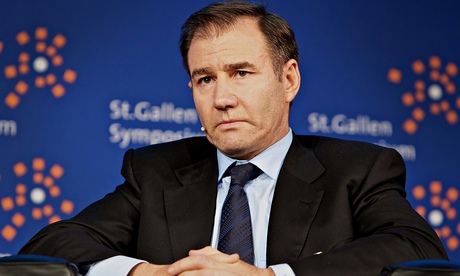
Ivan Glasenberg will not get anywhere near Rio Tinto for at least six months. Glencore is now off-side as a bidder or merger partner for that period after saying it is “no longer actively considering” an offer. But Glasenberg demonstrated at Xstrata that he can play a long game. Does his latest idea for a big deal just need time to mature? Never say never, of course – but it would require an astonishing turn of events for GlenTinto to come into being in next half-decade or so. Rio, surely, would have to sink into a deep corporate crisis for its shareholders to think of throwing in their lot with Glasenberg’s higher-risk trading and acquisition machine.
First, as argued here yesterday, Rio under chief executive Sam Walsh has sobered up after the madcap takeover of aluminium producer Alcan for $38bn (£19bn) in 2007, probably the worst deal in modern mining history.
It is true that iron ore, which provides the bulk of the company’s earnings, is sliding in price. The main raw ingredient used to make steel fetches about $80 a tonne, down from about $140 a couple of years ago. But Rio can still dig the stuff out of the Australian desert and ship it to China for about $45 a tonne. A trading profit margin of 44% ain’t bad.
What’s more, Rio can still meet its promises to shareholders at current prices. The dividend yield is 3.8% at today’s share price and there should be enough spare cash to fund a share buy-back or special dividend next year. And, if iron ore prices plummet further, there’s no need to call Glasenberg. Just take his advice to cut capital expenditure to the bone and curtail production.
Second, Glencore would bring little to the party apart from financial leverage. Rio’s debt is about $16bn. Borrowings at Glencore, the smaller company, were $33bn at the last count. Thus any offer would have funded largely in Glencore shares, which will remain the case for years to come. Yet Glencore paper is hardly a must-have for a mining investor: its value has fallen 35% since flotation in 2011.
Share prices can change, of course. But it will still be the case that Rio has the superior assets. Its main mines are concentrated in stable democracies and contain enough supply for a century or so. Why join Glencore’s adventures in the Democratic Republic of Congo and elsewhere?
The only possible reason would be a huge takeover premium. But that’s the third reason why this idea looks a non-starter: Glasenberg doesn’t do big premiums. He was bullied into paying a modest version at Xstrata, but circumstances there were different: Glencore already owned 35% of its target and failure was unimaginable.
By way of garnish, one could add further complications, such as possible objections from competition authorities and the Australian foreign investment review board. But the bottom line is that it is almost impossible to see the financial stars coming into alignment any time soon. Rio doesn’t need Glencore; and Glencore will struggle to offer attractive terms without killing its own share price.
Glasenberg always gets what he wants in the end, they say. But there are exceptions to any rule and this looks to be one.
Bank must stick to rules
One director of HSBC’s UK bank has resigned, and another is likely to follow, apparently alarmed by the prospect of working under a tougher regulatory regime that could see individuals go to jail if they took reckless decisions that led to the collapse of their employer.
Bankers, no doubt, will claim this development proves the Bank of England’s proposed new rules are unworkable and will deter good candidates from applying to join the boards of banks. Expect the lobbying to go into overdrive.
Threadneedle Street should resist the pleading as far as possible. The new regime is built on a firm foundation – the observation by the Banking Commission that senior individuals at failed and unscrupulous banks escaped punishment via an “accountability firewall.”
Time after time, senior directors of failed institutions argued at parliamentary hearings that responsibilities were delegated or decisions were made collectively. Like Macavity, they were never there. The new rules are designed to makes lines of responsibility and accountability clear, which seems entirely sensible.
Much of the fuss is concentrated on the threat of jail and the supposed presumption of guilt when banks collapse. But, as almost every lawyer agrees, the bar to prove recklessness will be set very high: it will cover only extreme cases.
Two HSBC bankers, one of whom also cited work commitments elsewhere, do not amount to a rebellion. The Bank should stick to its principles, and reflect that any reform worth implementing might suffer a few drop-outs.