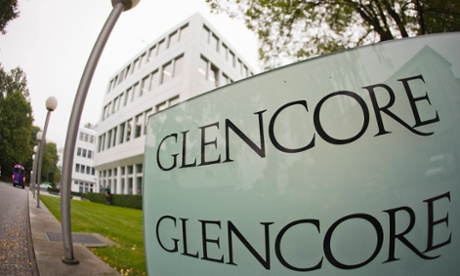
It’s the mega-merger rumour that won’t go away: Glencore is getting ready to make a bid for Rio Tinto. The latest airing, from Bloomberg, contained the detail that Chinalco of China, which owns almost 10% of Rio, is being sounded out to support the creation of a $160bn (£100bn) mining monster. Rio’s New York-traded stock briefly rose nearly 20%.
Glencore’s Ivan Glasenberg, billionaire kingpin and 8% owner of the company, has an unquenchable appetite for owning and trading assets, so the heart of the tale is easy to believe. It’s hard, though, to understand why Rio’s shareholders would be tempted by any price that Glencore could afford to offer.
Rio has had accidents aplenty in the past – from the hubristic $38bn top-of-the-market purchase of Alcan in 2007 to the comic failure to gain permits to ship coal along the Zambezi in Mozambique. But these days Rio investors know roughly what they own: a low-cost producer of iron ore in Australia with a sideline in copper in Mongolia.
Iron ore prices are currently plunging but, if investors don’t like Rio’s reliance on serving Chinese steelmakers, other miners’ shares are available. Why would they wish to swap their Rio shares for Glencore stock, except on terms that Glasenberg would never offer?
Glencore, in case anybody has forgotten, has been a shocking performer as a public company. It was floated at 530p in 2011 but the shares fetch 340p today. Where is the appeal for Rio meant to lie?
Tesco’s new hire
Richard Cousins of Compass Group, on the face of it, is a good hire for Tesco as a non-executive director. He is a successful chief executive; he has crisis-fighting experience as his first task at Compass, in 2006, was to resolve a messy scandal involving a UN contract; and Compass, as a contract caterer, could be viewed as being in the retail game, broadly speaking. But there’s a problem: does Cousins have enough free hours to get his hands dirty at Tesco?
One would have assumed not, because lack of time was the reason Cousins gave for quitting the Reckitt Benckiser board in May. Reckitt’s statement from last December was frank on why Cousins would leave: “Richard is assuming an increasingly day-to-day operational role as CEO of Compass Group, which he has concluded will impact on his ability to devote sufficient time to his role as a non-executive director of Reckitt Benckiser.” No room for misunderstanding there: Cousins felt he needed to concentrate on his day job, an understandable stance as it is Compass that pays his wages. Five months after leaving Reckitt, however, Cousins suddenly has time to put in a shift at Tesco. How? Neither Tesco’s nor Compass’s statements explained.
Compass shareholders, you would think, will want to push chairman Paul Walsh. Was Cousins using the “not enough hours in the day” plea as a polite excuse to exit Reckitt? Or has his “day-to-day operational role” at Compass changed yet again?
Reckitt was a gentle posting as the Dettol to Durex group tends to run on rails. Today’s Tesco is a very different prospect. Sir Richard Broadbent, chairman, is relying on Cousins, plus Mikael Ohlsson from Ikea, to repair the board’s deficit in retailing experience.
Of course, even an overstretched non-executive worth his salt could have told Broadbent that running four corporate jets, then ordering a fifth, is inviting trouble. But the job is meant to be more demanding than that. If Cousins found the Reckitt post too time-consuming, what is he doing at Tesco?
Bramson’s mistake
Edward Bramson, the activist investor, got what he deserved yesterday in an attempt to storm the boardroom of Electra Private Equity: a thumbs-down from other shareholders. Four-fifths of their votes were cast against his election. In the end, the outcome wasn’t even close. Bramson’s Sherborne Investors, despite owning a 20% stake, could only get to 38%.
Bramson’s mistake was to claim there was “at least” £1bn of extra value to be released from Electra but fail to explain how he could, in effect, double the share price within a couple of years. “He had no insights, no thoughts, no opinions, no plans – nothing whatsoever,” said the representative from Investec Asset Management at the meeting.
Quite. If Bramson really thought there was a spare £1bn waiting to be scooped up, he should have tried to summon a few financial backers to support a full bid. Instead, he created the impression that his efforts were an attempt to gain creeping control of Electra.
This was a resounding defeat but Bramson is not the type to slink away. Perhaps he will attempt a full takeover. If not, the whole adventure looks an enormous waste of time and energy.