The four female athletes representing Saudi Arabia at the Olympic Games this year are simply a "fig leaf" to appease the international community as Saudi women at home continue to face serious discrimination in sport, say critics.
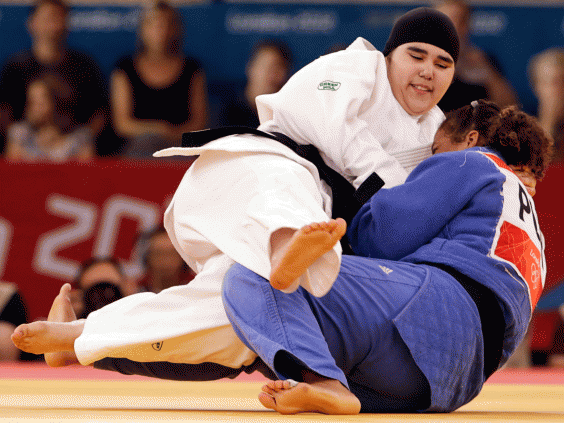
Although twice as many women are competing this year as in the 2012 Games - in which runner Sarah Attar and judo wrestler Wojdan Shaherkani were the first ever to represent Saudi Arabia - few of the women were actually born or brought up in the country, say researchers on the topic.
Lubna Al Omair in fencing, Kariman Abuljadayel in athletics, Sarah Attar in athletics and Joud Fahmy in judo wrestling are the four women sent by the conservative Middle Eastern nation to compete in Rio de Janeiro this year. Yet most trained, studied or were brought up outside Saudi Arabia.
So having them represent the country disguises the fact most Saudi women are unable to participate in physical activity at home - with serious health impacts - a new report by Human Rights Watch has warned.
Mink Worden, director of global initiatives at Human Rights Watch, said while the creation of a new women's department for sport in Saudi Arabia was a "welcome move", serious reform for girls and woman accessing sport was needed.
“Saudi women are making tremendous strides in the world of sports – climbing the tallest mountains and swimming the lengths of rivers", she said, referencing Raha Moharrak, the youngest Arab to reach the summit of Mount Everest three years ago after training herself.
“They are showing their determination, talent, effort, and heart despite daunting legal, cultural, and religious hurdles.
"As the Rio Olympics open, Saudi Arabia needs to change the game by addressing the profound discrimination that holds back women’s and girls’ participation in sport in the kingdom.”
Such discrimination includes women not being allowed to attend men's matches as spectators - as in Iran, some of whose women watched their first ever matches in Rio this year - and may not take part in national tournaments or state-organised sports leagues.
Most girls' state secondary schools have no gym or sports facilities, while boys have compulsory physical education classes, and PE teachers at private schools tend to come from Egypt or elsewhere.
And while the General Authority for Sports appointed Princess Reema Bint Bandar Al Saud as the head of a new female department on 1 August, the Saudi National Olympic Committee still does not have a women's section.
Moreover, Ms Attar grew up in California, Ms Jadayel is a student at Boston University, Ms Fahmi trained in the US and Ms Omair trained in Egypt. All four women representing Saudi Arabia - whose standard is still below that required of the Olympics but allowed on special invitation - had to leave the home country they represent in order to be good enough to do so.
Some government schools are now offering physical education to girls, according to public reports in recent years. A few female-only fitness studios are also opening across the country.
But the international community should not lay off the pressure which forced Saudi authorities to either allow women to compete or be banned from the Olympics altogether, said a leading researcher.
Ali Al-Ahmed, co-author of a report on the "Saudi Ban on Women's Sports", said the inclusion of female Olympic competitors by Saudi Arabia was actually a step backwards than a step forwards.
"The presence of female athletes [in 2012] made things worse, because it allowed Saudi Arabia to escape criticism," he told Quartz.
"It was a fig leaf - they did this for the international community."
Government-sanctioned discrimination has led to 44 per cent of Saudi women suffering from obesity compared to 26 per cent of men - a situation Mr Al-Ahmed described as "killing them softly".
"The Saudis are experts at telling people what they want to hear and delaying reforms for ever," he added.
The Independent has approached the Saudi Arabian Olympic Committee and the Saudi Embassy in London for comment.