George Monbiot’s call for “a government commission on post-growth economics” should be urgent parliamentary business (Growth: the destructive God that can never be appeased, 19 November). All MPs should read the article, and they should tell us how they respond to some relevant questions. Do you realise that economic growth today demands more fossil fuel combustion that exacerbates disastrous climate change? Do you believe the UK could create a steady-state economy? Do you agree that social justice in a steady-state economy would require major reduction in the gap between the rich and the poor? Do you agree that the survival of most of the human race depends on these issues? Are you desperately worried about the world your grandchildren will inherit?
Britain led the world in the industrial revolution with economic growth: could we now take the lead in a steady-state revolution with zero economic growth?
Michael Bassey
Newark, Nottinghamshire
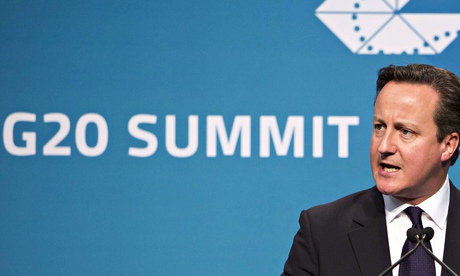
• The G20 in Brisbane was a missed opportunity to reinvigorate the global economy. Instead of stimulating new international action, its red-light warnings have been used by David Cameron to pre-empt criticism of any forthcoming downturn in the UK economy (Cameron fears second global financial crash, 17 November) and dismissed by Ed Miliband as irrelevant to explaining any future UK failures (Miliband mocks PM over ‘excuses’ for borrowing, 18 November). The sad truth is that Britain should have been playing a leading role before and during the G20 to mobilise support for multilateral actions of stimulus and balanced global growth, on which the health of the world economy depends. Global actions of stimulus briefly succeeded in 2009, though sadly were abandoned before they had taken hold on a global scale, though not before they had demonstrated some real success. The global economy grew 4% in 2010. A fuller agenda of what was and is still required was set out in the Stiglitz commission report presented to the UN general assembly, which dealt with both short- and medium-run actions, as well as providing specific proposals for diminishing financial risks and strengthening global institutions. Until such actions are pursued seriously, protecting the UK economy from a global downturn will be whistling in the wind.
Professor Richard Jolly
Lewes, Sussex
• The prime minister’s decision to announce his fears about the instability of the global financial system (Opinion, 17 November) was surprising. What was his gloating over the economies of the eurozone supposed to achieve? I questioned Mario Draghi, chair of the European Systemic Risk Board, in the European parliament on this unhelpful behaviour. He refused to comment. Given the crucial role that confidence plays in the world of finance, it appears that Cameron is himself becoming a systemic risk. I do hope that he is not risking the future of the continent’s financial system merely to score some political points at home.
Molly Scott Cato MEP
Green, South West England
• Red warning lights have been flashing for some time on our fragile recovery, based on the usual housing bubble that has now burst leaving thousands of households in dread of an interest rate rise. Running a country is not the same as running a business or a household, described by one economist as the zombie idea still walking. As the national debt is historically low, it makes sense to borrow at low interest rates to invest in the rising generation, too many of whom have been sacrificed on the altar of the deficit. Our children are tested to death but not educated to have the skills necessary to find employment, and feel they are on the scrapheap. We do not employ them, or house them, but we do lock too many of them up in overcrowded prisons where the suicide rate is rising.Another £30bn worth of cuts will reduce us to consumers of privatised public services rather that citizens in a democracy.
Margaret Phelps
Penarth, Vale of Glamorgan
• Am I the only one to treat the news that the economy is not growing; as good news? We live on a planet with finite resources. I can see no difference between an economy that relies on growth and a pyramid selling scam.
Rod Thompson
Camborne, Cornwall