About the crassest tag anyone has tried to hang on Rickie Lee Jones is that she’s “the female Tom Waits”. It is also the kind of tag that will probably cause the recipient a good deal of discomfort over the next year or so.
Unfortunately, it’s also kind of apt. The similarities between Ms Jones and the aforementioned Waits are more than a little marked. Both have a basis in 1940s jazz nostalgia, both seem to be trying to turn themselves into characters from some Beat Generation/Damon Runyon world where Nick the Greek slips through the shadows and Jack Kerouac could show up any moment in a beat-up Hudson.
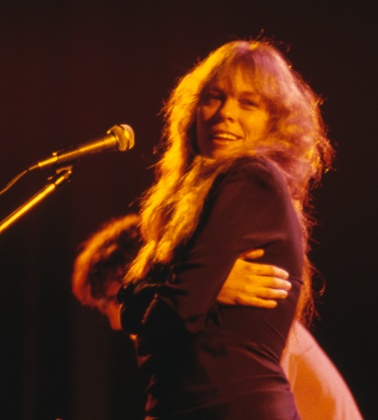
The resemblance doesn’t even stop there. Onstage, in a beat-up cocktail dress, pink beret pulled down over one eye and a Sherman cigarillo hanging out of the corner of her mouth, Rickie Lee slugs back drinks with the confidence of someone who believes she has a cast-iron liver. Just to complete the Waits connection, she even hung round with the same LA bohemian street crowd in the bars of Hollywood and Venice.
Like a lot of people who seem determined to turn themselves into an instant legend, Ms Jones is unwilling to talk much about her background. “It’s a long story; a year and a half long.”
What she does give away is straight romantic American fantasy. Her father was the son of a vaudeville family who spent too much of his childhood dumped in orphanages while Mom and Pop worked the circuit. In his turn, he wound up as a less-than-successful musician and songwriter. When times were hard, he worked as a waiter. And, by all accounts, times were often hard.
‘‘We’d move most every year. I was back and forth, mostly between Chicago and Phoenix. I went to as many schools as the years I was in school.’’
Although reticent about the past, she seems to relish telling how she and a teenage boyfriend stole a car so they could run away together, and how she was one of twelve students booted out of high school in Olympia, Washington, for refusing to conform.
A lot of this carries echoes of early Patti Smith legend-laying. But, unlike La Smith’s studied posturing, there is an essential robustness about Rickie Lee Jones that makes it much more credible. Without any insult, the term ‘broad’ could have been coined for her. Contrary to the publicity machine, Ms Jones is no Joni Mitchell sorrowful waif. Big-boned, wide-hipped and with a face out of the classic Bardot/Faye Dunaway mould, she has moves that, if her voice gave out tomorrow, would guarantee a headline spot in any strip joint.
When singing, she is so aggressively animated that the audience is drawn in and all disbelief is suspended. This is crucial for any performer attempting to move the audience not only at gut level but also to take them out of present reality and transform the place that she’s playing into a mythical sleazy jazz joint some 30 years in the past.
Although not so far down the road as her friend and hero, she seems determined to do what Waits has done: become virtually indistinguishable from one of his own characters. It could soon be hard to tell the real Rickie Lee Jones from the hipster/hooker/hustler/bar-room broads who show up in the rest of her songs. This may be something of a problem.
Tom Waits has never had to go through the whole media star-making process. For the most part, he was left alone by the record company to develop in his own time, and to slowly build his now considerable cult following.
Rickie Lee Jones, on the other hand, is slap in the middle of the hype spotlight. With an album only just in the stores, her management are already vetoing interviews and instructing muscle to stop photographers at her shows. She has been jerked out of small LA clubs like the A La Carte and the Comeback Inn and set adrift in the rock’n’roll big league to record with the likes of Willie Weeks, Mac Rebennack, Randy Newman, Tom Scott and Buzz Feiten.
Right now, she seems to be relishing the experience.
“Most girls, most artists for that matter, aren’t real secure. They walk into a situation and they don’t direct; the producers direct. So you don’t have any collaboration, any involvement. It’s very unusual for someone to get this much support. Now I know that I won’t have to fight to make these songs heard, I feel a lot more confident about writing and performing my music.”
Sadly, however, sometimes the fight to be heard is what shapes and matures talent. The big hype may get instant results, but all too often it can destroy an artist. Bruce Springsteen was one of the exceptions who managed to find his way back.
Rickie Lee Jones, undisputedly, has talent. Whether she has the strength to ride the machine rather than allow the machine to ride her remains to be seen.
© Mick Farren, 1979