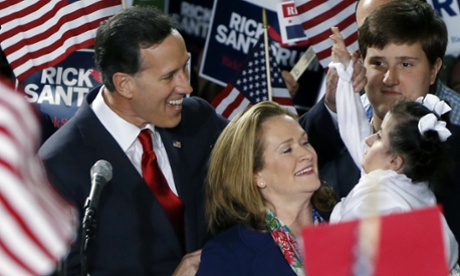
Former senator Rick Santorum announced Wednesday that he would again seek the Republican nomination for the presidency.
Santorum, who finished second to eventual nominee Mitt Romney in 2012, held a rally at Penn United Technologies in Cabot, Pennsylvania, just a few miles from the western Pennsylvania town where he grew up, to announce his decision.
In a speech to a crowd of several hundred people holding signs and chanting his name, Santorum touted his message of “blue-collar conservatism”. Although the former Pennsylvania senator has long been known as a social conservative, he is playing up his populist bona fides this cycle and emphasizing his concern about immigration and skepticism about free trade deals. The theme was even obvious in his campaign’s theme song, a guitar-driven country track titled “Take Back America”.
Santorum came on stage holding a hunk of coal and proclaiming “this is where it all started”, a reference to his grandfather who immigrated from Italy to become a coal miner. He went on to rail against “big labor, big government and yes, big business”.
The former two-term senator offered a strident criticism of increased immigration, both legal and illegal. To Santorum, big business backed immigration reform to drive down wages and “control costs”, while Hillary Clinton backed it “because, well, she just wants votes”. He derided those “whose priorities were profits and power”. Instead, Santorum insisted “my priority is you, the American worker”.
Yet for all the populism, Santorum didn’t shy away from the social conservatism for which he is best known. The former Pennsylvania lawmaker got his biggest cheers in the crowd when he referenced his work to pass the partial birth abortion ban in 2003 and when he proclaimed: “As president, I will stand for the principles every life matters: the poor, the disabled and the unborn.”
The crowd in the western Pennsylvania warehouse, filled with cardboard boxes and orange shelving which stretched 30ft in the air, ranged from supporters who travelled long distances to those excited to see a local boy who had done good.
Grant Gil had travelled from Lafayette, Louisiana, in order to see Santorum’s announcement. Dressed in a pinstriped suit, Gil said he hadn’t slept in 30 hours and saw Santorum as similar to Ronald Reagan. “I loved Reagan,” he told the Guardian. Gil thought Santorum “had a lot of very similar qualities” including “sincerity” and the will to do what was right, regardless of the political cost.
Dwight Sarver said he liked Santorum because he was a strong conservative and was supporting him because he “was raised around here”. Sarver seemed to be the very epitome of the blue-collar conservative that Santorum was trying to woo. As he told the Guardian: “I was never fond of unions, even though I belonged to three of them.”
In his first bid for the White House in 2012, Santorum finished second to Mitt Romney in the Republican primary and won 11 states. Long considered an underdog, Santorum surged in the run-up to the crucial Iowa caucuses. Although Romney was initially judged to have won Iowa, a recount eventually showed that Santorum had won by a hair. The former senator went on to battle Romney for several months before he finally dropped out in April, just days after Romney edged him out in the Wisconsin primary.
Prior to his White House bid, Santorum served two terms in the House of Representatives and two terms in the Senate, representing his home state of Pennsylvania. The former senator lost his 2006 bid for re-election to Democrat Bob Casey by a margin of 59%-41%.
Santorum faces new obstacles in his second run for the White House. Unlike in 2012, there are a number of strong contenders, like Ted Cruz and Mike Huckabee, who appeal to the Republican Party’s evangelical base in the 2016 race.
Furthermore, Santorum faces the possibility of being excluded from televised debates, as he is just at the national polling threshold necessary to participate. The current criteria set by Fox News for the first Republican debate in August are that only those candidates in the top ten in national polling can participate and Santorum is currently polling in tenth place in the 16-person GOP field.
John Brabender, a top advisor to Santorum, expressed his concern about possibility of any candidates being excluded from the debates, noting that the GOP had 12 credible candidates this year and he thought it would be to the Republican Party’s advantage to put them all on stage. Brabender also emphasized that Santorum was starting from behind compared to the rest of the field: “He doesn’t have a TV show on Fox and he’s not on the Senate.”
The top GOP strategist went on to note that the former senator’s campaign launch this year was a far bigger deal than it was four years ago, with Fox News going live to cover it and the national press corps on the scene. In contrast, he thought that there might have only been a single news camera there last time.
In addition to national press attention, Santorum will still have the backing of financier Foster Friess. The Wyoming-based investor, who attended the rally, donated several million to a pro-Santorum Super PAC in 2012 and was credited with keeping the campaign of the former Pennsylvania senator afloat into the early spring. Friess played a little coy with the Guardian about whether he’d get behind Santorum to the same extent this year but still made his support clear, saying: “Well, does the fact I just spent $26,000 on a charter flight to come from Jackson Hole answer that?”
After his announcement, Santorum is scheduled to bring his “Take Back America Tour” to the early primary states of Iowa and South Carolina in the next few days.