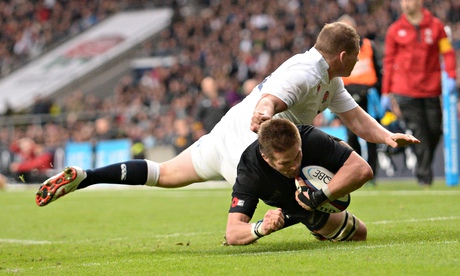
When it was all over, and England had lost again, the crowd broke out into boos, jeers and hoots. It was almost as loud as the rendition of Swing Low they had sung earlier in the afternoon, which had entirely drowned out the All Blacks’ haka. It was not England they were upset with, far from it, or even the referee, Nigel Owens, though they had howled in protest at some of his decisions. The chorus of catcalls was aimed at Richie McCaw, who had just been named as the man of the match. Some will say they should know better, will think it a sorry business, as they did when another great player English fans love to hate, Ricky Ponting, received a similar treatment during the 2009 Ashes. But the boos are, in a perverse way, a fine tribute to the man’s work. And, besides, it is all water off McCaw’s black-shirted back. Music to the ears, mate. If he was not busy irritating 80,000 English fans, he would not be doing his job.
Of the many records McCaw has set in his 13-year career, one stands out as perhaps the most remarkable. Oh, there are plenty that will make you do a double take – like the fact he has won as many Tests, 119, as England’s most-capped player, Jason Leonard, played in his entire career; and that the try he scored on Saturday was his 25th for the All Blacks, which is four more than England’s entire starting XV had mustered between them. But listen to this: in all those matches, across all those minutes on the pitch, McCaw has been shown only two yellow cards – fewer than George Smith, fewer than Sergio Parisse, fewer than Martyn Williams and Mauro Bergamasco, the four other loose forwards in the 100-cap club. And of course McCaw has played more than any of them.
It is not that McCaw never cheats. He is always at it. It is that he so seldom seems to get caught or punished. The first yellow happened in 2006, when New Zealand thrashed Wales 45-10 in Cardiff. The referee, Dave Pearson, warned McCaw twice about killing the ball, then snapped.
As Eddie Butler wrote in his report in the Observer: “Of course McCaw wriggles into positions he should not, and of course he dabbles with a hand when it is expressly forbidden but it is what he is paid to do.” And that was it for the next eight years. The second and only other time McCaw has seen the inside of the sin-bin was in the Bledisloe Cup match this August, when Raymond Poite penalised him for playing the ball on the ground in the 12th minute.
McCaw is a master thief, always evading justice. He was caught out once on Saturday, when Owens penalised him in the last minute of the first half. But there was so much more he seemed somehow to get away with – subtle things like the stray flailing arm that checked Semesa Rokoduguni as he burst away from a tackle. Well, McCaw was just trying to get his balance back, wasn’t he? And if he happened to catch Rokoduguni as he did it, what fault was that of his?
And that crucial turn-over he made in the second half, when he stripped the ball off Billy Vunipola. The time between his playing the ball and his feet being off the ground was so short, so sharp, who was to say whether his play was legal or not?
Rival fans say McCaw charms the referees, that he has them in his pocket. But against England he hardly seemed to say a word to Owens. He was a lot less voluble, for sure, than Chris Robshaw. McCaw is more interested in adapting his own game to suit the referee’s interpretation of the laws than he is in complaining about what the other side are up to. He is like a lawyer who understands the case depends more on the whims of the judge than it does on the letter of the law.
And so, called out once, he made sure Owens did not have the chance to penalise him again, until right at the end, when he figured the reward to be had from blatantly killing the ball was worth the risk, since there were only minutes to play and New Zealand were 10 points up.
At the same time McCaw played that second half with a blazing intensity, which earned him the match award. As Steve Hansen said, in the second period his forwards had an urgency and desperation about them that allowed them to take control of the match. To step it up like that while simultaneously retaining the self-control to stay on the right side of Owens is quite a balancing act. McCaw said he and his team snapped into life when Dane Coles was sin-binned and they were a man down. Adversity brings the best out of them.
One final, astonishing statistic. The All Blacks have been shown seven yellow cards in the 12 Tests they have played this year. The combined score in those 70 minutes of 14-man play? New Zealand 24, the rest of the world nine. They have not conceded a try while a man down. But they have scored three.
McCaw will be back at Twickenham next year, for the World Cup. They may even be the final games of his career. If that is the case, if he does call it quits, then England’s fans will, surely, feel able to offer this extraordinary player all the ovations he deserves, secure in the knowledge they will never have to see him cheat them, or beat them, ever again.