Summary
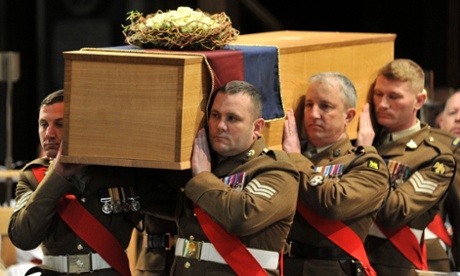
- The remains of Richard III have been reburied in a solemn ceremony at St Martin’s cathedral, Leicester.
- The bishop of Leicester, Tim Stevens, said his mortal remains were being given the dignity originally denied them in death.
- There were numerous references to Richard’s villainous reputation, stemming largely from Shakespeare, but it was emphasised they were not gathered there to judge, praise or damn him.
- Ahead of the general election, which he mentioned, Stevens delivered a contemporary message warning about the modern threat of damaging tribal behaviour and of the “me” culture instead of the “we” culture.
- Prayers were said for all of those who died in the War of the Roses and at the Battle of Bosworth where Richard fell.
- Benedict Cumberbatch, newly identified as a distant cousin of Richard’s, read a specially commissioned poem, Richard, written by Carol Ann Duffy.
'Richard' poem written by Carol Ann Duffy #richardreburied pic.twitter.com/XvFVHvH8NA
— victoria hicks (@vixhix) March 26, 2015
'So wise so young, they say, do never live long.' Shakespeare R3 III.i. #RichardIII #richardreburied
— Shakespeare Today (@Shakes_Today) March 26, 2015
And the ceremony is over.
The Countess of Wessex, the Queen’s official representative, clad in black, is leaving.
She is presented with posies by a girl. Not to be missed out, the Duchess of Gloucester also gets a bunch.
They are singing the national anthem now.
It was a special arrangement by the master of the Queen’s music, Judith Weir, apparently.
Updated
They were also watching Cumberbatch on the big screen in Leicester.
Benedict Cumberbatch gives his reading to the #richardreburied service pic.twitter.com/aejElLJ0qC
— LeicesterCityCouncil (@Leicester_News) March 26, 2015
Benedict Cumberbatch, newly identified as a distant cousin of Richard’s, is now reading the specially commissioned Richard, written by Carol Ann Duffy:
My bones, scripted in light, upon cold soil,
a human braille. My skull, scarred by a crown,
emptied of history. Describe my soul
as incense, votive, vanishing; your own
the same. Grant me the carving of my name.
These relics, bless. Imagine you re-tie
a broken string and on it thread a cross,
the symbol severed from me when I died.
The end of time – an unknown, unfelt loss –
unless the Resurrection of the Dead …
or I once dreamed of this, your future breath
in prayer for me, lost long, forever found;
or sensed you from the backstage of my death,
as kings glimpse shadows on a battleground.
Cumberbatch is due to play Richard III in a film of the War of the Roses.
Updated
Soils from Fotheringahy, Middleham and Bosworth are sprinkled onto the coffin and a prayer is offered to all those who died in the War of the Roses.
The Archbishop of Canterbury leads prayers as Richard III's coffin is lowered into the grave. #RIIIP pic.twitter.com/9zLX7F4AC3
— Channel 4 (@Channel4) March 26, 2015
The coffin is lowered
The coffin is lowered.
The archbishop of Canterbury, Justin Welby, says:
We have entrusted our brother Richard to God. We now commit his human remains to the ground, earth to earth, ashes to ash.
Updated
The Bearer Party move the coffin to the grave, accompanied Ghostly Grace by Judith Bingham, composed for this service #richardreburied
— King Richard III (@KRIIILeicester) March 26, 2015
Archbishop of Canterbury,The Most Reverend and Right Honourable Justin Welby censes the coffin & blesses with Holy water #richardreburied
— King Richard III (@KRIIILeicester) March 26, 2015
There is a special anthem, Ghostly Grace, being sung by the choir now. It was composed from Richard’s books. While it is being sung the coffin is being moved to the grave and the archbishop of Canterbury will bless it.
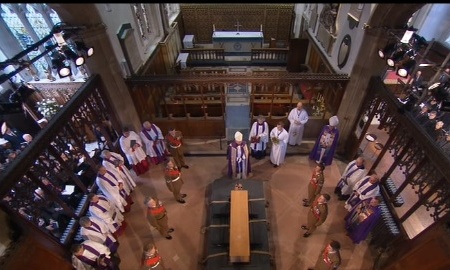
The Bishop of Leicester Tim Stevens says the crowds who thronged to see the king have “confounded the sceptics”.
Richard’s reputation, so much contested and disputed, will, like so many other continue to evolve.
He says that 500 years after the war of the Roses, we still face the threat of damaging tribal behaviour.
God’s power is not like that of kings, presidents, and prime ministers, says Stevens.
We recognise at the graveside that all journeys lead us to this place where reputation counts for nothing and human strife turns to dust.
The Duke of Gloucester reads Exodus 13.19-22 and then the choir sings Psalm 138.
Bishop of Leicester Tim Stevens, begins the sermon
Search, find, honour ....King Richard has stepped from the pages of history into the fullest glare of the world’s attention.
Richard belongs to all of us he says.
They have come here in there tens of thousands not to judge, praise or damn but to stand humbly.
We come to accord this king, this child of god, these mortal remains the dignity denied them in death.
He talks about the city scape of churches giving way to one that now includes mosques and gurdwaras.
This city that will be home to Richard’s grave now strives to build harmony instead of conflict.
The Lord’s prayer followed and now they are singing Psalm 114:
When Israel went out of Egypt, the house of Jacob from a people of strange language;
Judah was his sanctuary, and Israel his dominion.
The sea saw it, and fled: Jordan was driven back.
The mountains skipped like rams, and the little hills like lambs.
What ailed thee, O thou sea, that thou fleddest? thou Jordan, that thou wast driven back?
Ye mountains, that ye skipped like rams; and ye little hills, like lambs?
Tremble, thou earth, at the presence of the Lord, at the presence of the God of Jacob;
Which turned the rock into a standing water, the flint into a fountain of waters.
Richard’s Book of Hours, found in his tent after the Battle of Bosworth, is placed on the coffin by HRH The Duke of Gloucester.
— King Richard III (@KRIIILeicester) March 26, 2015
After the opening prayer, led by the dean of Leicester, David Monteith, the congregation sing O God of Earth and Altar as the coffin is brought in.
The Dean says:
Today we are committing his mortal remains to the consecrated ground of this cathedral.
He calls for remembrance of all those who died in the Battle of Bosworth.
Here history meets the present.
Professor Gordon Campbell, fellow in Renaissance Studies at Leicester University and university public orator, begins with a eulogy, saying this is not a funeral to mourn but a ceremony to afford him a dignified farewell and “to return his bones to the earth”.
He says that Richard’s posthumous reputation has not been great, thanks largely to Shakespeare but this has been revisited over the years.
We have gathered in a spirt of reconciliation, he says, not to argue about facts.
He namechecks those involved in the discovery of Richard III’s remains.
Not everyone watching is in the cathedral
Plenty of hardy souls braving the weather to watch on the Clock Tower screen. There's Benedict! #richardreburied pic.twitter.com/gUhs1k0YoD
— LeicesterCityCouncil (@Leicester_News) March 26, 2015
Here are some more photographs, taken by BBC journalist Martine Croxall.
Queen's Division Band play as dignitaries arrive for the reburial of Richard III at Leicester cathedral pic.twitter.com/t8sYacKMPS
— Martine Croxall (@MartineBBC) March 26, 2015
Bishop of Leicester and Dean of the cathedral awaiting the reinterment of King Richard III pic.twitter.com/2OOn5qP10N
— Martine Croxall (@MartineBBC) March 26, 2015
The Leicester University team has been led in by naval cadets. At the head of the group of archaeologists and scientists was Richard Buckley, head of the archaeology unit, and Mathew Morris, the dig leader who uncovered the bones in the first hours of the excavation.
Philipa Langley, who drove the search for Richard’s remains, has taken her place near Benedict Cumberbatch, newly identified as a distant cousin of Richard’s, wearing a white rose breach in the lapel of his dark suit.
Sherlock star Benedict Cumberbatch arrives at Leicester Cathedral for Richard III's reburial http://t.co/pi9Iyqg2cg pic.twitter.com/RlyRml8JpG
— Daily Mirror (@DailyMirror) March 26, 2015
Updated
As well as the enthusiasm which saw thousands of people watch the funeral cortege and queue to view Richard’s coffin at the cathedral, there have of course been plenty of naysayers as well.
True to form, one of them is the Guardian columnist Charlie Brooker:
I’ve just never really been into Richard III. Maybe it’s his Savile-esque haircut, or the fact that his name is widely used as rhyming slang for fecal matter, or just the way he’s routinely depicted as a murderous, scheming cross between Mr Punch and Quasimodo; a panto villain with nephews’ blood on his hands ...
One funeral isn’t good enough for Richard, no. Apparently he needs two, the diva. Even Liberace was content with just one.
Well we can’t be doing with two funerals. Not in Austerity Britain. Don’t know if you’ve noticed, but the country’s up against it right now. We’re mired in debt, there’s an election on, the cold war’s simmering again, people are running off to Syria, and what are we doing? Burying a king from the middle ages.
While A&E units are shut down or shat on, we’re expected to tug our forelocks and gaze at our shoes, whispering King Richard’s name with hushed reverence as the funeral cortege rolls by, accompanied by people dressed as knights and minstrels and giant turnips. No. No. We can hardly slag off Isis for being medieval when we’ve voluntarily turned the news into a bonus episode of Wolf Hall.
The church is already packed. It is standing room only for some of the late admitted media and arguments continue over at the accreditation desk.
“A hearse a hearse, my kingdom for a hearse” to misquote Shakespeare who was largely responsible for the villainous reputation of Richard III, through the play taught to generations of schoolchildren.
The Telegraph’s Tom Rowley writes that the service today, which he explains is not technically a funeral, is proof that Richard’s reputation has been redeemed somewhat.
The groundlings would love it. Five centuries after the reputation of Richard III seemed shredded forever by Shakespeare, an unscripted epilogue will be staged today in Leicester Cathedral.
Part solemn ritual, part medieval pageantry, the Queen’s Division Band will play as the coffin of England’s last medieval monarch is brought to its final resting place, 529 years after his death in battle.
During a service attended by descendants of the king’s family, and the peers he fought at Bosworth on his final day, his coffin will be placed inside a tomb of stone quarried from the North Yorkshire estate he once owned.
At times, the service, led by Justin Welby, the Archbishop of Canterbury, will look and sound like a state funeral. And yet it will be neither. Not a funeral, because he is thought to have been given one already, by the knights who buried him on the plot that later became a car park where his remains were discovered three years ago. Technically, then, it is a “service of reinterment”.
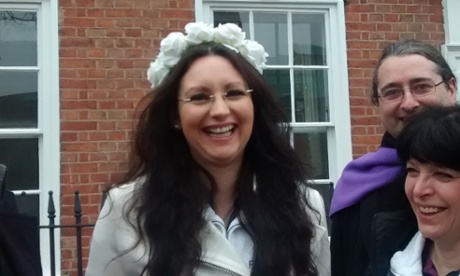
Pauline Carroll in the white rose wreath, and Kim Sidwell, were both excavators at the car park in 2012. They didn’t get seats in the ballot and so came at 8am to get front row places opposite the cathedral. Sidwell said:
Today feels a liitle sad - it’s the end of an extraordinary period in our lives.
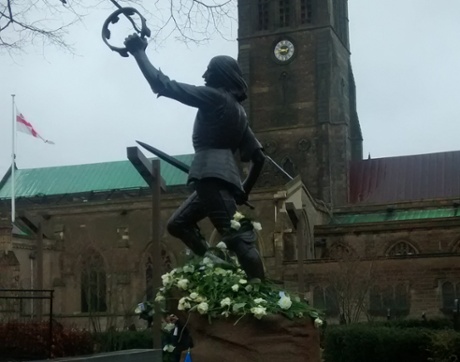
White roses, the symbol of the House of York, adorn the statue of Richard III outside the cathedral. which was part of a £2.5m regeneration project.
The bronze figure, with a new, full-length sword, was restored, cleaned and polished before being installed at Cathedral Gardens, having previously been situated in Castle Gardens, further from where his body was found and from where it will be laid to rest.
Local MP John Ashworth sums up the mood in Leicester today:
It might be wet but tremendous buzz about Leicester this morning ahead of the reinterment of Richard III #RichardReburied
— Jonathan Ashworth MP (@JonAshworth) March 26, 2015
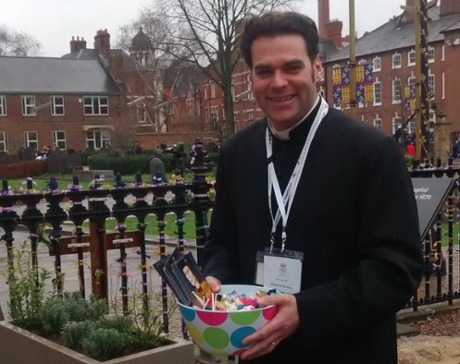
Rev Barry Hill, is distributing mints and lollipops to people going into the cathedral:. He said:
It’s not very dignity and honour but it might keep you going.
Here’s an extract from our preview piece:
The archbishop of Canterbury, Justin Welby, and the bishop of Leicester, Tim Stevens, will preside over the ceremony, which will be attended by the Countess of Wessex, academics and archaeologists from Leicester and other universities, Phillipa Langley - whose unshakable belief that Richard would be found launched the project - local school children, veterans who have guarded the coffin, newly traced descendants of both sides at the battle of Bosworth Field in which Richard was killed, and members of the public who won their seats through a hugely oversubscribed public ballot.
Thousands more will watch the live transmission on Channel 4, on giant screens of the sort usually set up for major sporting events.
The word “cathedral” may conjure up images of the grandeur of St Paul’s or Westminster. St Martin’s in Leicester’is lovely, but small. In Richard’s day, when he was buried in a roughly dug hole smashed through the tiles of the choir of the Greyfriars church just 100 yards away, it was a comparitively modest parish church.
It only became a cathedral in the 20th century in a move that was intended as temporary until something grander could be built. It is, in the words of Rev Pete Hobson, whose personal and clerical life were upended when he became the project manager for the reinterment, “the second poorest cathedral in England”.
Contributions towards the £2.5m cost of the ceremonies, and the dramatic reordering of the building to make space for the tomb, have come from the diocese, the local authorities, members of the public and donations including £100,000 only last week from the Leicester Tigers football club.
Summary
Welcome to live coverage of the funeral of Richard III, more than 500 years after his death.
The reburial will be the culmination of a remarkable series of events, that have captured the imagination of thousands of people.
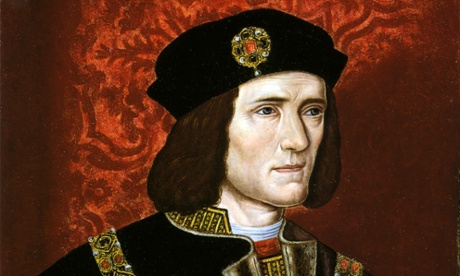
Richard of York was born on 2 October 1452 and died on 22 August 1485 at the Battle of Bosworth, the last English king to die in battle.
But the modern day story began in August 2012 when archeologists announced that they were searching for the remains of an English King under a car park in Leicester. The following month they struck gold.
There followed legal wrangling between a group of his relatives and the Plantagenet Alliance over where he should be buried.
Today, he will finally be laid to rest at St Martin’s cathedral during a solemn ceremony presided over by the archbishop of Canterbury, Justin Welby, and the bishop of Leicester, Tim Stevens.
At 10.30am the procession from Leicester Guildhall to Leicester cathedral will begin.
The service of reinterment will begin at 11.30am, during which the mortal remains of Richard III will be reinterred in Leicester Cathedral.