Behind the Atlantic-facing beaches, close to where a tractor track allows access to the sands, peculiar structures are sometimes found. Though the materials used vary, their basic construction is the same: a longish line of carefully spaced low uprights, made perhaps of stacks of washed-up pallets or retired salmon cage floats, with the gaps between them bridged by other suitable found materials that come to hand.
Though in the summer they seem merely to be abandoned curiosities, at this end of the year their function as drying racks becomes apparent, and many, like the one on the route of my walk this morning, are draped with neatly arranged stems of tangle, or kelp.
The seaweed intended for later use on the fields is scooped up in huge bites by tractor and left to rot in great whiffy mounds. But this weed has been collected by hand, for it has a different future ahead of it.
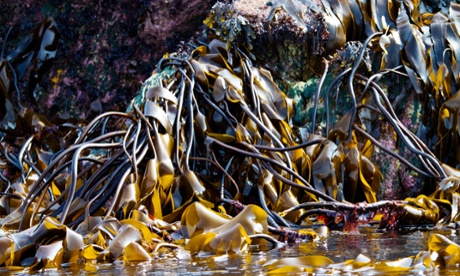
In the winter I’d watched as the fresh oarweed, as it is sometimes known, was gathered from the beach. Some stems were easily picked up from the gale-deposited pile, while others had to be disentangled from the heap with more effort.
Then the broad fan of still glistening fronds would be snapped off, though the gnarled remains of the holdfast were left at the other end. Once brought to the drying rack, the shiny stems were placed across it, each armful parallel to the last and with the weight evenly distributed to prevent the whole wet slithery lot heading groundwards.
Fresh, gleaming and coppery-brown then, the stems have now dulled in colour, becoming tougher, more fibrous and, it must be said, rather less attractive as they’ve dried in the open air. And, surprisingly, dry they do, even in a wet winter such as the last.
Soon they will be collected from the Heath-Robinsonesque racks and, unlikely though it seems, shipped to France and its alginates industry, with an ultimate destination as an ingredient in products as diverse as medicines and food stabilisers.