This series discusses the present and future of washoku traditional Japanese cuisine. This installment features rice that plays a leading role in washoku.
In February 2018, shocking news swept through the most famous region among production areas for Koshihikari rice.
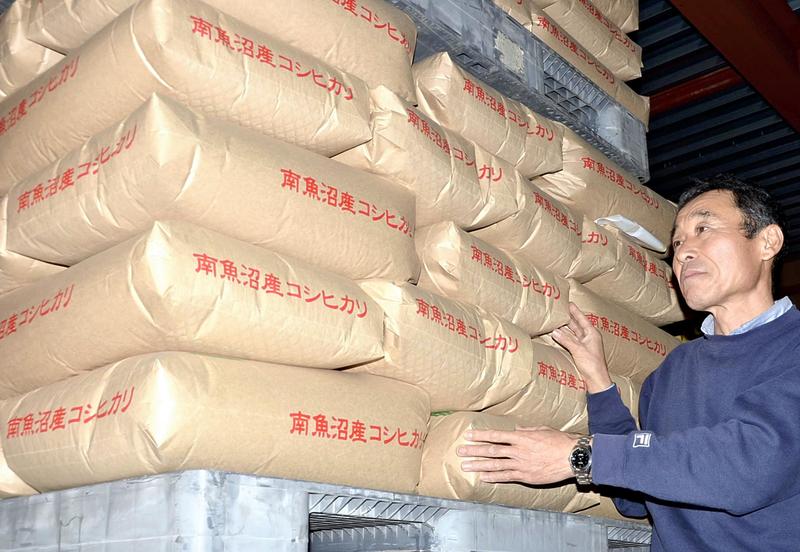
"I didn't think the quality of our rice would fall compared to what we had previously produced. I was completely shocked," said Ryoichi Takamura, 61, who grows rice in 26 hectares of paddies in Minamiuonuma, Niigata Prefecture.
In the annual rice flavor rankings, Koshihikari produced in the Uonuma region in 2017 fell one level from "Special A" -- the highest in the five-tier ranking -- to simply "A."
Uonuma Koshihikari had obtained Special A status every year for 28 years since the grade was first introduced for rice harvested in 1989.
After the results were released, the Niigata prefectural government summoned officials from five cities and two towns where the rice is produced for talks on how to address the situation.
The officials concluded that the delay in harvesting caused by continuous rains had damaged the quality of the rice. "We have to take the rankings seriously because they're widely known," a prefectural government official said.
Under the slogan "regaining Special A within a year," farmers and officials returned to the fundamentals of rice-growing in 2018. The entire production area made an all-out effort to carefully cultivate the soil, examine the progression of growth, and plant and harvest rice in a timely manner, among other measures.
"We might have gotten careless because we took our Special A status for granted," Takamura said. "As a rice producer, I'm deeply concerned with the results of the ranking. I want to see good results."
The rankings for rice harvested in 2018 will be announced in the coming weeks.
Every year, rice-producing areas anxiously await the results of the rankings, which are determined by the Tokyo-based Japan Grain Inspection Association. The organization examines the physiochemical properties of rice, conducting DNA analysis and inspecting pesticide residues, among other tests.
The flavor rankings are determined by human taste testers, who evaluate various samples of cooked rice at 11:30 a.m. The tests are conducted by 100 inspection staff -- 20 each from the head office and four regional branches -- who all have passed gustatory and olfactory tests.
The taste testers sample "standard rice," a blend of Koshihikari from multiple production areas, and rice from each region. They measure the amount of water contained in polished grains, add water and use the same type of rice cookers so that they can cook all of the samples under the same conditions. Every time they conduct a taste test, they eat 50-gram servings of rice from three production areas in addition to the standard rice and compare flavors.
Evaluations in comparison to the standard rice take into account six factors -- "appearance," "aroma," "flavor," "stickiness," "firmness" and "comprehensive appraisal." For example, the color and luster of rice are considered when judging "appearance," while "flavor" is evaluated based on such factors as subtle sweetness and how the rice feels when swallowed. The tasting and evaluation are conducted every day from November, just after the new rice is harvested, until around February before the rankings are released.
"It's very difficult to quantify how delicious rice is by using a machine," said Kiyoshi Funyu, an association official. "There is no way other than to taste it and conduct sensory assessments based on human evaluation."
The flavor rankings first began for rice harvested in 1971. The Special A grade was introduced due to the growing number of samples that were receiving A grades. For rice harvested in 2017, 43 of 151 varieties tested were designated Special A, while 76 were classified as A. The number of samples assessed as Special A has increased in recent years, as there is more and more rice of high quality, according to the association.
Balance of elements determines flavor
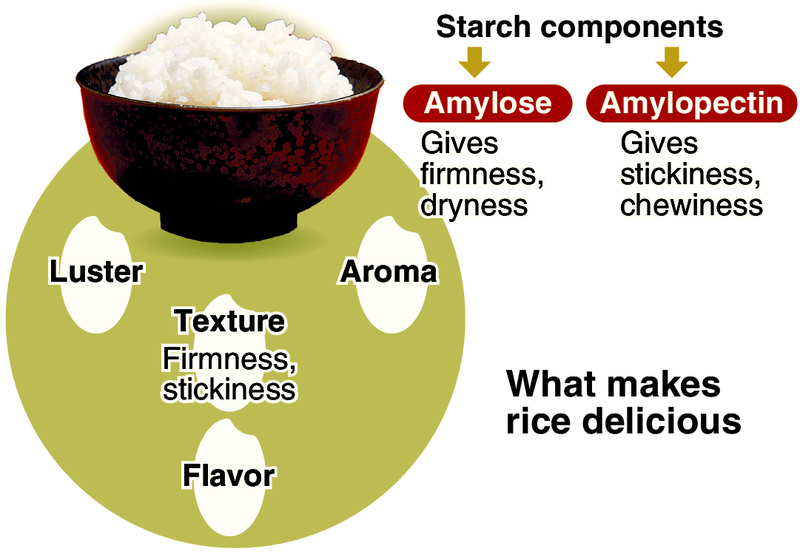
The major constituent of rice is starch, which makes up about 80 percent of the grain. Starch is composed of amylose, which determines the firmness and dryness of rice, and amylopectin, which influences the stickiness and texture. The balance between the two components determines the flavor of rice.
Koshihikari rice, which has dominated rice acreage in Japan for about 40 years, contains relatively small amounts of amylose and has a sticky texture. It is favored by contemporary Japanese consumers.
"Koshihikari's flavor is natural for people born in the Heisei era [since 1989], because they have eaten the rice since they were small children," said Toyozo Nishijima, who runs rice shop Suzunobu in Tokyo and is certified as a five-star rice meister. "They now favor the tastes of new rice varieties with strong characteristics. People have begun moving away from Koshihikari."
Many rice varieties that fully debuted last year have distinctive characteristics. Fukui Prefecture's Ichihomare, for example, is described as "post-Koshihikari" because it has an adequate level of stickiness while retaining a granular texture.
Miyagi Prefecture's Date Masayume features a soft texture, while Yukiwakamaru in Yamagata Prefecture is relatively firm.
"I feel that rice has become an item of taste in a certain sense," Nishijima said. "If there are 100 people, each of them has his or her own tastes, and they choose rice according to their preferences, like wine. Since washoku is highly appreciated overseas for being healthy, more people could enjoy eating it if it is looked at anew in the run-up to the Tokyo Olympics."
To find out more about Japan's attractions, visit http://the-japan-news.com/news/d&d
Read more from The Japan News at https://japannews.yomiuri.co.jp/