One by one, manga works are joining the world of rap, depicting MC battles, or improvised rap battles, in which two rappers throw words at each other.
Elaborately rhyming lines make such manga all the more exciting.
So, do manga and rap get along well?
"I always wanted to draw rap for a long time, but I didn't know how to do so. When MC battles became popular, I thought, 'I can do this,'" said manga artist Kiminori Wakasugi, who draws "Rhyming Man" in the Young Animal manga magazine published by Hakusensha, Inc.
The lead character, Fumio, is a high school student whose life is dominated by his father, a jobless rapper. Fumio used to hate rap, but he gradually comes to find it interesting. There is one scene that demonstrates MC battles are not about trading insults. Fumio faces off with a girl for whom he feels unrequited love, and he assails her with words that are too harsh to repeat here, albeit with love.
"I racked my brain so hard thinking about this scene," Wakasugi said. "He makes a girl he has a crush on cry. But in an MC battle, they say things they can't normally say to each other, and shake hands at the end, feeling refreshed. I feel like rapping myself through this manga."
Wakasugi also included a rapper in his past hit manga, "Detroit Metal City," which was a music-themed comedy like "Rhyming Man." But the new manga has a stronger feeling of a hot-blooded young adult story. "That's because I love rap after all," he said.
Hear it in your head
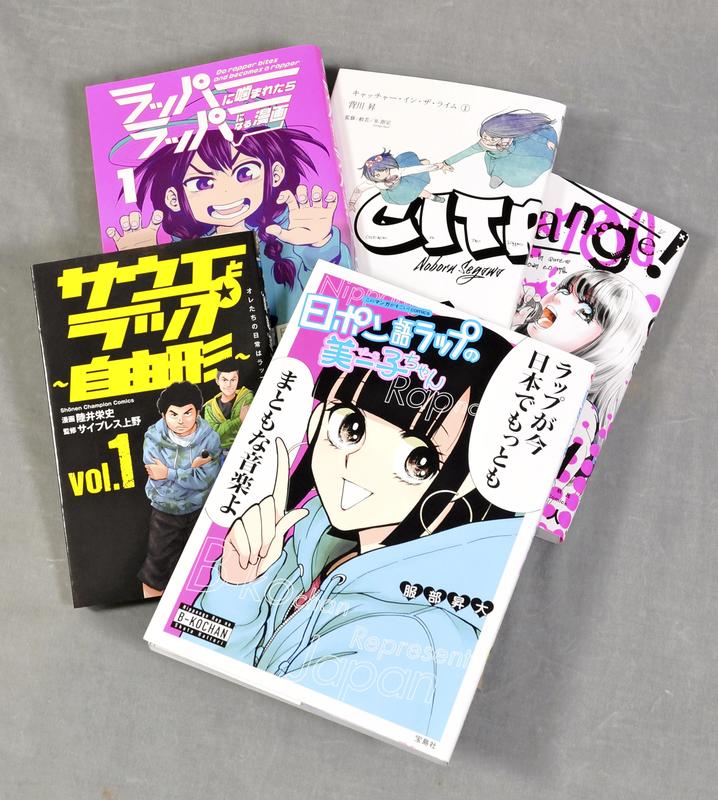
Rap manga has suddenly increased since last year. Among the recently issued works are "Saue to Rap Jiyugata" (Saue and Rap Free Style) by Eiji Mutsui and Cypress Ueno, published by Akita Publishing Co.; "Rapper ni Kamaretara Rapper in Naru Manga" (Da Rapper bites and becomes a rapper) by Inkateikoku, published by Line Corp.; and "Catcher in the Rhyme" by Noboru Segawa, published by Shogakukan Inc.
Masahito Soda, a leading manga artist of hot-blood manga, is also drawing "Change!" featuring a rapper girl in Shonen Magazine, a manga monthly published by Kodansha Ltd.
Rap manga are characterized by rhyming lines.Words are given rhythms and new energy when each line ends on the same vowel.
"Rhyming Man" has a punchline that goes:
Oya ga do toka kankei ne / Dare no sashizu mo uketsukene / Dare no saizu nimo osamarane
(Parents or what, it doesn't matter / I take no one's instruction / I fit in no one's size)
"It takes much longer to draw than usual manga," Wakasugi said, smiling embarrassedly. But rap may have a potential to open a new ground for manga about music. With clever rhymes, rap can make readers feel they are listening to the music in soundless manga.
Rap for beginners
The MC battle boom started with the popularity of satellite TV show "Bazooka!!! Kokosei Rap Senshuken" (Bazooka! High school students rap championship), which began airing in 2012, and "Freestyle Dungeon" broadcast on a terrestrial channel from 2015. Now you can readily watch MC battles on YouTube as well.
Yet rap is still a genre the uninitiated find it hard to approach. For such people, "Nippongo Rap no B-ko-chan" (B-ko of Japanese rap) by Shota Hattori will serve as a rap beginner's guidebook. Part of Takarajimasha Inc.'s "'Kono Manga ga Sugoi!' [This manga is great] Comics" series, it is based on a manga Hattori posted on the internet from 2015 and is a comprehensive compilation of the history of Japanese rap and a list of recommended rap discs.
"You don't need any instrument to brush up your rap skills. Rap is music for the disadvantaged," Hattori said.
He said the current rap boom may reflect poverty and other plights suffered by young people.
"You open up yourself in rap, so it's suited to manga. I hope the stereotype image of rap as a thing for bad boys will change," he said.
©KIMINORI WAKASUGI/HAKUSENSHA
Main characters in "Rhyming Man" by Kiminori Wakasugi are seen in this picture. Fumio, left, is usually shy and timid, but he raps aggressively once he grabs the mic.
The Yomiuri Shimbun
Some recently published rap manga, including "Nippongo Rap no B-ko-chan" (B-ko of Japanese rap) by Shota Hattori, front. Its lead character is based on the heroine of a famous ad manga for a penmanship course.
Read more from The Japan News at https://japannews.yomiuri.co.jp/