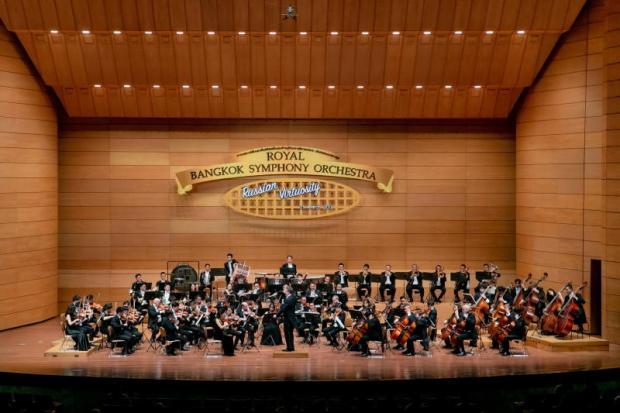
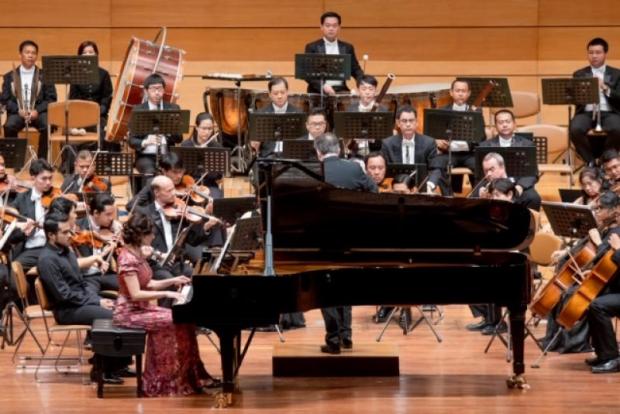
In the presence of HRH Princess Sirivannavari Nariratana, it was a refreshing delight to hear the Royal Bangkok Symphony Orchestra (RBSO) perform Prokofiev's brilliant Piano Concerto No.3 at the Thailand Cultural Centre late last month, with Bulgarian pianist Dora Deliyska rising commendably to the considerable challenges present in this undisputed pinnacle of the literature. It represents an imposing challenge for even top level performers.
Since his appointment as RBSO music director, Michel Tilkin has clearly embarked on a programming policy specifically designed to expand and develop the level of repertoire and technical scope of the orchestra. His choice to conduct and introduce this work counts as a moment of inspired planning.
Titled "Russian Virtuosity", the concert opened with Glinka's firework of an overture Ruslan And Ludmilla which, although absolutely no stranger of a piece to the RBSO (it has been a staple of the venerable orchestra's annual Park Concerts for a quarter-of-a-century), was taken at a furious breakneck speed as it had perhaps not been encountered throughout the ranks before. And indeed all desks of the first violins in particular had a noticeably improved overall sheen to them, with many familiar faces of experience from the orchestra's history now increasingly supplemented by an equal number of youthful new recruits, all happily brimming with energy and enthusiasm after presumably fruitful recent studies in major musical centers abroad.
Although composed in France when the country was becoming his second home following the international earthquake which was "The Great War" (following in the footsteps of Stravinsky, he also began a collaborative ballet relationship with Parisian impresario Diaghilev), Prokofiev's first truly tuneful piano concerto is still wholly Russian in spirit. Of the five concertos, it indeed remains the most popular for audiences and performers worldwide. It makes use of compositional materials and ideas he had been storing up for use over a decade, hence the unusual depth, density and pure musical quality of its many expressive strands. The composer was deeply in love with his future wife at the time, and this comes across in the score. The dedicatee of the masterpiece, poet Konstantin Balmont, wrote these lines to describe it: "Prokofiev! Music and youth in bloom" , "in you, the orchestra yearns for forgotten summer sounds", "and the invincible Scythian beats on the tambourine of the sun".
Prokofiev is always ear candy of the most aurally delicious variety, and he is often very much a musical chameleon in character, with orchestral colours shifting constantly just as chromatically tinged harmonies regularly sidestep our tonal expectations with an ever-so-clever sleight-of-hand.
Deliyska was at her best in the quieter, more reflective passages, where she was able to coax some spellbinding sonorities out of the Steinway. Chief among these were Variations 1 And 4 of the central movement, the intoxicatingly beautiful nature of the latter marked at figure 69 in the score, where time seems to stand still in an exquisite reverie. However, the pianoforte is categorised as a member of the percussion family, and we are dealing here with a work that (in much the same way as Bartók) treats it uncompromisingly as such for much of the piece. Deliyska didn't come across as a pianist blessed with the ability to transmit substantial power all the way from the shoulders down through to the hammers which actually strike the strings. Thus the quirkily demonic nature of Variation 3, for example, as with many other forceful, louder passages, unfortunately didn't come across quite so convincingly under her fingers.
Tempos were also often significantly slower than standard metronome markings, which meant some measure of the thrust and momentum of the music's insistent lines was occasionally lost. Given these relative pianistic limitations, however, the note-playing was largely accurate and faithful to the score (she didn't perform from memory, probably a wise decision), resulting in an admirably brave rendition which was more than enough to impress and please the TCC audience. Deliyska duly reappeared after the curtain calls and applause for a touching encore, which was well suited to her style of pianism. Chopin's Waltz No.10 In B-minor Op.69 was politely shaped, apart from one slightly unclean chord spacing.
Tchaikovsky's emotionally turbulent Symphony No.6 In B Minor Op.74 (Pathétique) was then played superbly by the RBSO, with Tilkin directing the Herculean score with huge passion, focused conviction, and a musical commitment which perhaps surpassed even his other recent TCC appearances. In front of the podium there were moments of challenging orchestral passage work in which a number of players approached an international level of professional credit, and in fact the entire ensemble did a splendidly convincing job of bringing this best known of symphonies alive. The raw power of its unavoidably depressing denouement cast an electric atmosphere as the final string utterances faded to total dead silence -- a profound, sobering experience for all.