
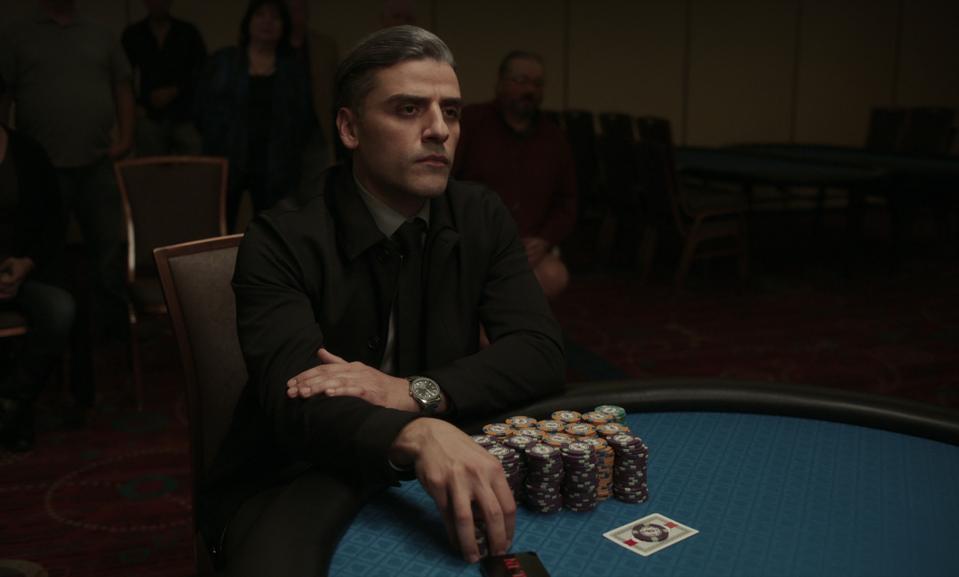
Paul Schrader is no stranger to troubled male protagonists with dark pasts or presents, and The Card Counter follows yet another such protagonist in an engaging film that can interestingly be called both muted and electric at the same time. The film stars Oscar Isaac as former interrogator-turned-professional gambler William Tell, a man torn away from the world in every possible way by his past sins. William was one of the military interrogators who went down for torturing prisoners at the Abu Ghraib prison in Iraq. He served a time for it, a sacrificial lamb of sorts thrown under the tread of the military machinery while civilian contractors and military brass walk away clean. In the slammer he taught himself the art and probabilities of counting cards, and ever since he lives on the road, a modern anonymous nomad running from regret.
One fateful gambling foray sees him visit a talk by an old civilian contractor in Iraq, the man who trained him to torture, Major John Gordo. Despite Gordo’s pivotal role in the torture, he walked away free from the fallout. William is chased down by Cirk (Tye Sheridan), the son of another of Gordo’s trainees who similarly fared less well than Gordo—he killed himself. Cirk recognizes Tell and proposes a plan: revenge. Simultaneously Tell meets La Linda, a backer of gamblers who’d like Tell to up his takes and work with her—she provides the cash for bigger endeavors and he splits the winnings. These counter-pulls disrupt Tell’s ordinary life, propelling him towards a tense crescendo at the end.
William Tell is a muted man, one who travels solo, gambles modestly, wraps his motel rooms in white sheets to eliminate all traces of his existence... not just from the casinos he frequents but from himself. He’s a man who deep down wants to be erased, and Isaac plays him with such a steadied intensity and visible regret that it’s easy to sympathize with him even as you know he’s done the unforgivable. It’s clearly his film, around which the rest rotates. Tye Sheridan also gives a solid performance as Cirk, an unmoored and somewhat spontaneous young man with a troubled familial past. Tell seems to gravitate towards Cirk as almost a father figure would—as it saving him means saving a part of himself.
Alexander Dynan’s cinematography is another bright star here, ably using light and color to make the motel rooms featureless, the hopeful excursions magical, and the casinos and hotels feel oppressive, menacing, and all-consuming. Accompanied by an exceptionally emotive score and each moment feels like Tell’s life is a constant stream of being digested by these dark, dingy dens and spit out for eternity.
As always, Schrader has a knack for dialogue that rings both true yet unusual, though in this case there are a few errant moments of exposition that could use a little honing. Structurally, the film is a breezy watch even if only to watch Isaac’s masterful performance. It’s engaging throughout, although some plot turns in the set up or towards the climax feel a little abrupt or convenient. The biggest issue with the film, unfortunately, is with Tiffany Haddish as La Linda. It’s impossible to walk away from any scene she’s in here without a strong sense that she’s acting or attempting to wear a performative shoe that doesn’t quite fit. Stacked against Isaac’s flawless performance and the miscast stands out every time.
The Card Counter is an engaging film about a man haunted by his own sins, and one adeptly performed by an Oscar Isaac at the peak of his powers. Is it a perfect film? No. But it is a quite good one that succeeds royally as a showcase of Isaac’s considerable talents, alongside a masterful command of tone thanks to its stunning and moody cinematography and score. It’s definitely one you won’t want to forget, and Isaac’s performance certainly won’t be forgotten come Oscar season.
The Card Counter releases in theaters September 10th.