Alex would have been happy with a quiet life, but that's not what Alex got.
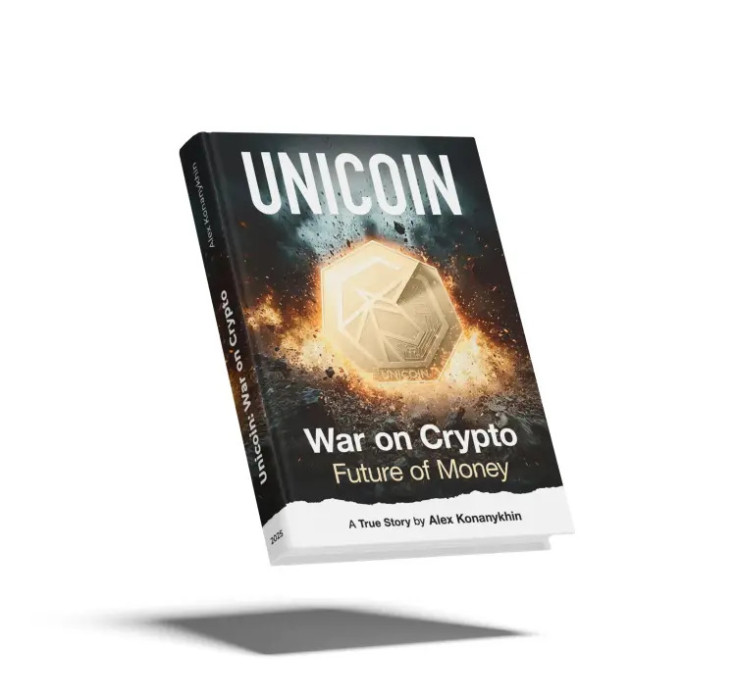
Over the years, literature on cryptocurrency leans toward either dystopian fear mongering or idealistic evangelism, but somewhere in between lies reality. That's the story told by UNICOIN: War on Crypto & Future of Money. It's the true-to-life chronicle of Alex Konanykhin, a crypto visionary who is determined to do things the right way, much to the chagrin of the SEC.
From a kidnapping to a coup, life on the run, hunted by the Mafia, creating a multi-billion dollar business, and everything else you might find in a Tom Clancy novel, Alex has stayed afloat. Yet, the battle extends far beyond his one company. In this telling, it's an ongoing struggle over who will control the future of finance.
The Indiana Jones of Finance
Alex Konanykhin rose from a young physics major in the Soviet Union to one of Russia's earliest leaders in private banking. By his mid-twenties, he had co-founded the Russian Exchange Bank and built an empire worth hundreds of millions of dollars. Unfortunately, this made him a high-profile figure in a place where wealth and power shifted like a feather in the wind.
After being kidnapped in Hungary in 1992 and escaping, Konanykhin sought refuge in the United States. Starting over, Alex smoothly transitioned to tech. The ability to think on his feet set the stage for his next move into the world of digital assets and the creation of Unicoin.
A Cryptocurrency That Embraces Regulation?
It's a bold premise and one that backfired most dramatically. While traditional cryptocurrencies can be too volatile to serve as the foundation of a new monetary system, Unicoin was created to fill the gap. It seemed simple enough.
The unique currency was supported by tangible assets, audited religiously, paid dividends, and was voluntarily reported to US regulators. The entire setup was purposely designed to embrace oversight, rather than dodge it. Yet, Unicoin was severely punished for doing just that.
Trust Before Trading
Unicoin was launched in 2022 with a consistent branding campaign, a tactic that has never been seen before in the cryptocurrency world. The strategy was pretty straightforward. Rather than rushing to speculative trading markets, the Unicoin team prioritized brand development, asset acquisition, and institutional credibility.
Testimonials, extensive press coverage, and even an internationally televised investment series, Unicorn Hunters, helped build awareness and legitimacy. Only after strengthening those fundamentals, the book declares, did the team prepare for major exchange listings.
From Compliance to Confrontation
Everything seemed to be coming up roses, and just as Unicoin's worldwide marketing campaign scaled across TV, billboards, taxi tops, and digital channels, the Securities and Exchange Commission (SEC) issued notice of its intent to sue—not as regulation, but retaliation.
The Bigger Fight: Innovation vs. Incumbency
The persecution of Unicoin is situated within a larger fight. The global crypto market has surpassed $4 trillion, and while digital assets attract mainstream adoption, for some people, they threaten to erode certain control over traditional financial systems. As a result, banks and some U.S. regulators have a strong incentive to slow the evolution of cryptocurrency.
A few years ago, under the leadership of Chairman Gary Gensler, the SEC launched high-profile enforcement actions against high-profile digital-asset companies. Eighteen state governments challenged the constitutionality of these efforts, and a federal court subsequently fined the SEC for abuse of power.
These events legitimize Unicoin and elevate the battle from a corporate dispute to a constitutional issue. Is U.S. regulatory power being used to protect investors, or is it being used to shield incumbents?
The International Ripple Effect
The market implications are apparent. The legal action against Unicoin not only imposes multi-billion-dollar damages on thousands of investors, but sends a loud message to global innovators: build elsewhere. As the book notes, technological revolutions rarely tolerate stagnation. They simply migrate.
A Warning for U.S. Crypto Leadership
UNICOIN: War on Crypto & Future of Money teaches us you can never be too comfortable. The book makes a sober economic point: American leadership in digital finance is not always guaranteed.
If regulatory bodies continue to define innovation solely through enforcement, the next generation of money may not be centered in New York or Silicon Valley, but rather, in countries more comfortable balancing risk with progress.
An Ongoing Issue
The fight is far from over, and this book does not have a happy ending (although escaping kidnapping is a plus). The story is still being written. Whether the SEC's case dissolves under a new administration or escalates into a precedent-setting trial, the outcome will echo far beyond one company.
"This war is about controlling the Future of Money," the author writes, and the final chapters, in courts, in Congress, on trading floors, are not yet recorded.
For investors, UNICOIN can be a tale of caution, yet conviction. It's not just a book. It's a statement that responsible innovation deserves encouragement, not prosecution. This means, companies trying their hardest to follow the rules, should not be sacrificed in the name of preserving a system that already challenges their existence.
The ongoing story of Unicoin reminds us that no matter what, regulatory clarity is the deciding factor in all emerging asset classes. The crypto market has proven it can grow extremely fast. The burning question is whether the US intends to lead that evolution, or litigate itself out of relevance. Alex is gonna ride the wave, regardless.