UN humanitarian and development agencies have quietly transformed the way that they talk about climate change, The Independent has found, with internal strategy documents showing a sharp decline in references to the issue since Donald Trump returned to the White House.
Key agencies including the World Food Programme, the International Organisation for Migration, the UN High Commissioner for Refugees, and the UN Development Programme are all talking significantly less about climate change in strategic documents that drive their multi-billion dollar programmes. This is despite the fact that the climate crisis is only intensifying as each year passes, driving record heatwaves, devastating droughts, and catastrophic flooding around the world.
It comes as US government departments and aid programmes have shifted away from climate action since Trump’s re-election, and reflects the significant pressure that the climate sceptic US – as a major aid donor – can place on the UN.
“The current US administration decided to withdraw from 66 international organisations, in what was a profound retreat from global cooperation that is actively undermining the collective safety and health of people everywhere,” says Catherine Pettengell, executive director of the Climate Action Network UK, which represents 45 civil society organisations working on climate change.
“But the UN can and must hold firm on this most urgent issue of our time. It must not be cowed by a government that has pulled its funding and is neglecting its responsibilities to its own citizens as well as the rest of the world.”
“This change in approach from UN agencies demonstrates the real-world impact of the Trump Administration's lack of leadership on climate change,” adds British MP Tracy Gilbert, who co-chairs the UK All-Party Parliamentary Group on the UN Sustainable Development Goals.
“We have seen in the UK the impact of climate change with more extreme and unpredictable weather. This will be felt even more harshly in developing countries reliant on this aid, and will have ramifications for the entire world, regardless of whether political parties accept the reality of climate change.”
The findings from The Independent come a week after the World Bank – another major development agency closely affiliated with the UN – ditched a target for delivering climate benefits with 45 per cent of its annual lending, in what has also been seen as an example of a global institution responding to US pressure.
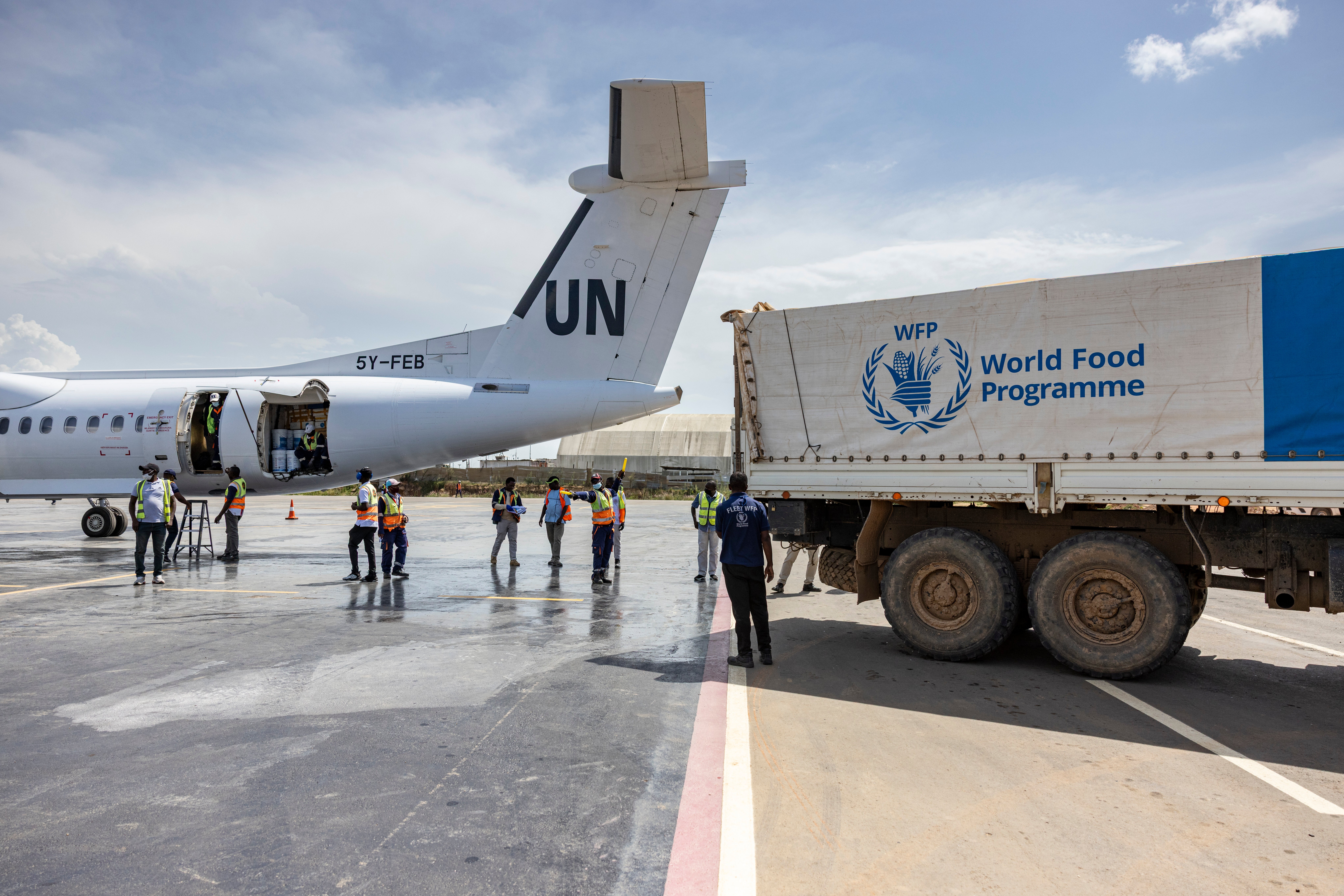
The World Food Programme is the world’s largest humanitarian organisation, targeting 110 million people in 2026, following a period in which food insecurity has been increasing year-on-year due to global threats including climate change and conflict.
At the same time, The Independent has found that as different country programmes gradually release updated strategies in the Trump era, they are talking less and less about the climate crisis.
Rwanda, Iraq, and Guatemala – three countries considered extremely climate vulnerable – mentioned the word “climate” 31, 23, and 41 times in their second most recent strategic country plans, which were all published during the first Trump Administration between 2018 and 2020. But their strategies published since Trump came to power for the second time respectively mention the term twice, once, and not at all
Ethiopia and Rwanda also redrafted strategic plans over the course of last year, with early strategic plans mentioning “climate” 10 times and nine times, and later plans mentioning the word four times and three times.
For Mauricio Vazquez at think tank ODI Global, the findings reflect how the US has traditionally been the biggest backer of WFP since its foundation on the recommendation of President Dwight D Eisenhower in 1961. “WFP has always received particularly high US funding and within the UN system. This shift from agencies is happening to ensure their survival,” he says.
Countless programmes around the world, including some seen by The Independent, show that WFP is still responding to climate needs around the world, and the organisation is continuing to apply for climate funding from the major climate aid funds, Vazquez adds. But that is not to say that a new reticence to talk about the climate crisis will not have potentially significant impacts on its development programmes.
“Climate risk does not disappear because it is no longer prominently featured in strategy documents to accommodate political sensitivities. Instead, vulnerabilities are only growing,” Vazquez says. “Climate adaptation and resilience should not be seen as different from development outcomes; they are often what determines whether investments succeed or fail over the long-term.”
WFP is not the only UN agency to scale back references to climate change in its strategic planning. The United Nations Development Programme (UNDP), a multi-billion-dollar agency that supports countries in developing national development strategies, reduced references to "climate" from 25 in its 2022–2025 Strategic Plan to 15 in its Trump-era 2026–2029 Strategic Plan.
The two UNDP documents are the same length, but their framing noticeably differs. The earlier plan opens by declaring a "planetary emergency" and identifies "mitigating and adapting to climate change" as a core priority. The latter plan begins with broader concerns about threats to "the world's resilience" and growing challenges to "the principles of multilateralism," without highlighting climate change in the opening.
In other UN strategies, references to "climate" remain, but increasingly as a qualifier for terms such as "shocks" or "resilience" rather than "change". This shift in framing places less emphasis on the human drivers of worsening extreme weather and more on responding to climate-related risks, potentially allowing such events to be understood as natural hazards rather than effects of accelerating global warming.
.jpeg)
The International Organisation for Migration, another UN development agency that focuses on supporting migrants around the world, mentions “climate change” 41 times in its Biden-era 2024 appeal for donors. Its Trump-era 2026 appeal is significantly shorter at 36 pages rather than 97 pages, and it only mentions “climate change” twice in contrast to the 41 appearances of the phrase in the 2024 edition.
The UN High Commissioner for Refugees (UNHCR), which supports refugees around the world, shows a similar pattern in its annual regional response plans. Between 2024 and 2026, references to “climate change” fell from six mentions to four mentions in the Syria edition; from seven mentions to two in the Sudan edition; and from seven mentions to zero in the Ethiopia edition.
For Karen Mathiasen at the Center for Global Development think tank, it is “too early to say” whether these rhetorical shifts are resulting in a serious impact on how programmes are designed. “[But] UN agency strategies are important because they set priorities, guide resource allocation and provide a framework for accountability,” she says. “They are more than communications documents, and they help shape an agency's strategic direction.”
US funding for UN agencies was heavily cut in the first year of this latest Trump administration. Funding for the WFP fell from $4.5 billion (£3.4bn) to $2.1bn, for the UNHCR it fell from $2.1bn to 0.8bn, while funding for other agencies is not yet totally clear.
The pattern of less mentions of climate change is not evident among all UN development agencies. Several – including the United Nations Population Fund, UN Trade and Development, and the World Health Organisation – do not face the same issue due to the fact that the US has effectively withdrawn all support.
The UN Office for the Coordination of Humanitarian Affairs (OCHA), which is both a major humanitarian funder and responsible for coordinating operations with NGOs, continues to heavily reference climate concerns in its Trump-era appeals. But money it has accepted from the US under Trump has come with significant stipulations, including that the money only go to a defined set of priority countries, and that the money should prioritise immediate emergency relief rather than broader development or resilience activities.
Another exception to the pattern is Unicef, the UN children’s agency. Nearly every country to have published a country plan during Trump’s second term has seen references to “climate” increase significantly compared to previous editions, reflecting not only how climate impacts are escalating the world over, but also the fact that Unicef national strategies are drafted with national governments. This can mean much less influence for major donors. Unicef has also traditionally received a lower portion of its funding from the US than agencies like the WFP, with America providing around 14 per cent in 2024.
One notable outlier among the Unicef strategies is Argentina, whose updated strategy has removed all references to “climate”. Argentinian President Javier Milei is a close ally of President Trump, and he regularly states that he does not believe in man-made climate change.
In response to this article, a spokesperson for IOM said that “climate mobility remains central to IOM's mandate and operational response”, adding that the methodology used here “does not capture the breadth, scale or trajectory of IOM's climate mobility work”. A spokesperson for the UNDP said that “addressing climate change is a structural pillar of our organisation, reflected in direct and measurable action in the countries we support”.
Andrew Harper, special advisor on climate action to UNHCR, said that climate change is an “existential threat to refugees and displaced people” which “continues to be reflected in our operational priorities and communications”. But he added that as a result of shrinking foreign aid pools and growing needs of refugees around the world, “partners are being forced to prioritise the most urgent life-saving and protection interventions”.
Unicef, WFP, and the United States Mission to the UN have also approached for comment, but a reply was not received by publication.
This article has been produced as part of The Independent’s Rethinking Global Aid project