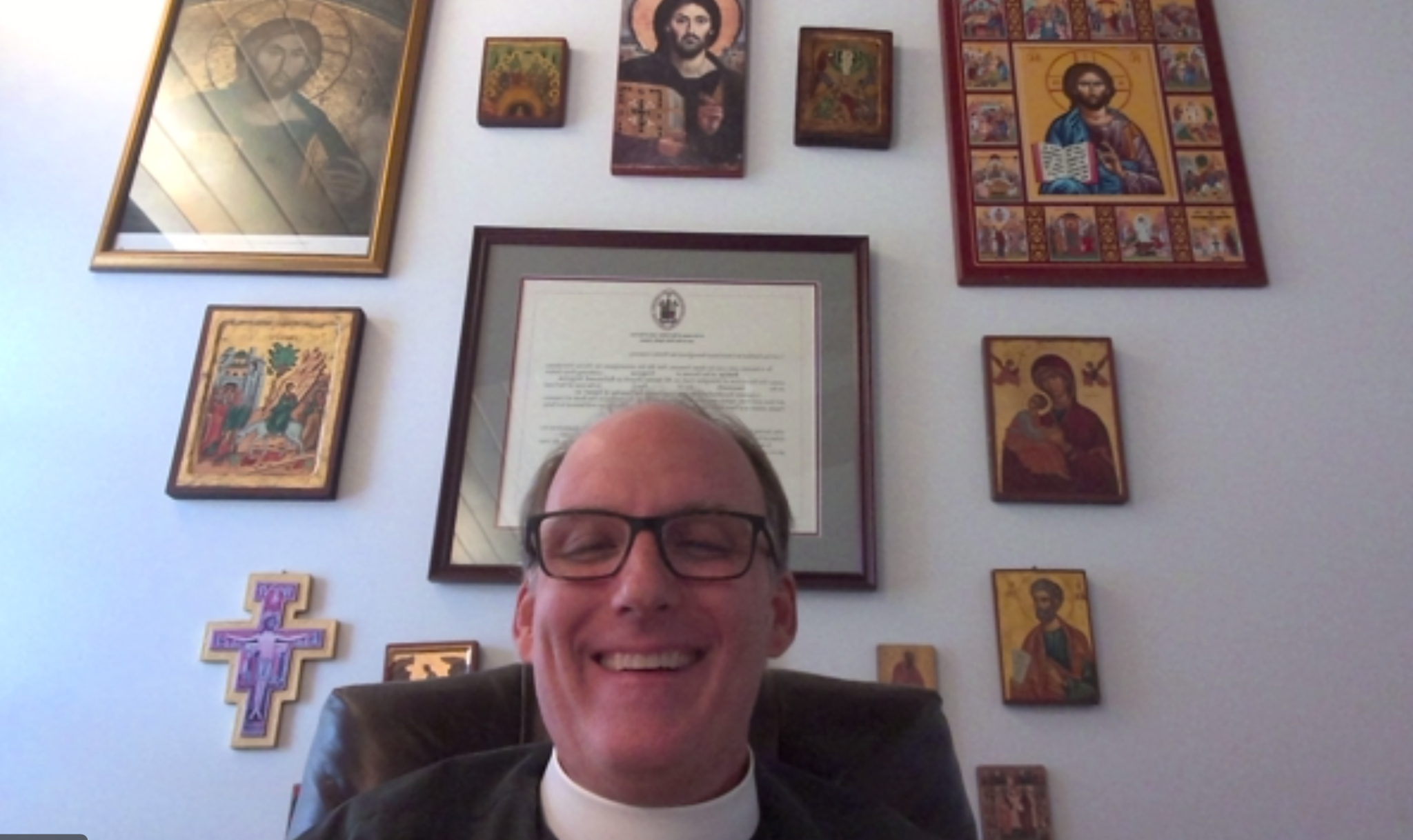
Long before the Rev. Tom Simmons turned “Priest in the Hot Seat” into a podcast, it was an annual tradition for teenagers at St. Peter’s Episcopal Church.
Each year, the youth group gathered for an all-night event with sleeping bags, snacks and plenty of questions about God, faith and life in general. Simmons sat in front of them and opened the floor to whatever was on their hearts.
“People have a lot of questions about the Christian faith,” Tom Simmons said. “They often don’t know who to ask, or they don’t feel comfortable bringing up difficult questions, or they’re just not thinking of their questions when they have an opportunity to bring them up. So many questions go unanswered.”
Simmons wanted the students to understand that it was okay to ask. They asked about demons and doubt. They asked about other religions, suffering, prayer and whether Jesus was really listening. Simmons answered directly, without a script and without flinching.
Over time, “Priest in the Hot Seat” became more than a youth event. It became a trusted space for honest questions.
It also became a future digital mission field.
From One Night to an Ongoing Ministry
The first person to see the podcast’s potential was Chris Hunt, the church’s youth minister and a media production professional. For years, he had watched the format connect with teenagers. Eventually, he began asking a bigger question.
What if this did not have to happen only once a year? What if it did not have to be limited to the youth group?
“Chris was key in developing the podcast, both from a visionary and technical point of view,” Simmons shared. “On vision, he was key in imagining what this could be. Starting from the initial idea, he suggested the name and the audience focus.”
The idea for the podcast was simple and timely: bring the honesty of the hot seat to a wider audience, first within the congregation, then across the community and eventually to anyone online with questions about Jesus and their faith.
Hunt knew how to build it. His media production background gave him the experience and connections to move the idea from concept to reality. He brought in Eduardo, a colleague with video and audio expertise, and together they helped St. Peter’s test the format before the church made major purchases.
“Chris had access to all the equipment we needed to set up a loaner studio in my office,” Simmons explained. “With that borrowed equipment we could try a system, test out how well it worked in that space, and then select the right equipment when it came time to purchase our own. This saved us a lot of expensive trial and error. It worked out very well.”
Once the concept proved itself, the resources followed.
A $1,500 grant from the Robey Foundation helped move the project forward. The family behind the foundation has a century-long relationship with St. Peter’s Church, dating back to its support of the church’s 1922 Bell Tower project. Additional gifts came from members of the congregation, with the balance covered by the vestry.
Within a few months, the borrowed setup became a permanent studio. A producer named Josh was trained and the system was running smoothly. “Priest in the Hot Seat” was no longer an annual youth tradition. It had become a weekly ministry.
What COVID-19 Taught the Church
The move online did not come out of nowhere. Like many churches, St. Peter’s learned during the pandemic that digital formation could reach people in ways traditional church programming sometimes could not.
In many ways, Simmons saw it as a modern-day Acts of the Apostles movement. The Word of God kept moving, even when the church had to find new ways to gather.
“Through COVID, we discovered that very rudimentary Zoom videos, turned into video files and emailed to the congregation, generated much more participation than we could get with in-person forums or classes,” Simmons said. “If we got 10 or 15 people to a series of classes on Sunday between the services, we would easily get double that for the same sort of content in a video delivered via email to the congregation.”
The reason was not complicated.
“It’s just so much more convenient to watch a video at your leisure than to come early or stay late at church on Sunday for a class,” he said.
When lockdowns ended, the church moved away from the video format. It no longer felt necessary. But the lesson stayed with Simmons and Hunt: people would engage with faith formation when the church met them where they were, on their own time and in a format they could revisit.
That became one of the seeds of the podcast.
The early response suggests they were right. Since launching “Priest in the Hot Seat,” St. Peter’s has grown its YouTube subscriber base by 15%. During the pandemic, videos often drew 40 or 50 views. Now, Simmons said, episodes regularly draw more than 100 views, with some reaching several hundred depending on the topic.
The growth has happened organically, before the team has fully focused on search optimization and broader distribution. Simmons sees that as the next phase of the work.
The Rev. Tom Simmons Is Open To Hard Questions: ‘Why Not Ask?’
Eighteen episodes in, the podcast carries the same spirit as the old youth lock-ins, but the room is much larger.
The questions still range widely. What is Lent? What about demonic forces? Does Islam teach violence? Is the pope a pacifist? That last episode, Simmons said, drew more conversation than any other so far, especially because of its timing amid major headlines involving Iran. The episode on demonic forces and spiritual warfare has been another hit.
Simmons sees the podcast as more than content. He sees it as a way to meet people where they are. The gospel has always moved toward people, into homes, marketplaces, conversations and communities. In a digital age, Simmons said, that also means showing up on the platforms where people already ask questions, search for answers and try to make sense of faith.
“Once you open that door and provide a forum in which people can raise their questions, assured of receiving an answer, it helps them be bold and ask,” Simmons said. “And once they’re receiving a weekly podcast with a different question being answered every week, it reminds them that they have questions too, and why not ask?”
That is why Simmons does not see digital ministry as secondary to church life. He sees it as another way to carry the Good News beyond the walls of the church. People can listen on the way to work, while cooking dinner for their families or during their own private study time.
“The podcast medium makes it easy to send episodes to colleagues and friends and family, people outside the normal distribution network of our congregation,” Simmons said. “And we’ve also noticed that some topics seem to pick up wider viewership through the algorithm of YouTube.”
The team has started experimenting with social media distribution as well, with a particular focus on reaching people in the broader Purcellville area. Some may never walk into a Sunday service first. But they may watch a 15-minute video that answers a question they have quietly carried for years.
To Simmons, that is part of the call: go to the people, make room for their questions and trust that God can water the seeds.
Turning Strangers Into Friends
St. Peter’s has a five-word mission statement that shows up often when Simmons talks about the podcast: “Turning strangers into friends into followers of Jesus.”
It is a sequence, not just a slogan.
A stranger may first encounter St. Peter’s through a question. A viewer who keeps watching may begin to trust the church. Over time, Simmons hopes that trust grows into relationship, and that relationship draws people closer to Christ.
“My vision for the future is to reach as many people as possible in the online environment,” Simmons said, “to engage them with meaningful content, developing relationships that keep them coming back for more, to deepen their knowledge and connection with Jesus.”
Practically, that means the team will spend the next season sharpening its distribution strategy, improving search visibility and learning more about who is watching.
The approach is the same one that carried the project from a borrowed camera to a working studio – test, learn and keep building.
It would be easy to describe “Priest in the Hot Seat” as an old youth-group idea repackaged for a new platform.
Simmons sees something deeper.
“It would be great,” Simmons shared, “if this podcast brought our neighbors in western Loudoun into our fellowship at St. Peter’s Episcopal Church in Purcellville.”