Twenty years ago, volcanic eruptions forced the evacuation of the entire population of Miyakejima island, which is part of Tokyo's Izu islands.
A number of islanders who left during the natural disaster that occurred Sept. 2-4, 2000, have since returned, while there are also newcomers now making the island their home.
Talking with a pair of native islanders now serving as tour guides gives us an idea of what makes this volcanic island so enchanting.
--Chance for a new life
When Mt. Oyama erupted in 2000, Shiitori Shrine in the Kamitsuki district on the island's northeast side was engulfed in a mudslide of volcanic ashes. Today, the upper horizontal beam of the torii gate and part of the roof of the shrine hall are the only traces visible amid a grassy field.
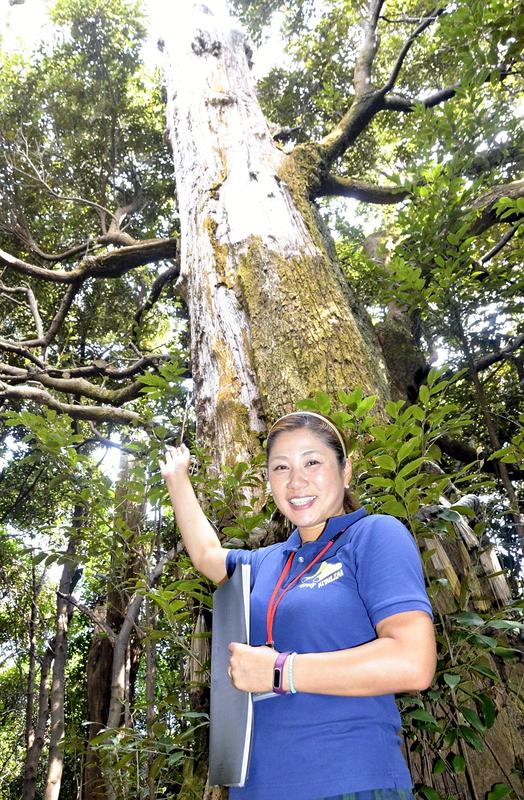
The shrine's sacred tree, a sudajii broad-leaf tree believed to be about 250 years old, still stands, and while the upper part is wilting and turning white, new buds sprouting from the trunk and roots have produced thick, green growth.
"Volcanic eruptions are also a chance for new life to bud," says Hitomi Kikuchi,the island's official nature guide, as she looks up the thick trunk of the tree.
Kikuchi, 44, moved to the island from Nara Prefecture in 1999 to work as a guide for dolphin watching. But the next year, while on a trip back to hometown, Mt. Oyama erupted. Since she could not return to the island, she became a lecturer at a technical school for animal care.
But she could never keep the abundant nature of Miyakejima out of her mind, so she returned in 2007 and began working as a tour guide for sightseers.
The island exerts a similar hold on others. "This is the only place I can go home to," says a middle-aged woman, who resumed running a minshuku guest house even though the number of tourists seriously declined. There were elderly who came back despite the presence of volcanic gases, saying they want to part of the soil of the island when they died.
"I think there's a similarity between the sudajii tree that survived the eruptions and the islanders who want to live there no matter what," Kikuchi says. "I must tell about these people, as well," saying that she regards it as her mission as a tour guide.
--Designated 'Geo Spots'
Since the 11th century, at least 15 volcanic eruptions are known to have occurred on Miyakejima. The island is rich in nature nurtured by the volcano since ancient times -- a fresh-water lake created at the time of a volcanic eruption 2,500 years ago; mountains born from eruptions; oddly-shaped rocks resulting from eroded lava; rare birds migrating to the island.
To utilize such nature as a tourism resource, the village of Miyake selected 25 locations of unique scenic beauty on the island linked to eruptions, labeled them "Geo Spots" and prepared them as tourist attractions. Shiitori Shrine is one of them.
A nature observation facility operated by the Miyake government called Akakokko-kan trains the nature guides who take tourists to the Geo Spots. Kikuchi is among about 10 people now working as nature guides accredited by the facility.
--More than sightseeing
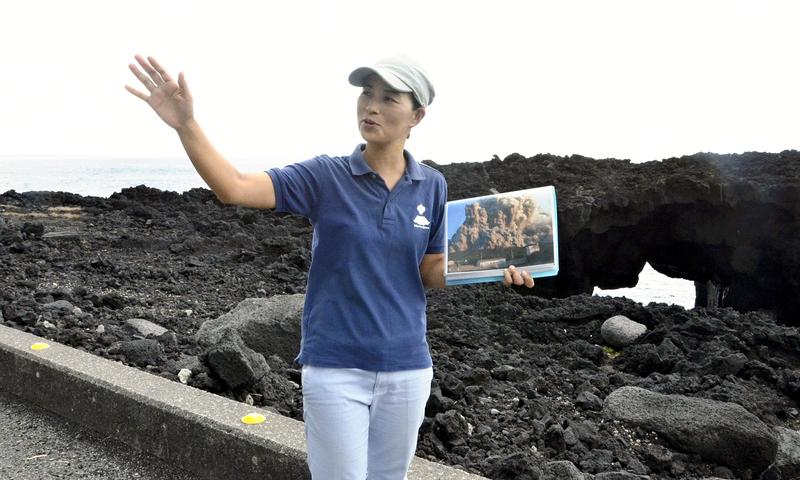
However, Kikuchi and others don't want to just take tourists to sightseeing spots. Natsu Hirano, 35, a native islander who was in the third year of junior high school when the eruptions occurred, is among them.
Her parents returned to the island in 2005 when the evacuation order was lifted for the whole island, but Hirano, enrolled in a graduate school in Kanagawa Prefecture, decided to continue her research on marine ecological systems.
But she felt the pull of her home island after taking a friend there on a diving and camping trip. "Miyakejima is really nice," her delighted friend said. So overjoyed was Hirano to hear such a comment, she decided to return to the island when she was 24.
"I want to do my part to help the island as it still undergoes reconstruction," Hirano thought at the time.
The island is also subject to typhoons, and when one approaches, it is normal for local residents call on each other, pay visits to elderly living on their own, and help reinforce shutters and make other preparations to brace for the storm.
While guiding tourists, Hirano relates the experiences of residents. "As I was heading to a shelter with my child after one of the eruptions, I felt really safe because I was with my neighbors," Hirano says one resident told her.
"Connections in local communities and conversing with people on a daily basis ultimately helps protect you and those important to you," she says.
No one can predict when or where a disaster will occur.
"As long as we choose to live close to a volcano, people on this island will help out each other," she says. Such is the message she wants to convey to visitors to the island.
Read more from The Japan News at https://japannews.yomiuri.co.jp/