Some retailers and food service operators are cutting the pre-tax prices of products, keeping prices unchanged even after the consumption tax hike in October and thereby trying to continue attracting customers.
The move is good for consumers but may compel companies to engage in a grueling war of price competition.
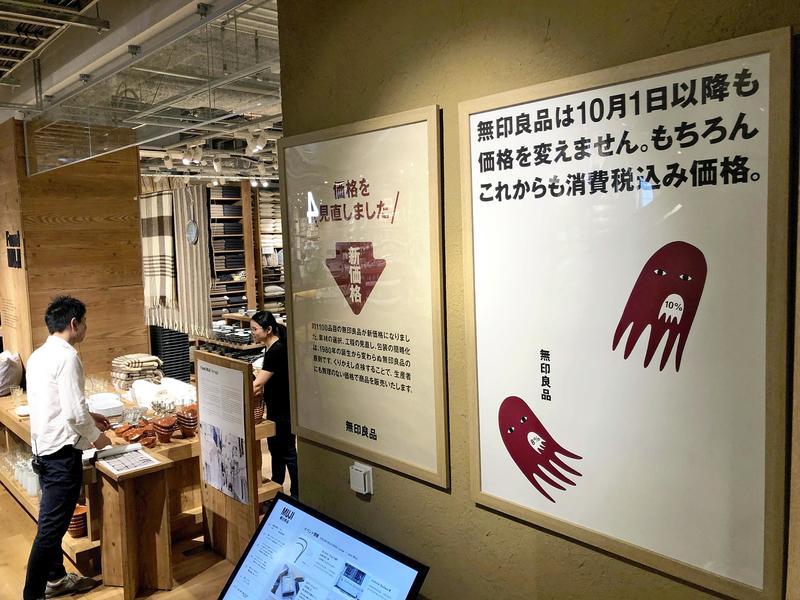
Ryohin Keikaku Co., which runs Muji Stores, has displayed posters in its stores since mid-September saying, "Our prices won't change after Oct. 1." It will reduce its pre-tax prices in order to make the tax-inclusive price at 10 percent tax equal to the current price with 8 percent.
The variety store has cut costs by cooperating with suppliers to consolidate factories and streamline production processes. The company took the same approach when the consumption tax rate was raised from 5 percent to 8 percent in April 2014. As a result, it saved itself the trouble of changing price tags, the company said.
Fukuoka-based leading drugstore chain Cosmos Pharmaceutical Corp., which runs about 1,000 outlets nationwide, mainly in western Japan, will keep its tax-inclusive prices unchanged for pharmaceuticals, daily necessities and other items. Those products account for between 30 percent and 40 percent of its sales in monetary terms.
"We may temporarily lose profits but we believe that we will gain the trust of budget-minded consumers," a spokesperson said.
The food-service industry -- where a reduced consumption tax rate of 8 percent will be applied to takeout meals -- are either keeping prices unchanged or reflecting the tax increase, depending on the product.
Kentucky Fried Chicken Japan Ltd. announced on Sept. 19 that it would keep the tax-inclusive prices of its mainstay products the same after the tax hike, such as that of Original Recipe Chicken. McDonald's Company (Japan) Ltd. will keep its tax-inclusive prices unchanged for 70 percent of its products, including the Big Mac and 5 piece Chicken McNuggets.
Companies are concerned that consumers will hold back on spending due to the tax increase. In line with the hike, a government-led reward points program for cashless payments will be introduced at small and midsize retailers, resulting in many other companies aiming to compete through real price cuts.
"Excessive price-cutting competition could rekindle deflation," said Atsushi Inoue, an executive director of the Japan Chain Stores Association that comprises supermarket chains nationwide.
Read more from The Japan News at https://japannews.yomiuri.co.jp/