Major retail and apparel firms are ramping up efforts to collect and recycle used clothing as part of the push to reduce the volume of carbon dioxide emitted when burning such items.
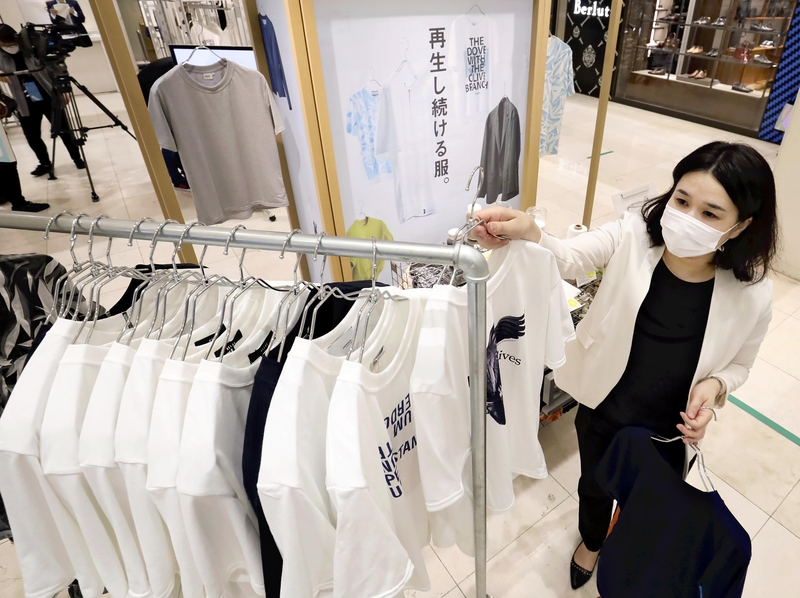
Upscale department store operator Takashimaya Co. has started selling about 60 kinds of clothing for men, women and children that contain polyester fibers extracted from used clothing items. Among these are T-shirts by popular designers, available for a limited-time, at a special sales corner on the first floor of Takashimaya's Shinjuku store in Shibuya Ward, Tokyo. An employee in charge of purchasing products for stock said, "We hope customers will feel recycled products as their familiar items."
According to Takashimaya, it contracted a business tie-up with Jeplan Inc., a start-up based in Kawasaki that deals with recycling businesses to produce high-quality polyester from used clothing. If recycled clothing items are collected again, they can be repurposed into new clothing repeatedly, so Takashimaya intends to market them as "clothing items continuing to be recycled."
Takashimaya President Yoshio Murata expressed his hope for the recycling effort, saying, "Hopefully, our efforts could become an opportunity to widely consider the necessity of a recycling-oriented society through our products."
Major supermarket chain Aeon Retail Co. is taking a full-fledged approach on a project similar to Takashimaya's. Aeon is selling blouses and other summer clothing made with recycled materials at its about 380 outlets nationwide. It has been promoting the collection of used clothing for some time and intends to focus on sales of products with recycled materials.
Large apparel companies are also taking a lead in terms of making use of recycled materials. In 2019, Sanyo Shokai Ltd. established a joint venture with the Spanish brand Ecoalf that produces items such as sneakers made with recycled plastic waste, to reduce the amount ending up in the oceans.
Fast Retailing Co. contracted a business tie-up with Toray Industries, Inc. beginning last autumn to collect used down jackets at its Uniqlo shops in Japan and recycle them into new apparel.
It should be noted that despite the high cost involved with collecting used clothing and recycling polyester, these products are sold at prices similar to those of ordinary products.
Europe and other parts of the world have been a leader in recycling clothing items, and it has been pointed out that Japan is lagging behind.
Taketo Yamate, management consulting firm Frontier Management Inc., said: "In Japan, where the deflationary trend has taken root, costly environmental measures have received a low priority. But from now on it will become essential to make efforts for environmental measures."
-- Addressing disposal issues
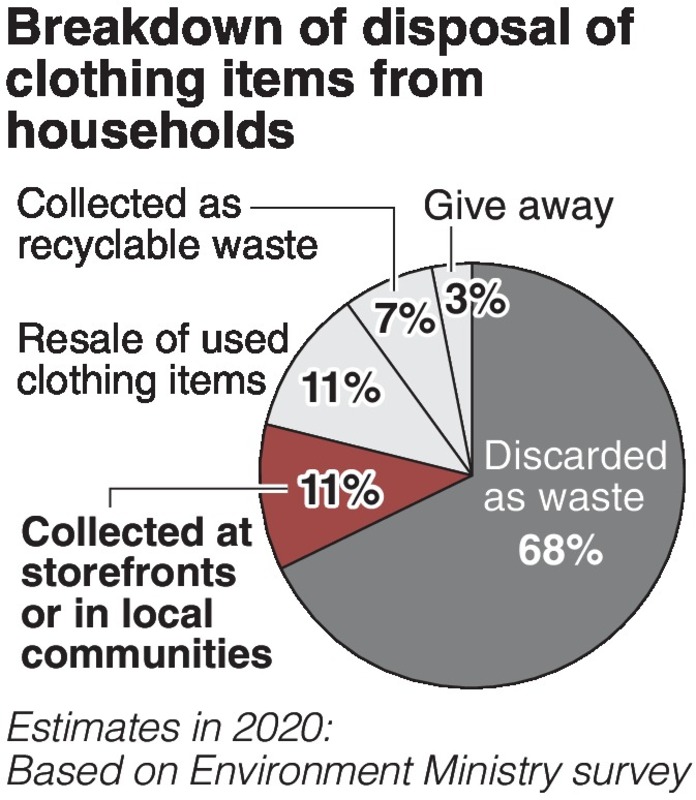
According to the Environment Ministry, 810,000 tons of clothing items were newly delivered in Japan in 2020. It is estimated that clothing disposed of by households reached 750,000 tons while that from offices measured 30,000 tons.
Among clothing items from households, 490,000 tons were discarded as waste, accounting for 70% of the total. Clothing collected at storefronts and local communities were 80,000 tons at 11%, while those collected as recyclable waste were 50,000 tons at 7%.
Clothing items that ended up in landfills or were incinerated were tantamount to the equivalent of 130 truckloads per day.
The volume of CO2 emitted in the process of production, sales and discarding of clothing items reaches about 2.1 billion tons per year in the world. Among this amount, CO2 emissions in Japan are estimated at 95 million tons, accounting for 4.5% of the total. It is said that the CO2 emissions per clothing item equal the volume emitted when 270 plastic bottles are produced.
Read more from The Japan News at https://japannews.yomiuri.co.jp/