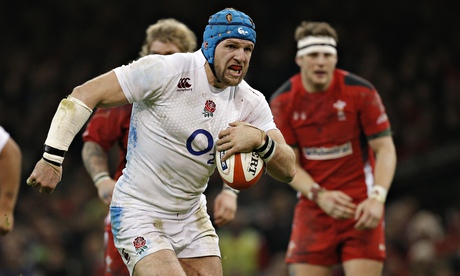
Blood ran in a thin trickle, down from James Haskell’s right ear across his cheek and jaw towards the corner of his big, broad smile. He did not seem to notice it. The wound was a small one and the pain overwhelmed by the great wash of happiness that would sustain him at least until the next morning. England’s win, 21-16, was one of the sweetest he had experienced in his long career.
“I think for some of us it was about banishing demons,” Haskell said, harking back to Wales’s 30-3 victory in 2013. “There are going to be some pretty sore bodies during the week but, look, this is a great place to come and win.”
These moments have not come along too often in Haskell’s international career, as he admits. “The number of caps I have got, I have probably lost more than I have won,” he said. Which is not quite correct – before Saturday England had won 29 and lost 22 of the 53 matches he had played – but it is not far off. Among the 38 players who have won at least 50 caps for England only one, Danny Care, had won so few of his matches. So one knew Haskell was telling the truth when he offered up the old line: “To get any win, especially against a Welsh side, is very satisfying.” Even if, as he added a moment later: “It’s all just a little bit marred by the fact that your body is in pieces at the end of it.”
Haskell has been around so long it is a little surprising to discover he has not turned 30 yet. He made his debut at the Millennium Stadium against Wales in 2007, in a XV which also included Martin Corry and Mike Catt. He won most of his caps when Martin Johnson was head coach and he was one of a number of players Stuart Lancaster cut from the squad when he first took charge, in a clean break with the ignominious past.
Lancaster has never seemed quite to trust Haskell since. He has picked him only 12 times, six of them as a substitute. Time was when Haskell seemed to be a little full of himself but Lancaster has not made it easy for him and he is a better, hungrier player for it.
If Tom Wood had not injured his ankle a fortnight before the match, there is every chance Lancaster would have left Haskell on the bench this time too. Instead he started him and was rewarded with what he described as “his best game for me in my time as England coach”. Haskell enjoyed the compliment but he was not getting carried away with it. “If you have any ambitions to improve and be a world-class side, you have to be very tough on yourselves,” he said. “I will have to go through my game rigorously and there is probably lots of things we can improve on.” He missed a tackle, for one thing, on Taulupe Faletau in the run-up to Wales’ try.
After that Haskell came into his own. He made each and every one of his next nine tackles and was barnstorming in the loose, never more so than when he made his bullocking run through the Wales 22 and smack into the upright. “My head is killing me,” he said. “But you should see the post. It’s gone into retirement.” More important than his sheer physical presence – he is one of the strongest players in the England squad – was the leadership he showed in a tight situation, something England lacked in 2014. He was one of the players who drove the team into the lead during the second half.
Haskell has learned a lot through his time playing abroad, in France, Japan and New Zealand, and lately as captain of Wasps. He has matured and it shows. “If you look at some of the best sides in the world, and we all talk about New Zealand, they have got a lot of experience there, guys who have been through those situations before,” he said. “Small talk, as we call it, makes a big difference.
“There were boys who had never been here, never experienced what it is like to play here, and it can play tricks on you. So it was important to stay calm and to recognise the opportunities. And that’s what rugby is about, recognising situations you have been in before and making the right decision. The best teams in the world do that.”
Haskell has been around for two World Cups already. He missed the first one, in 2007, and the team blew the second one, in 2011. He seems determined not to make the same mistake again. Now he has got a starting place back, one suspects he is not going to give it up any time soon.