To tighten border controls to curb the further spread of the coronavirus, the government since Saturday has been requesting those who have entered Japan from 38 countries, including those in Europe, to stay at home or to take other self-isolation measures for two weeks.
Among those who tested positive in Japan since the beginning of the month, 98 of them came from foreign countries, as of Saturday. There are also cases where the infection has spread within the family.
The government is monitoring the situation more closely because of the risk that those entrants pose to spreading to infection and causing an "overshoot," or an explosion in cases.
Kazuhisa Uchihashi said, a 60-year-old musician living in Berlin who arrived at Narita Airport on Sunday about 10 days earlier than he had originally planned said, "I have to work in Japan in April." When he arrived, he was driven to his home in Tokyo by his friend and plans to stay home for the next two weeks.
Uchihashi said the German government set forth specific rules, such as banning any event with 50 or more people and added that the level of "self-restraint" that is occurring in Japan is ambiguous.
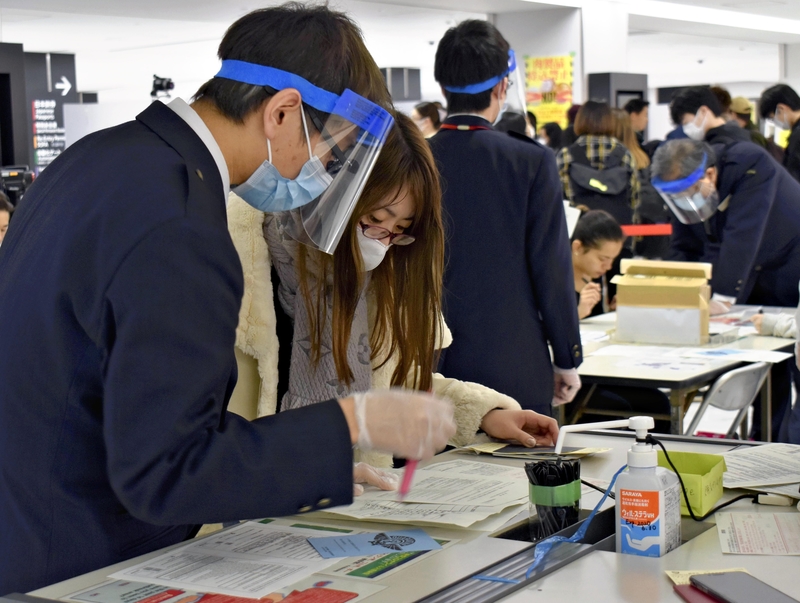
When people from those 38 countries -- in addition to China and South Korea -- entered the country, they were taken to special quarantine stations at Narita Airport. Quarantine officers and others wearing masks have the entrants fill out a health card to confirm where they will be staying and how long they will be in the country while requesting that they refrain from taking public transportation.
According to data released by prefectural governments, there have been 830 confirmed cases of the virus in Japan since the beginning of the month. Of those cases, 98 -- 12% -- tested positive after they entered the country, The Yomiuri Shimbun has learned.
Twenty-three people who arrived from Egypt tested positive for the virus, making it the highest number of infected people returning from any one country. Many of those infected were found to have taken part in a cruise of the Nile and stopped at the Valley of the Kings, which is a famous tourist destination.
Eight men and women from Saitama Prefecture, ranging in age from their 20s to 70s, traveled to Egypt starting in late February. They took a cruise on the Nile and tested positive after they returned to Japan. A total of five other family members, who did not go to Egypt, also tested positive for the virus.
Of those who entered from European countries, which is the region that the World Health Organization (WHO) considers the center of the latest pandemic, 56 were confirmed to have the virus. Many of those infected had traveled to France, Italy, Spain and the U.K. for vacation or a business trip.
An elderly married couple from Shiki, Saitama Prefecture, tested positive on either March 18 or 19 after traveling to Finland and Norway on March 7. The wife developed a fever during her travels but did not report it at the quarantine station upon returning to Narita Airport. Later, it was discovered that both of them had been infected.
A panel of experts said the government would need to take certain precautions or the coronavirus could spread further because of people returning from abroad or from tourists coming into the country.
The Health, Labor and Welfare Ministry has been testing all entrants from Italy and certain provinces in Spain where the coronavirus is prevalent.
"If a [returnee] goes home before the test results come back, they may infringe on the Quarantine Law. We ask for their cooperation to stop the further spread of the virus within the country," a ministry official said.
Read more from The Japan News at https://japannews.yomiuri.co.jp/