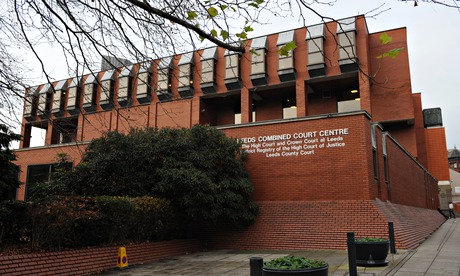
A judge decided to lift reporting restrictions preventing the media from identifying Ann Maguire’s teenage killer because “there is a public interest in naming defendants who are convicted of murder”.
Mr Justice Coulson at Leeds crown court said there was a “fine balance” when considering whether Will Cornick should be identified, but decided in favour of the principle of open justice.
An application was made by Guardian News and Media, Associated Newspapers, News Group Newspapers, the Press Association and Telegraph Media Group for the judge to lift an order he made at the start of legal proceedings earlier this year.
The order, made under section 39 of the Children and Young Persons Act 1933, banned identification of the defendant, Cornick, as well as all witnesses who were under 18. It would have lasted until their 18th birthdays.
No application was made to identify the child witnesses: pupils who were in the classroom at the time of the attack on 28 April. They continue to be protected by law.
The Guardian and others argued that justice should be done and seen to be done in what they deemed a case of “exceptional public interest”, quoting section 10 of the European convention on human rights, which guarantees the right to freedom of expression. That usually means the media have a right to attend all court hearings and are able to report those proceedings fully and contemporaneously.
The media also pointed out that as Cornick had already admitted the murder there was no danger of him being identified in the context of a high-profile trial, only to be subsequently absolved of all responsibility. Identification can properly serve as a deterrent to others, the Guardian and others argued.
The application was opposed by Richard Wright QC, defending Cornick, who said naming his client would be “wholly contrary” to the boy’s welfare. He told the court that the team responsible for Cornick’s care did not want his name to be made public as it “would impede his management and treatment”.
The boy had already been moved from one institution after other inmates worked out who he was, and there was a substantial risk he would be attacked should his identity be widely known, said Wright.
The barrister told the court that Cornick was already on around-the-clock suicide watch and was being held in a complex needs unit for vulnerable prisoners. He also argued that Cornick’s parents should be protected “because of the central role they will inevitably play in his treatment and rehabilitation in custody”.
The boy’s father, Ian Cornick, wrote to the court to say the press intrusion had made his family ill. He said: “We wish nothing more than to be left in peace so that we can grieve with dignity and try to piece together what remains of our lives.”
Cornick’s mother, Michelle, said she had visited her son three to four times each week while he was on remand and hoped to continue regular visits “without the fear of being followed by the press”.
The prosecution, led by Paul Greaney QC, took no view on whether or not the order should be lifted.
Ruling in favour of the media, Mr Justice Coulson said that he did not agree that Cornick would be at greater risk of suicide as a result of being named, given that he was already under constant watch. “It does not seem to me that the risk increases if he is identified as the killer of Ann Maguire,” said the judge.
Though he accepted that other prisoners may want to harm the boy, the defence had not demonstrated there was a “very real” threat to his life.
The judge agreed with the media that “there’s a potential deterrent effect” in naming him, “but I do not put it as high as the general interest in open justice”. He said: “There is a public interest in open justice. There is a public interest in naming defendants who are convicted of murder.”
The judge said he gave only “a little bit” of weight to the media’s argument that Cornick had already been widely named on the internet and had been legally identified by the Sun before he was charged.
A section 39 order was designed to protect a perpetrator, not their family, said the judge, who paid tribute to Cornick’s mother and father for supporting their son. They were the first parents who had ever asked for permission to sit in the dock with their child in ten and a half years as a judge, he added, saying: “They are plainly dedicated to [their son’s] rehabilitation. They are more dedicated to his rehabilitation than he may be.”
This was unlikely to change as a result of reporting restrictions being lifted, he ruled, adding: “Ultimately his rehabilitation has to come from himself.”