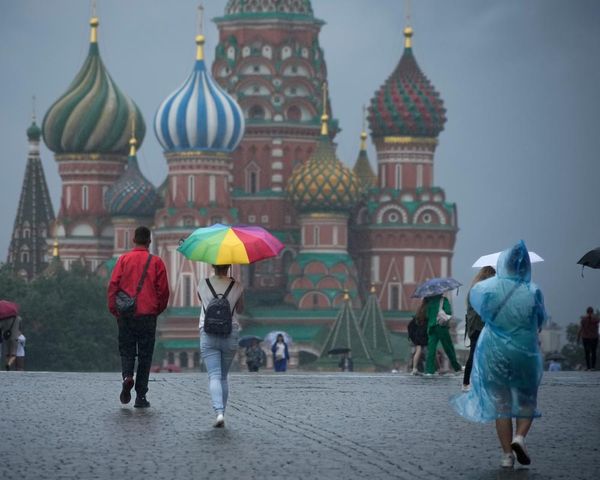
Restaurants were among the establishments in the Tokyo metropolitan area that opened a little longer from Monday.
Some businesses also resumed operations after staying closed during the central government's state of emergency covering the capital and the prefectures of Kanagawa, Chiba and Saitama.
The hope is this marks the beginning of a new normal in the efforts to get the economy going while preventing a rebound in infections.
-- Here comes a regular
Shortly after 8 p.m. on Monday, a regular showed up at Kushiage Dongara-Gassyan, a deep-fried skewered food restaurant in Shinjuku Ward, Tokyo, after it extended its closing time by an hour to 9 p.m.
The 48-year-old man used to come to the restaurant three or four times a week before the coronavirus outbreak, but he had rarely been able to make it during the emergency period as the place closed at 8 p.m.
"I'm glad that the restaurant is open longer, even by an hour," he said. "I want to continue to support this place."
"We're now able to serve alcohol for an hour longer," owner Yoko Shirono said. "This will expand opportunities for our customers to visit us more often."
The central government's new request to close at 9 p.m. will remain in place until the end of this month for restaurants and other eating and drinking establishments in the Tokyo metropolitan area. Each outlet that cooperates with the request will receive 40,000 yen per day.
The Tokyo metropolitan government is calling for eateries to each register a staffer in charge of infection prevention measures.
"We'll do whatever we can and prepare the environment so that our customers feel they're glad that they came," said Shirono, who plans to register with the project.
The Isetan Shinjuku department store is again open until 8 p.m. after closing at 7 p.m. during the emergency period.
"With so many people on the trains and in the streets, I'm worried that there might be a rebound in infections," said a 27-year-old female company employee from Nerima Ward, Tokyo. "I want to get back to normal life without letting my guard down against infection."
-- Closing time
Ikka Dining Project., Ltd. in Chiba Prefecture, which runs 71 izakaya pubs and other establishments in the Tokyo metropolitan area, on Monday resumed business at most of the about 60 eateries it had closed in late January.
The decision to close those outlets had been made because the company concluded it would not be profitable to comply with the request for shorter operating hours. The company's sales in February were down by 93% compared to the same month last year.
"We can reopen our restaurants, so our employees are in high spirits about getting back to work," said a person in charge at Ikka Dining Project. "However, we don't know how many customers will actually come back when we open for another hour."
At the Japanese-style pub Izakaya Sen in front of Shibuya Station in Tokyo also opened its doors for the first time in a while. After the state of emergency was declared, the number of customers plummeted to one or two groups a day. It decided to temporarily close because the deficit would only increase if it stayed open.
"I'm worried, thinking how long this pandemic will last," said Yuki Nagasawa, the izakaya's 52-year-old female owner. "But I just have to do my best, believing customers will return."
-- Same as it ever was
A yakiniku grilled meat restaurant in Tokyo near Shimbashi Station, an area popular for after-work socializing among office workers, had at first complied with the request for shorter operating hours following the latest declaration of a state of emergency in January.
However, it went back to its usual business hours because the operator said the 60,000 yen cooperation payment per day for complying with the request was not enough to keep its business and its suppliers going.
According to the operator, the restaurant and three affiliated outlets have remained open until 11:30 p.m. since early February, though sales have decreased by about 60% compared to the time before the pandemic.
The restaurant has halved the number of seats available to customers and has been conducting PCR tests for all employees, among other measures against infection. It is continuing to operate normal business hours.
"I hope the central government and the metropolitan government will allow shops to operate normally once the establishments take proper countermeasures," the 45-year-old female owner said.
-- Law and order
A number of the 32 eating and drinking establishments that had not complied with the request to shorten hours that were subsequently issued orders to do so by the Tokyo metropolitan government continued to remain open after 8 p.m., The Yomiuri Shimbun has learned.
The revised special measures law to cope with new strains of influenza allows local governments to impose fines on business operators that do not conform to orders after notifying a court. The metropolitan government will consider its next move after confirming the details.
Read more from The Japan News at https://japannews.yomiuri.co.jp/




.jpg?w=600)