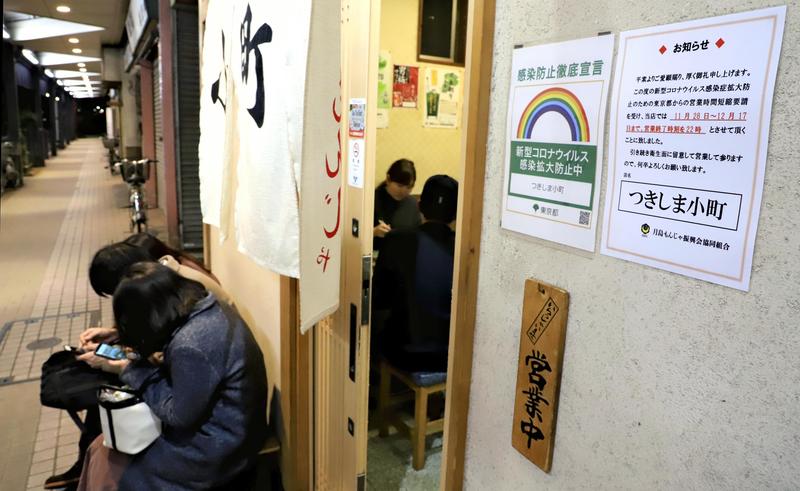
"This is the third time I've accepted the request for shorter hours," said Masayuki Hirano, manager of the NST branch of Osio, a monja pancake store with six locations in Tokyo's Tsukishima. "It's rough, but it can't be helped."
It's a little after 8 p.m. on Saturday and the restaurant is only about 30% full.
In response to the recent surge of the novel coronavirus, the Tokyo metropolitan government issued a request for restaurants and other facilities that serve alcohol to shorten operating hours starting Saturday.
Similar requests were made in the spring and summer. The current appeal will remain in effect until Dec. 17, putting it square in conflict with the year-end party season, and some restaurants are trying to think of ways to attract customers even under the strict conditions of closing by 10 p.m.
At Osio, 8 p.m. would usually be a busy time with groups filling the place. But this year, there have been almost no reservations, perhaps because of the general "mood of restraint" along with the request for shorter hours.
"It's a tough situation, but the regulars are still showing up," Hirano said. "We want to serve our customers in a style in which they can enjoy themselves when there are only few of them."
-- Resistance from some
On the other hand, it is noticeable that some establishments have actively resisted the request this time.
The Shinbashi 4-chome Tavern Wattsuri is continuing its normal business hours, while maintaining infection prevention measures such as placing disinfectant at the entrance.
According to the manager, December is an important time when it can expect 1.5 times as many customers as usual. "We cooperated the past two times because we had a chance to catch up in December." he said, revealing the hardship. "This time it is difficult."
Instead of a time for going wild with the traditional year-end party, this has become a season for exercising patience. Given the circumstances, both restaurants and companies are scrambling for ideas.
Tokyo-based Sapporo Lion Inc, which operates the Ginza Lion beer hall, has shortened the length of its normal banquet course from 120 minutes to 90 minutes. "We're striving to allow people to enjoy eating and drinking with peace of mind," the company said.
Mellow, which develops business opportunities that involve automobiles, has proposed open air year-end parties using food trucks.
The Tokyo-based company said it thought customers would enjoy eating and drinking outdoors to keep from being in crowded situations, as long as they have heaters and heavy clothing to protect from the cold. Some customers held a small-scale end-of-year parties without waiting for December.
-- Nixing the company party
According to a nationwide survey by Tokyo Shoko Research Ltd., 88% of companies will not hold a year-end or New Year's party this season.
Of that figure, 67% said they held a party last year but will not hold one this year. "In the midst of the coronavirus crisis, all companies are being cautious to protect their employees and corporate image," a representative said.
The survey was conducted on Nov. 9-16, among 10,000 companies.
On the other hand, a survey by Nippon Life Insurance Co. of 25,000 people in October found that 66% of teleworkers feel that "communication through drinking" in the workplace is "necessary" or "somewhat necessary," 11 percentage points higher than the overall average.
According to Prof. Makoto Ueno of Nara University, a culture similar to modern parties, in which officials gathered to drink together, sprouted in Japan in the 8th century Nara period.
"People have been drinking, eating and dancing together since ancient times to form a society," Ueno said. "It is possible to enjoy banquets with small numbers of people while taking thorough measures to prevent infection and using online services."
Read more from The Japan News at https://japannews.yomiuri.co.jp/